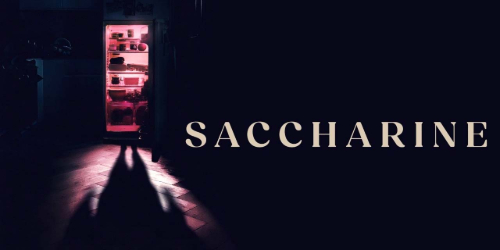
Quick Synopsis: A young woman struggling with her body image discovers an increasingly disturbing way to lose weight.
This is weird, this is uncomfortable to see, and this is ugly. But enough about my face.
Saccharine is a unique film. For one, it’s Australian. Despite sharing the same language, having plenty of cultural similarities, and producing some huge stars, Australian cinema doesn’t make much of a splash at the UK box office. There are, of course, a few exceptions, but they’re not nearly as common as you’d expect, considering the size of the country and the amount of talent it produces. It’s a shame, really, because there’s something appealing about discovering a film that feels a little outside the usual Hollywood-dominated landscape. You’re not necessarily going into it with familiar faces, established franchises or preconceived expectations. Sometimes, it’s just a chance to discover something different.
So it’s nice when a film like Saccharine comes along. Something new, starring people you’re not necessarily familiar with. The only performer I’ve seen before is Danielle Macdonald, thanks to her role in Patti Cake$. Yet there’s not a weak performance among them. The standout is obviously Midori Francis. She’s incredible, bringing real weight to every delivery and making Hana a fascinating character to watch. There’s a vulnerability to her performance that makes the character’s increasingly disturbing behaviour all the more interesting. You can understand where she’s coming from, even when you’re questioning some of the decisions she makes. It’s a performance that gives the film much of its emotional grounding.
It’s also very well directed. You can see why Natalie Erika James was trusted with the Rosemary’s Baby prequel Apartment 7A. She has a real knack for making things unsettling, often finding ways to turn seemingly ordinary moments into something deeply uncomfortable. The key example of this is when Bertha, the obese woman whose ashes Hana swallowed in pill form, descends from the ceiling to haunt her. It could be a nothing shot, just a large person floating down towards someone, but it’s incredibly disturbing. There’s something about the way it’s presented that makes it genuinely unnerving. There’s also a biting scene that’s equally uncomfortable. Another highlight is a really creative shot from the POV of the scales as Hana stands on them. It’s a low angle, which could easily have come across as overly sexualised or creepy, but James handles it beautifully. It’s an interesting perspective that puts you in the moment without making you feel as though you’re being invited to leer at the character. That’s a surprisingly important distinction, particularly given the subject matter.
On the downside, I’m not entirely comfortable with how often the film equates obesity with horror. It may be me seeing things that aren’t there, but it definitely feels as though the fatness itself is part of the horror, rather than simply reflecting how the character feels about her own body. There’s a difference between exploring someone’s insecurities and suggesting that there’s something inherently frightening about the thing they’re insecure about. I appreciate that the film is dealing with some fairly complicated issues surrounding body image, but there are moments when I found myself questioning whether the horror was supposed to come from Hana’s perception of herself or from the physical appearance of the person haunting her. It’s an uncomfortable distinction, and not necessarily in the way the filmmakers intended.
Hana definitely has body issues. It’s difficult to figure out how much of the pressure she feels comes from societal expectations and how much comes from her family. I like that. Some things are complex. Deal with it. It’s not always possible to point to one person or one thing and declare them responsible for somebody’s insecurities. The stuff involving her family is particularly interesting because, in its own way, it makes perfect sense. Her mother dotes on her because of what happened to her husband, but her attempts at showing care and love only end up fuelling Hana’s insecurities. It’s a well-intentioned form of overcompensation, where somebody is trying so hard to protect another person that they fail to recognise the damage they’re potentially doing. She even bakes her the most depressing cake imaginable: no egg, no butter, no sugar. Instead, there’s beetroot. I don’t know whether I’d call that a cake or a cry for help.
The characters are interesting, with not all of them behaving as you might expect. The gym instructor in particular is a good example. When Hana is seen to be losing a lot of weight, you’d expect this character to be saying something along the lines of “Well done, keep doing what you’re doing”. After all, isn’t that supposed to be the point of going to the gym? Instead, she shows genuine concern about how quickly it’s happening. She’s not interested in congratulating Hana for achieving some arbitrary idea of physical perfection; she’s more concerned about whether she’s actually okay. That’s weirdly refreshing. It’s a small detail, but it helps make the character feel like a real person rather than somebody who’s simply there to reinforce the film’s ideas about body image.
Hana herself is an odd character. Most of the time, her behaviour makes sense, and you can understand the motivations behind her decisions, even if you don’t necessarily agree with them. However, she gets used to the idea of consuming human remains far too quickly. I appreciate that this is a horror film, and that we’re dealing with some fairly unusual circumstances, but there’s something quite extraordinary about being able to casually incorporate another person’s remains into your diet. You’d think there would be a little more hesitation. Perhaps some second thoughts. Maybe even a moment of wondering what the hell she’s doing. Instead, she seems to accept the situation remarkably quickly. It’s a relatively minor issue, but it’s one the film never quite gets past.
All of this probably sounds like high praise, and it is. So you’d expect me to love it. I didn’t quite. It’s a very good film, but it feels as though it repeats its themes rather too often. It has something to say, and then keeps saying it. There’s nothing wrong with having a message, particularly when it’s dealing with something as complicated as body image, but there’s only so many times you can make the same point before it starts to lose its impact. It brought to mind a film desperate to justify its runtime, as though it was worried that audiences might miss what it was trying to communicate if it didn’t keep reminding them. There’s a good beginning and a good ending, but the middle section is where it really struggles. Narratively, it spins its wheels a bit, neither developing the story in particularly interesting ways nor putting forward any ideas we hadn’t already considered. It feels like there’s a stretch of the film where things are happening, but very little is actually progressing. By the time it reaches its conclusion, I was still impressed by what it had achieved, but I couldn’t help feeling that it could have got there considerably sooner.

