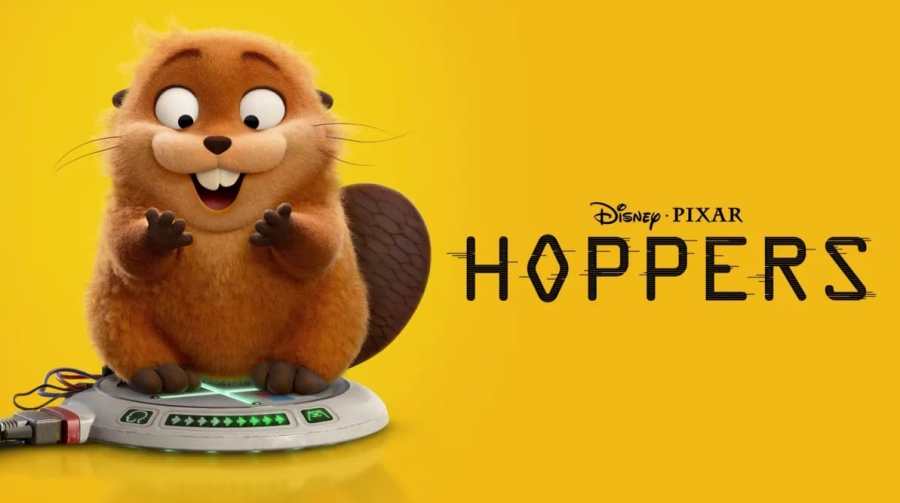
Quick Synopsis: A young animal lover uses experimental consciousness-transfer technology to “hop” her mind into a lifelike robotic beaver, uniting the local wildlife to save their forest glade from an ambitious mayor’s development plans.
I avoided this at the cinema. I’m still not entirely sure why. I’m not opposed to seeing animated films at the cinema, and Pixar are usually very high quality. I think it’s because the few clips I saw of this gave me nothing. It almost felt like the company were embarrassed by it. I’ve felt that way about a lot of their recent work, though. It might be because I don’t see many kids’ films at the cinema, but it feels like Pixar films are barely marketed now. There’s something rather strange about a studio that was once synonymous with must-see cinema releases seemingly struggling to generate much excitement around its new films which aren’t sequels. Perhaps it’s because we’ve become so accustomed to Pixar being good that we’ve stopped getting particularly excited about the prospect of another one. Or perhaps the films themselves just aren’t generating the same level of anticipation.
Then again, it might be because films released by Disney are no longer essential cinema movies. There’s no rush to see them at the cinema because you know that if you wait a month or two, they’re going to be on Disney+. It’s difficult to justify spending money on a cinema ticket, particularly when you know you can watch the same film at home without having to pay anything extra. Why make the effort when you can just wait? That’s a shame, as I love seeing films at the cinema. The scale, the feeling like you’re part of a community, the little rituals of entering, the fact you actually have to make an effort. There’s something quite special about setting aside a couple of hours, putting your phone away and giving a film your undivided attention. Even the experience of sitting in a room full of strangers, all reacting to the same things, adds something. It all means films at the cinema seem bigger than ones you see at home. They’re events rather than just something else to stick on in the evening. And perhaps that’s what Disney has inadvertently taken away from some of its releases. When you know a film is only a few weeks away from being available at home, it’s harder to convince yourself that seeing it now is particularly important.
So the fact I saw this on Disney+ might be why I don’t love it as much as I should. Don’t get me wrong, it’s very good. After seeing this, I feel more kids’ films should play Rebel Girl. It’s actually a much smarter film than it needs to be, particularly in how it approaches its characters. It would be so easy to write Jerry as a typical villain. I mean, he’s a mayor who’s aiming to bulldoze nature so he can build a road. That’s so 90s kids’ villain-coded that he might as well be trying to get the kids to smoke too. But he’s shown as not being a terrible person. He wants to do good. He’s not focused on the building work because a company paid him a bribe or out of malevolence; he genuinely believes it’s the best thing for the town. In an era of towns struggling to the point of disrepair, someone being driven to feel he needs to do something like that is believable. He’s not good, but he’s not a total shit. There’s something quite refreshing about a film recognising that people can have good intentions while still making decisions that are fundamentally wrong. Jerry isn’t necessarily blind to the damage he’s causing; he just thinks the benefits outweigh the costs. It’s a much more interesting starting point for a character than simply having someone who wants to destroy nature because they’re evil.
Really, the villain is a butterfly. But the fact Jerry is the villain until the obligatory mid-film villain switch means the actual villain is not as fleshed out as he could be. He shows potential to be memorable, but his metamorphosis into something incredible never really happens. It’s a shame because there’s an interesting character lurking in there, and I would have liked the film to spend a little more time exploring him rather than moving on to a more conventional antagonist.
The main characters are pretty well fleshed out, though. Mabel is a great lead character, full of energy and anarchy. She’s passionate, occasionally impulsive, and has the sort of determination that makes her easy to root for. She’s also a nice fit for the film’s more chaotic elements, never feeling like she’s simply there to deliver the environmental message. Although someone pointed out that a lot of modern animated films featuring non-white leads have them transformed into something non-human for most of the runtime, and the human characters aren’t the focus of the marketing. Once that was pointed out to me, it became impossible to unnotice. It’s an interesting observation, particularly when you consider how often these films are supposedly celebrating their protagonists while simultaneously spending most of their running time hiding their human appearances. I don’t think that necessarily makes it a problem with Hoppers alone, but it’s something worth thinking about.
Mabel is voiced well by Piper Curda. Curda’s performance suits the character perfectly, capturing her energy, enthusiasm and occasional moments of madness. It’s hard to think of who they could have got who would have been better. She gives Mabel plenty of personality without ever making her feel like a generic ball of future-medicated chaos, which is probably quite an achievement considering how much energy the character has. Everyone else is good, but nobody else really stands out. There’s nothing particularly wrong with the supporting performances, but they’re not exactly the sort of voices that leave you thinking about them once the film is over. The only voice I can really remember is Dave Franco’s. Which, considering the film also stars Melissa Villaseñor, Vanessa Bayer and Jon Hamm, is a bit weird. It’s a fairly impressive collection of comedy talent, but I can’t say anyone else particularly grabbed my attention. Oh yeah, it also stars Meryl Streep. I predict good things for her.
It looks great, but that’s Pixar. Pixar movies have always looked incredible, somewhat to their detriment now. When you’re consistently producing some of the best-looking animated films around, there’s a danger that people start taking it for granted. Because beauty is standard, it no longer feels particularly impressive. Hoppers is full of lovely little details, and the contrast between the natural environments and the various animal characters gives the animators plenty to work with. There’s a real sense of life to the world, and the character designs are suitably expressive. It’s all very pretty, but I can’t say it ever particularly surprised me. That’s perhaps an unfair criticism, but it’s a testament to just how high Pixar have set their own standards. I don’t really have much more to add to this; I just didn’t think I could get through the review without mentioning how pretty it is.
The story is fine. I mean, it does feel like Pixar are coasting slightly, like they’ve told this story before. There’s a familiarity to the whole thing that makes it difficult to get particularly excited about where it’s going. But Pixar going through the motions are better than most studios at their best. There’s enough here to entertain you, and the film is consistently fun. The idea of humans transferring their consciousness into robotic animals is pretty mature for a kids’ movie, and the film makes the most of the premise. It’s one of those concepts that could easily have been used for a much more complicated science-fiction film, but here it’s played for laughs while still allowing some interesting ideas to creep in. There’s plenty of potential for humour in the idea of a human suddenly having to navigate the world as an animal, and the film doesn’t waste it. More importantly, it gives Mabel a way of experiencing the natural world from an entirely different perspective. It’s a clever way of getting the audience to think about how animals experience their surroundings, rather than simply having characters explain why we should care about them. There aren’t many wasted opportunities here, even if the overall story doesn’t do quite enough to distinguish itself from other Pixar films.
What I particularly liked was how willing the film was to get a little weird. Pixar have always been good at taking an unusual concept and running with it, but there’s something about Hoppers that feels a little more anarchic than some of their recent output. It isn’t afraid to be silly, occasionally grotesque, or just downright bizarre. There’s a willingness to push the premise into increasingly ridiculous territory rather than settling for the obvious jokes or playing everything safe. It gives the film a real sense of unpredictability. You never quite know what it’s going to throw at you next, and there’s a certain energy to it that makes it difficult not to get caught up in what it’s doing. It’s refreshing to see a Pixar film that seems so happy to embrace its own ridiculousness.
And perhaps that’s what I wanted a little more of. There’s a very good film here, but I never quite reached the point where I was completely won over. The characters are likeable, the animation is gorgeous, and there’s a decent amount of humour and heart. It also has something worthwhile to say about humanity’s relationship with nature without becoming too preachy about it. There’s plenty to admire, and I was rarely bored, but I was never particularly surprised either. I think that’s the sticking point. So much of what works here feels like familiar Pixar territory, and while there’s nothing inherently wrong with that, I can’t shake the feeling that I’ve seen the studio do this sort of thing before, and perhaps do it better. It’s a film I enjoyed watching, but one that never quite gave me a reason to love it.
Still, Hoppers is a thoroughly enjoyable film, and one that deserves considerably more attention than I gave it before its release. Maybe I should have made the effort to see it at the cinema after all. There’s something rather ironic about a film celebrating the importance of experiencing the natural world being something I only got around to watching because it appeared on a streaming service. I enjoyed it, but I suspect the big screen might have helped me appreciate it a little more. Really, though, the biggest issue might be expectations. I mean, in a year where Toy Story 5 was released, how could any other Pixar film hope to get attention?

