Quick Synopsis: Kris, a 29-year-old filmmaker, is hired to resurrect and reboot the tired Camp Miasma slasher franchise for modern audiences. Wanting to pay tribute to the original, she tracks down the actress from the original; shit gets weird.
I have a somewhat complex history with the work of Jane Schoenbrun. I think she’s one of the best filmmakers around today. Her use of colour is among the best in the business. The way she weaves metaphor and storytelling into the shots is a thing of wonder. I always leave her movies feeling slightly like I’ve been hypnotised and entranced. That being said, I’m not a fan of her scripts. They always start promising but end up just on the wrong side of incomprehensibility, although I suspect cohesion and understanding aren’t really the point. I’m aware that this, more than almost any other criticism, is deeply personal and subjective. Some people will love it BECAUSE of that, because the audience is constantly wrong-footed and left in a state of confusion. Personally, I don’t mind being confused; I just want a place in the narrative to ground myself
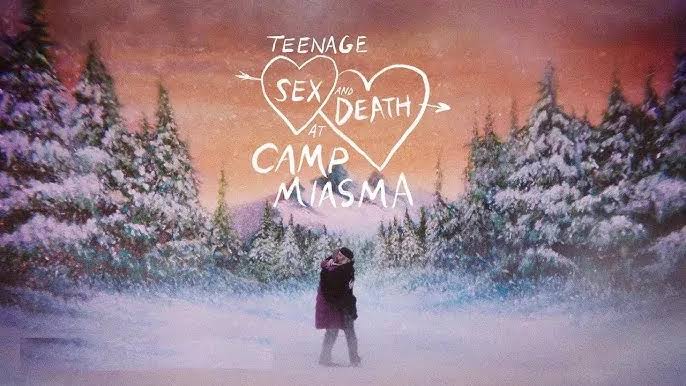
If you loved her previous work, Teenage Sex And Death At Camp Miasma (TSADACM, pronounced Tee-Sad-At-Cam) won’t dissuade you from being a fan; if you don’t like it, this won’t change your mind. Everything that works about her previous films is now better in this. The shots are better, the music is incredible, and the performances are outstanding. Schoenbrun knows how to make a killer playlist, helped enormously by a returning Alex G. There’s a great selection of danceable synth pop for you to sink your teeth into. Hannah Einbinder and Gillian Anderson have a chemistry that leaps off the screen. From the moment they first meet, there seems to be a magnetic pull between them, like the universe is begging them to kiss. They are helped by how unbelievably horny the script is. There’s an air of unashamed sexuality over the entire thing; arguably the sex is more important than the death. The supporting characters are all fine, but none are as fully fleshed out as those two, so the actors aren’t really given as much of a chance to shine.
It feels like a deeply personal story for Schoenbrun. Much like her previous work, this feels like she’s writing it as an exploration of her own personality, rather than worrying too much about whether the audience can follow along. It’s her examining her own sexual desires and feelings. And that’s fine, but if you do something like that, you have to be aware that it won’t fully land with everybody. Every time I felt I knew what was happening, the film was determined to throw me off. I’m still not sure whether the ending actually happened, was a fantasy, an alternate universe, or a dying thought. There’s a moment where the switch from “believable and understandable” to “confusion and oddness” happens, and it’s so abrupt that it becomes genuinely jarring.
So far, this review has probably seemed fairly negative, and it’s not meant to. There’s a lot to like about TSADACM. It has one of my favourite openings I’ve seen all year. The opening credits set up how Miasma is regarded in this world, complete with reviews, initial analysis, its place in pop culture, and how it’s viewed in modern society. There are multiple references to classic cinema, and problematic histories that a lot of long-running franchises have, especially when it came to how they treated characters who weren’t cisgender, straight white men. Fans of cinema and film theory will get a lot more out of some of the dialogue than casual viewers probably will.
So, is the in-universe movie believable? Kind of. Weirdly, Camp Miasma (the in-universe movie) has the exact opposite problem that Camp Miasma (the movie we’re watching, which I’ll refer to as TSADACM for clarity’s sake) has. The writing, characters and backstories of Camp Miasma feel convincingly rooted in the 80s. Yet the filmmaking itself definitely feels modern. If anything, Schoenbrun feels TOO good a director to make a believable, slightly terrible 80s slasher. Her use of camera movement and music is too advanced and slick for it to work. It pulled me out of the movie a little bit, despite the scene itself being incredible. If an 80s movie had used some of Schoenbrun’s techniques, it wouldn’t just have been good; it would have changed the genre. It’s the musical equivalent of Green Day attempting to make a ramshackle 70s punk record. Even without trying, they’d do things that wouldn’t have been done back then, either because the technology wasn’t available or because nobody had thought of doing them yet. Put all of that together on one album, and it would inevitably be too much
Gonna be honest, I’m still not entirely sure what genre this would fit into. It doesn’t really feel like horror so much as a video thesis ABOUT horror that uses horror scenes to illustrate its point. So you can’t really judge it like you would a traditional horror movie, by examining the villain, the scares, etc. I guess the closest I can think of would be *deep breath* Surrealsexual Romantic Psychological Thriller. It’s definitely unique, and for that alone it’s worth your time and money.
This is one of only two films I’ve paid to see in the last few years, and I watched it at the Curzon, which isn’t cheap. Plus it was on my birthday, and I was on my own. It had everything working against it, and I still want to see it again.
I should note that I’m not exactly the person these themes are aimed at. I love that films like this exist; it’s clearly going to be VERY important to someone, potentially even someone who feels seen by it in a way they haven’t felt seen before. But to me? I admire it and want to study it more than I like it. This wasn’t made with someone like me in mind, but it doesn’t need to be. It feels like it’s aimed at the confused teens (and adults) who need more films like this, and I think they’ll love it. Of course, I haven’t actually spoken to any people about this film, so for all I know, I’m woefully off the fucking mark.
Although there is one important thing to note, especially after what I just said. I don’t really feel comfortable explicitly stating what I’m about to say, so I’ll try to work around it. A few years ago, for my end-of-year awards, I noticed that EVERY film in the “most me” category had a female lead. It led me to ask myself a few questions about why that was, and whether those were questions I should actually talk to someone about. I did have a discussion with some friends, and they encouraged me to explore it further, many of them speaking from their own personal experiences. I never really got anywhere with those questions, but they haven’t entirely gone away either. So there’s something increasingly strange about the fact that TSADACM is almost certainly going to win the award this year. It’s another film that feels intensely, uncomfortably close to me in a way that I don’t entirely know how to explain. And every time that happens, I get a little closer to HAVING to ask myself those questions again.