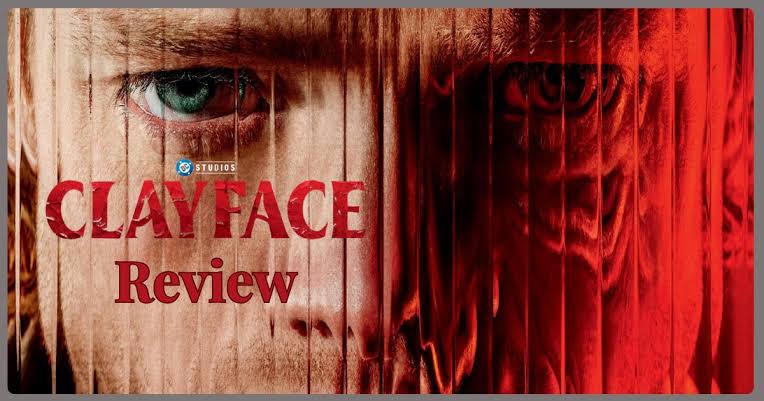
Quick Synopsis: An ambitious actor’s life is destroyed by tragedy, leading him down a horrifying path as he becomes the shape-shifting monster known as Clayface.
Movies based on superhero villains are inconsistent. By which I mean, Joker was good, most of the rest of them have been terrible. I would say all the rest have been terrible, but I can’t be 100% certain there’s not been an “okay” one that I’ve forgotten. It’s hardly the most impressive track record for a genre that should, in theory, be full of fascinating characters and interesting possibilities. Apparently, being a memorable villain in a superhero movie doesn’t automatically make you interesting enough to carry your own film. Compared to those, Clayface is a huge success. Really, the only comparison is Joker. It’s not quite as good as Joker, but it is less flawed.
That may seem contradictory, but I’ll explain. It never feels as weak as Joker did in its weakest parts. There’s no “look, this is set in the Batman universe, here’s an unsubtle reference” moments. It certainly works better as a standalone movie. The arc isn’t based entirely around the Wayne family. That’s not to say that Joker was necessarily worse for having those connections, but they occasionally felt like distractions from the story it was trying to tell. There’s a difference between making a film that happens to feature a character from a superhero universe and making a film that constantly reminds you of the universe that character belongs to. Clayface understands that distinction considerably better. It doesn’t need to rely on Batman’s presence, or the audience’s familiarity with Gotham, to make its story interesting. It doesn’t feel like it’s constantly trying to justify its existence within a larger franchise. Instead, it stands on its own merits, which makes it considerably easier to take seriously as a character study rather than simply another piece of superhero mythology.
On the other hand, it never reaches the highs that Joker did. There’s nothing quite as memorable, nothing that feels like it has the potential to become iconic (on the bright side, there’s a lot less songs by dead British paedophiles). It’s a consistently good film, but it never quite achieves that feeling of being something genuinely special. And perhaps that’s the trade-off. Where Joker occasionally reaches extraordinary heights, Clayface is much more content to remain on solid ground.
There’s a certain predictability to it. Not necessarily in terms of where the story goes, but in the sense that it rarely does anything that makes you sit up and think you’ve just witnessed something extraordinary. It doesn’t have those standout moments that stay with you long after the credits roll. Everything works, everything fits together, but there’s a slight lack of ambition when it comes to pushing things beyond what’s expected.
However, that consistency is also one of its greatest strengths. The standalone approach gives Clayface much more freedom than similar movies. It’s not concerned about setting up sequels, adding references, or planting seeds for the future. It doesn’t need to introduce another character who might become important three films down the line, or leave its story unfinished to accommodate whatever comes next. It just focuses on making a good movie, and in that aspect, it succeeds.
There’s something quite refreshing about that. A film that simply wants to tell its own story, explore its central character and reach a satisfying conclusion. It might not be the most spectacular superhero-related movie, but it doesn’t need to be. Sometimes making a good film is enough.
Clayface does a great job of showing how someone can become a monster. Matt Hagen/Clayface is an interesting character. You can tell he starts off with logical motives. He just wants revenge on those who ruined his life. Given what he’s been through, it’s difficult not to sympathise with him. He’s not particularly interested in world domination or some grand scheme. He just wants his old life back, or at the very least, some sort of justice for what’s happened to him.
But then he starts to become obsessed with the scientist who cured him, Caitlyn Corr. His obsession with her is what drives his villainous arc. Initially, there’s something quite understandable about it. She’s the person who saved him, someone who gave him a second chance when everyone else had effectively written him off. You can see why he’d become attached to her. The problem is that this gradually develops into something considerably less healthy.
For most of the film, you are on his side, but there are a few moments where you think “okay, that’s a bit weird”. His behaviour becomes increasingly difficult to justify, even if you can still understand where it’s coming from. The real turning point is when Matt murders Caitlyn’s partner. It’s the moment where his desire to be close to her crosses a line that there’s no coming back from. The thing is, you can see his logic: if he can be anybody, why not be what she wants? It’s a horribly twisted way of looking at things, but that’s what makes it so effective. He’s no longer thinking about what Caitlyn actually wants, only what he can turn himself into to get it. He’s convinced that his new abilities give him the perfect solution to a problem that exists entirely in his own head.
That’s what makes his transformation so interesting. He doesn’t suddenly wake up one morning and decide to become a monster. He gradually convinces himself that increasingly disturbing behaviour is perfectly reasonable. By the time he’s fully embraced what he’s become, he’s still following a line of reasoning that, in his mind, makes complete sense. He’s just lost any ability to recognise how monstrous it actually is.
The other characters are a little bit more underwhelming. As disturbing as the villains are, they’re so 2-dimensional that they’re basically printed on paper. There’s a difference between being frightening and being interesting, and unfortunately, the film doesn’t always seem to recognise that. They certainly make an impression in terms of the threat they pose, but there’s very little depth to them beyond that. They’re unpleasant, they’re dangerous, and they’re certainly capable of making your skin crawl, but that’s pretty much where the characterisation ends.
It’s particularly noticeable when you compare them to Matt. He’s given a proper journey, understandable motivations and a gradual transformation that makes you question just how much sympathy you should have for him. The other characters rarely get anything approaching that level of attention. They feel more like obstacles for the protagonists to overcome than actual people with their own motivations, personalities or complexities.
They exist to serve the plot, and once they’ve fulfilled whatever purpose the story requires of them, there’s not much left to remember. Even Caitlyn, who is obviously central to Matt’s transformation, could have benefited from a little more development of her own. There’s an interesting character somewhere in there, but the film is much more interested in how she affects Matt than who she actually is.
It’s a shame, because a little more attention to these characters could have added considerably more weight to the film’s more disturbing moments. When your central character is this well developed, it makes the comparatively thin supporting cast all the more noticeable.
Trust me, this film is disturbing. There’s some horrific body horror on display here, and it’s probably one of the film’s biggest strengths. I like that Clayface makes use of the character’s powers in its action and death scenes. Rather than relying on generic horror kills that could be dropped into practically any other film, it finds ways to make the most of what makes this particular character so unusual. Very few of the kills here can be reproduced in a generic movie; they’re very specific to the character and his abilities. It gives the violence a distinct identity, which is something that a lot of horror films could learn from.
There’s some truly shocking stuff here, and the film clearly isn’t afraid to get its hands dirty. I particularly liked the death of the main villain. It’s brutal, shocking, and very bloody. It’s also the sort of sequence that makes you appreciate just how unpleasant Clayface’s powers could be in the wrong hands. There’s a real sense of unpredictability to the violence because you’re never quite sure what his body is capable of doing next. The film understands that body horror works best when it makes you uncomfortable, rather than simply trying to make you jump.
On the downside, Matt gets used to his powers waaaaay too quickly. He goes from “this is weird” to cutting himself almost instantly. You’d think there’d be a little bit of hesitation there. Even allowing for the desperation of his situation, you’d expect someone to be rather more concerned about suddenly being able to reshape their own body. There’s a huge difference between discovering you have an unusual ability and immediately becoming comfortable experimenting with it in increasingly gruesome ways. It’s a small thing, perhaps, but it does make his transformation feel a little rushed in places.
Really, the main issue is that it’s too good to not be better. If it was slightly worse, you could chalk it off as shlocky fun. You could enjoy the ridiculousness, appreciate the gore and not worry too much about the bits that don’t quite work. But it’s so good at what it does that it sets up higher expectations than it would otherwise have. You start noticing the little things that could have made it even better, rather than simply accepting them as part of the package.
The music should have been more memorable. For a film with such a distinctive visual identity, I was expecting something a little more interesting from the soundtrack. It’s not quite explained how he can change his voice, either. It’s a relatively minor detail, but when you’re dealing with a character whose entire ability revolves around changing his physical appearance, you’d think they’d spend a little time establishing the limits of what he can actually do.
More importantly, his powers leave the film with almost no dramatic tension. Once you understand what he’s capable of, it’s difficult to see how anyone is supposed to stop him. He can change his appearance, reshape his body and seemingly get out of almost any physical predicament. There doesn’t appear to be much of a downside to using these abilities, either. It’s like watching a Superman movie where there’s no such thing as Kryptonite and he has no loved ones. Sure, it’s impressive watching him do all these things, but where’s the jeopardy? What exactly are we supposed to be worried about?
A superhero’s powers are only really interesting when there’s something that can challenge them. Without limitations, weaknesses or consequences, there’s very little uncertainty about the outcome of any confrontation. Clayface could have done more to establish what Matt can’t do, rather than simply showing us everything he can.
Plus, it’s a weird coincidence that the scientist who helped him is in a relationship with the cop investigating the crime against him. It’s one of those plot developments that feels a little too convenient, particularly in a film that’s otherwise quite good at making its characters and their motivations feel believable. It isn’t necessarily a deal-breaker, but it does make the world feel a little smaller than it should.
One big downside, and it’s not really a downside yet, is what comes next in the DC cinematic universe. There’s Man Of Tomorrow next year, that’s fine, that will definitely be different. The Brave And The Bold? Yup, there’s no way that’s going to be similar. But then there’s Swamp Thing. Depending on how that’s handled, that could invite comparisons to Clayface. And that’s where things get awkward. Either Clayface will look worse in hindsight because a future film does something similar but better, or Swamp Thing will end up being negatively compared to a film that’s already done it. Neither outcome is particularly good. It’s a strange problem for a film to create, but by doing something different and doing it so well, Clayface may have made life a little harder for whatever DC decides to do next.
This may seem a bit negative, but I did genuinely love Clayface. I thought it was expertly made, with some genuinely horrific moments, and it’s refreshing to see something so different from the usual DC output. It’s certainly a world away from Marvel’s latest offerings, too. I may not think it’s the best movie of all time, but that doesn’t mean I didn’t enjoy it. It’s an interesting, well-made film that does plenty right, and one I’d happily sit down and watch again. Sometimes that’s more than enough.

