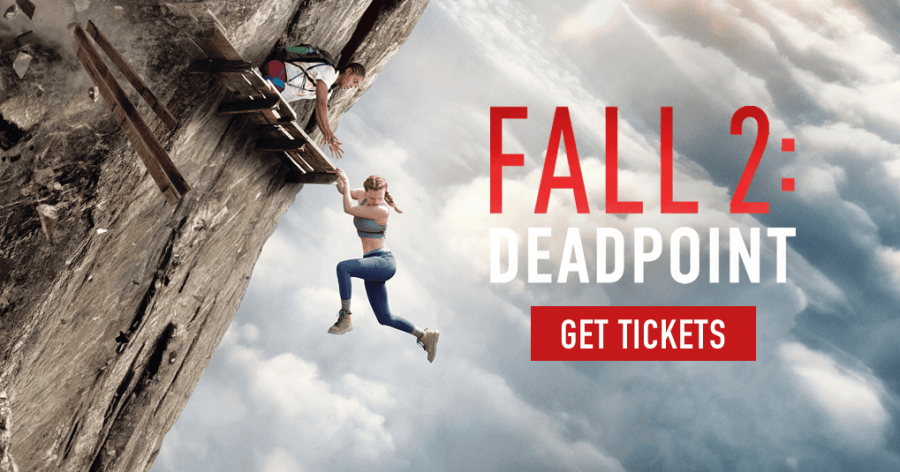
Quick Synopsis: A grieving woman and her late sister’s friend get trapped thousands of feet up on a dangerous mountain plank walk in Thailand after a rockslide destroys the path.
I absolutely loved Fall; it was probably the most tense film I’ve ever watched. I remember watching it, and at one particularly intense moment, a guy sitting nearby stood up, loudly proclaimed, “fuck this”, and walked out. Honestly, I get it. It was an unsettling watch that made my stomach jump constantly (although that could have been the sweet popcorn). So I was incredibly excited by the idea of a sequel.
I was a bit nervous that it was only a few months away from release and there still wasn’t a trailer. Then the trailer came out, and it was… fine. It didn’t blow me away, but mainly because it was so short that it didn’t really showcase much. I figured the finished film would be worth it.
It’s not. I’ll state that up front. It’s nowhere near as good as the first one; it feels like a cheap knock-off. Part of that is because I now have expectations. But part of it is because it’s simply not as good. There are moments where it’s incredible, where you finish a scene and realise just how tightly wound you were while watching it. So it’s not a terrible film, but it isn’t a good one either. There are three main issues: the script, the characters, and the visuals.
The script. The idea for Fall 2 is simple: two characters are trapped on a wooden bridge high up on a mountain. That’s it. Everything is there. It doesn’t need complicating. But it does it anyway. It tries to be clever, adding unnecessary twists and turns.
I’ll talk about one of them because it doesn’t really impact the script, so it’s not a spoiler. Who we thought was called Luce is actually called Billie. She claimed she was a friend of Shiloh (the woman from the first movie, and the sister of Fall 2 protagonist Jax), and it’s a shock to discover that she was actually just a fan. All shocking, all effective. Well, it would be, if any of this had actually mattered before. The fact that Luce is friends with Shiloh is mentioned in dialogue that is so ineffectual it’s basically homoeopathic. There are no conversations about “so what was my sister like at college?”, or discussions of their supposed friendship. There are so many dialogue-heavy scenes that it’s impossible to remember every single thing that was mentioned in passing.
It would be like if I suddenly said: “I absolutely detest sweet popcorn, much preferring salted.” It would mean nothing, because nobody reading this review is going to remember that I mentioned popcorn in the first paragraph. Why would you?
The characters. This was a slight issue in the first film: people taking reasonable decisions for their safety are labelled “not living life”, and standard things to make sure you don’t die are described as “letting fear run your life”. That’s taken to the extreme in this. Especially in a flashback sequence detailing the time Jax and Shiloh went skydiving, and Shiloh pretended to pass out mid-air. When they land, Shiloh does the whole “It was to teach you not to let fear run your life”. No, if you’re skydiving and the person you are trusting to keep you safe passes out, you have every right to be scared, and it’s not unreasonable to be pissed off if it turns out they’re faking it. It’s why parenting books don’t recommend breaking into your kid’s bedroom swinging a chainsaw to teach them about stranger danger. Also, Shiloh’s death doesn’t come up that much. At no point does Jax say, “Yes, I’m scared of falling from heights, but I have a good reason to be; my sister died falling from one”. They mention how her sister didn’t let fear rule her life, how she climbed tall structures with abandon, but don’t mention that it’s that fearlessness that killed her.
Fall 2 also has issues with pacing. It takes seemingly forever for them to actually get to the spot, so it doesn’t even feel like the main part of its own movie. For an idea of how long it takes to get there, the current plot section on the film’s Wikipedia page is 678 words long. It takes over 200 words before we get to “The two women are then left stranded.” The entire section describing the two of them alone is just 232 words.
Finally, the visuals. What worked about the first film was that it was set on a small radio tower. The tower itself was a constant visual reminder that there was nothing between them and the ground. Here, they’re on the edge of a mountain, so most of the shots are the two leads in the foreground, with a huge chunk of rock behind them. You don’t get that same constant reminder of the peril they’re in. There are a few moments where you do see just how high they are, but they’re few and far between.
I also felt the opening was overly stylised, shot more like an action movie than a survival thriller, which detracted from the realism somewhat.
This has all seemed pretty negative, much more so than this film deserves. On its own merits, it’s perfectly fine. It has some incredible shots, and the performances are all good too. My only criticism of the cast is how much Tom Brittney looks like a mix of Tom Ellis and Santino Fontana, but that’s not his fault; it’s just my brain looking for shortcuts.
Harriet Slater and Arsema Thomas are solid leads, only really let down by the script. I get the feeling that if they were scripted as friends, they’d be allowed to be much more natural with each other. As it is, they have to play two strangers, which means there’s only so much chemistry they can show.
In summary, I really wanted to like this. I’m still waiting for the obvious contender for my favourite film of the year, and I hoped Fall 2 would be the one to do it. Instead, it’s a clear favourite for “Most Disappointing”. If this had been released on its own, I’d be much warmer towards it. But when the original Fall had me genuinely considering whether I could stomach another minute of it, it’s hard not to feel let down by a sequel that never comes close to that level of tension.
The mountain in Fall 2 is MUCH higher than the tower from the first one, but the biggest difference in height is the difference in quality between the two. There’s a third movie on the way, featuring the leads from both films, and it looks like it’s set on a snowy mountain. If it follows the same approach as this one, I’m expecting much the same thing, but with added snow and clearer skies – which doesn’t exactly fill me with confidence that the visuals will be any more tense.