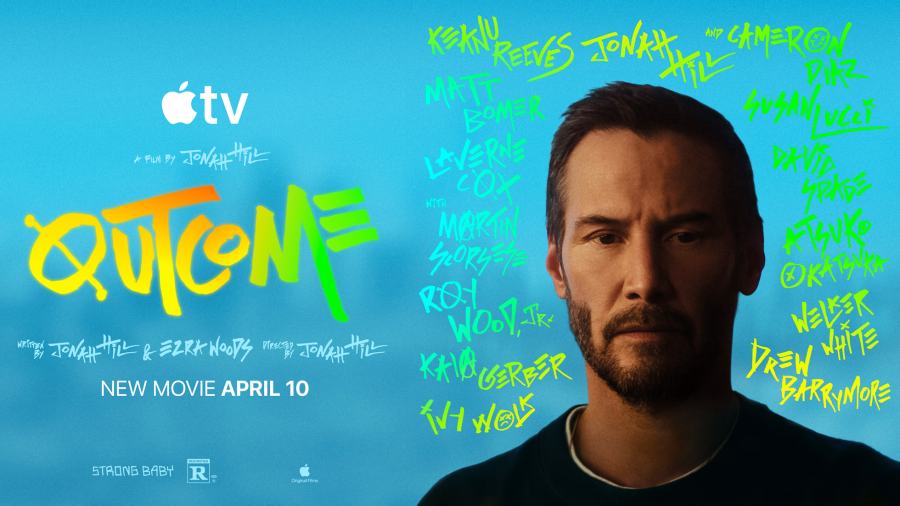
Quick Synopsis: A beloved Hollywood star embarks on a desperate redemption tour after a blackmail threat forces him to confront the mistakes that could destroy both his career and his sense of self.
I’m going to start this review off in a manner which I can almost guarantee no review of this movie has done, by talking about OJ Simpson. The murder of his wife (and the accusations of his involvement in her murder) haunted him to the point he felt compelled to write a book entitled “If I Did It”, which was essentially him insisting he was innocent while describing how he would have committed the crime if he had been guilty. It’s generally regarded as a really stupid and crass idea. Similarly, in 2018, in the midst of a sexual abuse scandal that would end up with him being imprisoned for 31 years, R.Kelly released a song called “I Admit”, where he “confessed” to things such as not going to church enough, with the only mention of his crimes being a denial. Which makes sense, the only evidence the world had that he was a paedophile was a rape tape he made with a minor in 2002 (which the world knew about, by the way, so fuck EVERY musician who worked with him after that date). Now, art is art, and I’m not saying musicians, writers and filmmakers should be arrested or punished for doing this. But it is in bad taste. Certain people should not make art and attempt to make money from certain subjects. That’s my big issue with Outcome. Jonah Hill should not have been involved. It feels like this may have been his way of dealing with the accusations of emotional abuse levelled at him, when he told his partner who was a surf instructor, not to surf with men, post pictures online of her in a swimsuit, or spend time with friends he didn’t approve of. I’m fully on board with people using pain and trauma for art, but it feels like he’s using other people’s trauma that involved him, rather than his own trauma. That fact overshadows everything else about the film, especially when it discusses how “the best thing to be is a victim.” If he wasn’t involved, you could look at those moments as the film mocking them, but with his involvement, it’s not difficult to view it somewhat cynically.
So, outside of that, how is Outcome? Honestly, it’s fine. It’s not horrendously bad, but it’s nothing special. Its streaming release feels appropriate. It’s the sort of film that’s worth watching on a quiet evening, but not one compelling enough to justify a trip to the cinema. It’s an interesting idea, but all it is is an idea, nothing more. The conversations between Reef and the people he may have wronged are genuinely compelling; emotive, introspective, and full of sharp characterisation. But everything connecting those scenes is surprisingly bland.
The casting of Reeves, generally known as one of the nicest people in the world, is perfect. The rest of the cast? They’re okay. You wouldn’t have guessed by watching this that Cameron Diaz was once one of the world’s biggest stars; she no longer has the effortless screen presence that once made it impossible to look away. I don’t know if it’s the performer or the character, but Reef’s assistant Sammy doesn’t suit the style, feeling like a deliberately kooky Deschanel-type, all quirks and forced performative behaviour. Martin Scorsese gives a surprisingly good performance. Everybody is aware of his talent behind the camera, but his work as a performer in this is to be admired, giving a lot of depth to what could be a pathetic character. His almost-monologue is full of pathos, emotion, and regret. You could build entire stories around that.
Ultimately, the film never quite figures out what it wants to be. Is it attempting to be a character study about someone realising he’s kind of a dick? Is it a satire about how fame is based more around PR than actual behaviour? Is it about how our expectation that celebrities should be perfect is a doomed endeavour? Or is it about how cancel culture ruins the lives of famous people? It feels like it is aiming to be all of them, so never fully commits to anything. All of those ideas are good ideas worth studying, but they never fully mesh in Outcome. Every time it looks like it’s getting deep into something, it pulls out (sex reference unintentional but I’m keeping it).
Visually, it’s fine. There are no shots which are ugly or distracting, but nothing that will make you appreciate it. When I was younger, I used to think the director’s job was very easy; you just point a camera at what’s happening and press record. That’s the approach it seems was taken to Outcome. The camera isn’t assisting the story or themes in any way. There’s very little sense that the camera is being used to tell the story, rather than simply record it. It’s just watching from nearby. This restrained approach to directing means that the weaker stretches have nothing to lean on. When the conversation dries up, there’s nothing carrying you to the next scene.
Under different circumstances, I think I’d have come away describing Outcome as an above-average streaming drama with some genuinely compelling scenes surrounded by a lot of filler. But art doesn’t exist in a vacuum, especially when it’s so easy to draw parallels between the story being told and the person telling it. Whether that’s fair or not, it’s impossible for me to separate the two, and the film never gives me enough to overcome that discomfort. It asks you to empathise with a flawed man trying to navigate the consequences of his actions, but because of who’s making that argument, it never feels like simple fiction. It feels like self-defence.
Outcome isn’t a disaster. There are moments of genuine insight, some excellent performances, particularly from Martin Scorsese, and conversations that linger long after the credits roll. But the film never develops beyond its central premise, and Jonah Hill’s involvement hangs over every scene like an elephant in the room. Maybe that’s unavoidable. Maybe that’s the point. Either way, it’s a film whose most interesting discussion happens outside the film itself.