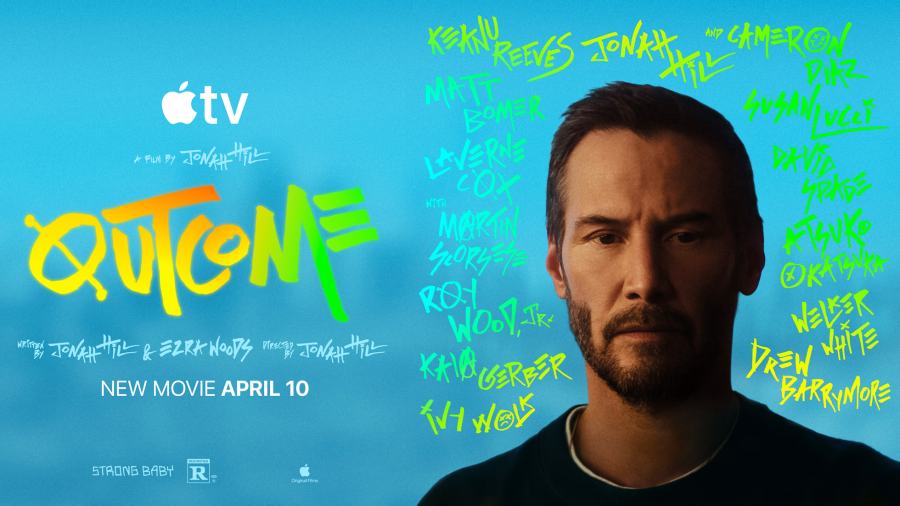
Outcome (2026) Review

Quick Synopsis: A beloved Hollywood star embarks on a desperate redemption tour after a blackmail threat forces him to confront the mistakes that could destroy both his career and his sense of self.

I’m going to start this review off in a manner which I can almost guarantee no review of this movie has done, by talking about OJ Simpson. The murder of his wife (and the accusations of his involvement in her murder) haunted him to the point he felt compelled to write a book entitled “If I Did It”, which was essentially him insisting he was innocent while describing how he would have committed the crime if he had been guilty. It’s generally regarded as a really stupid and crass idea. Similarly, in 2018, in the midst of a sexual abuse scandal that would end up with him being imprisoned for 31 years, R.Kelly released a song called “I Admit”, where he “confessed” to things such as not going to church enough, with the only mention of his crimes being a denial. Which makes sense, the only evidence the world had that he was a paedophile was a rape tape he made with a minor in 2002 (which the world knew about, by the way, so fuck EVERY musician who worked with him after that date). Now, art is art, and I’m not saying musicians, writers and filmmakers should be arrested or punished for doing this. But it is in bad taste. Certain people should not make art and attempt to make money from certain subjects. That’s my big issue with Outcome. Jonah Hill should not have been involved. It feels like this may have been his way of dealing with the accusations of emotional abuse levelled at him, when he told his partner who was a surf instructor, not to surf with men, post pictures online of her in a swimsuit, or spend time with friends he didn’t approve of. I’m fully on board with people using pain and trauma for art, but it feels like he’s using other people’s trauma that involved him, rather than his own trauma. That fact overshadows everything else about the film, especially when it discusses how “the best thing to be is a victim.” If he wasn’t involved, you could look at those moments as the film mocking them, but with his involvement, it’s not difficult to view it somewhat cynically.

So, outside of that, how is Outcome? Honestly, it’s fine. It’s not horrendously bad, but it’s nothing special. Its streaming release feels appropriate. It’s the sort of film that’s worth watching on a quiet evening, but not one compelling enough to justify a trip to the cinema. It’s an interesting idea, but all it is is an idea, nothing more. The conversations between Reef and the people he may have wronged are genuinely compelling; emotive, introspective, and full of sharp characterisation. But everything connecting those scenes is surprisingly bland.

The casting of Reeves, generally known as one of the nicest people in the world, is perfect. The rest of the cast? They’re okay. You wouldn’t have guessed by watching this that Cameron Diaz was once one of the world’s biggest stars; she no longer has the effortless screen presence that once made it impossible to look away. I don’t know if it’s the performer or the character, but Reef’s assistant Sammy doesn’t suit the style, feeling like a deliberately kooky Deschanel-type, all quirks and forced performative behaviour. Martin Scorsese gives a surprisingly good performance. Everybody is aware of his talent behind the camera, but his work as a performer in this is to be admired, giving a lot of depth to what could be a pathetic character. His almost-monologue is full of pathos, emotion, and regret. You could build entire stories around that.

Ultimately, the film never quite figures out what it wants to be. Is it attempting to be a character study about someone realising he’s kind of a dick? Is it a satire about how fame is based more around PR than actual behaviour? Is it about how our expectation that celebrities should be perfect is a doomed endeavour? Or is it about how cancel culture ruins the lives of famous people? It feels like it is aiming to be all of them, so never fully commits to anything. All of those ideas are good ideas worth studying, but they never fully mesh in Outcome. Every time it looks like it’s getting deep into something, it pulls out (sex reference unintentional but I’m keeping it).

Visually, it’s fine. There are no shots which are ugly or distracting, but nothing that will make you appreciate it. When I was younger, I used to think the director’s job was very easy; you just point a camera at what’s happening and press record. That’s the approach it seems was taken to Outcome. The camera isn’t assisting the story or themes in any way. There’s very little sense that the camera is being used to tell the story, rather than simply record it. It’s just watching from nearby. This restrained approach to directing means that the weaker stretches have nothing to lean on. When the conversation dries up, there’s nothing carrying you to the next scene.

Under different circumstances, I think I’d have come away describing Outcome as an above-average streaming drama with some genuinely compelling scenes surrounded by a lot of filler. But art doesn’t exist in a vacuum, especially when it’s so easy to draw parallels between the story being told and the person telling it. Whether that’s fair or not, it’s impossible for me to separate the two, and the film never gives me enough to overcome that discomfort. It asks you to empathise with a flawed man trying to navigate the consequences of his actions, but because of who’s making that argument, it never feels like simple fiction. It feels like self-defence.

Outcome isn’t a disaster. There are moments of genuine insight, some excellent performances, particularly from Martin Scorsese, and conversations that linger long after the credits roll. But the film never develops beyond its central premise, and Jonah Hill’s involvement hangs over every scene like an elephant in the room. Maybe that’s unavoidable. Maybe that’s the point. Either way, it’s a film whose most interesting discussion happens outside the film itself.

The Odyssey (2026) Review

Quick Synopsis: Odysseus, the Greek king of Ithaca, undergoes a long and perilous journey home after the Trojan War and encounters mythical beings as he attempts to reunite with his wife Penelope

I don’t think I need to see another Nolan film ever again. My problems with Nolan are well documented: his scripts often lack emotion, while his dialogue somehow manages to both overexplain everything and leave you wondering what anyone actually means (as perfectly encapsulated in this video). Of course, actually hearing that dialogue has always been another challenge thanks to Nolan’s sound mixing (a problem that’s cropped up throughout his career, but reached its peak with Tenet). The result has always been films I admire more than I actually connect with.

None of that is why I don’t want to see another Nolan film. I just wanted to lull you into a false sense of security. I don’t want to see another Nolan film because The Odyssey feels like what his career has been building towards. The fragmented timelines in Dunkirk, the sense of foreboding that hangs over Oppenheimer, the manipulation of geography in Inception, his exploration of mythic heroes from Batman. Everything has been building towards this moment. Seen in retrospect, the rest of his filmography feels like practice for The Odyssey. Homer’s epic demands a filmmaker obsessed with time, perspective, spectacle and impossible journeys, qualities Nolan has spent twenty-five years refining

The internet has spent an impressive amount of time arguing about the historical accuracy of a film based on a myth. Some of it has simply been misinformation, claims that Elliot Page is playing Achilles, despite actually playing Sinos. Some of it has been uglier, with people claiming Lupita Nyong’o is “too black” to play Helen of Troy (despite being one of the most strikingly beautiful actors working today, which feels rather relevant when casting Helen). Then there’s the debate over accents, with complaints that everyone speaks in historically inaccurate American accents, rather than the obviously much more historically accurate British ones. I didn’t invent that last argument, by the way. James Hibberd of The Hollywood Reporter was so annoyed by the accents that he wrote an entire article about it, arguing that the modern British accent is “traditionally considered universally pleasing and ‘just foreign enough'” to create a timeless quality. Apparently, the ancient Greeks were just waiting for actors to discover Received Pronunciation.

However, there is one criticism that does deserve to be taken seriously: Emily Wilson’s. Especially because her 2017 translation of The Odyssey formed the basis of Nolan’s adaptation. She argues that the film simplifies Odysseus, stripping away much of the complexity of the character and leaving little to say about the major themes of Homer’s work.

From the perspective of someone who has spent years studying the text, it’s a difficult criticism to dismiss. However, there is also a difference between experiencing The Odyssey as a scholar and experiencing it as a general audience member. Wilson has pored over every word of the original, examining it through historical context and the work of other translators and academics. A filmgoer is approaching the story very differently. They are not necessarily looking for every character, or comparing every choice against centuries of interpretation; they are experiencing the story Nolan has chosen to tell.

Let’s be honest, most audience members won’t leave the cinema wondering where Queen Arete is or which elements of the poem have been omitted. As historian Tom Holland (not the actor who appears in this film) has pointed out, there is no historically accurate version of Odysseus to recreate. He is a mythical figure. An “impressionist” interpretation of ancient history is arguably more valuable than a painstaking attempt to recreate every historical detail, because such accuracy is impossible. So with that in mind, how is the film itself? As you can guess from my second paragraph, I loved it. It’s long, you can’t deny that, but every scene feels like it earns its place. There is so much mythology packed into this story that removing anything risks making the journey feel incomplete. Some stuff you’ll be familiar with (the Trojan horse, the sirens, Circe), some you won’t (I can’t say because I don’t know what you’re familiar with). The impressive thing isn’t that Nolan includes these famous moments; it’s the way he reinterprets them. The Trojan horse isn’t simply a giant wooden structure waiting to be wheeled into Troy. The song of the sirens is not a beautiful melody, but a haunting lament for everything you’ve left behind. Circe’s transformation of men into pigs is one of the most disturbing versions of that event you could hope for, helped enormously by another excellent performance from Samantha Morton. Surely an Academy Award for one of her performances is only a matter of time?

The cast is one of the film’s biggest strengths. There are no real weak links. Robert Pattinson gives a deliciously sleazy performance that will make your skin crawl, somehow making every appearance both entertaining and deeply uncomfortable. Matt Damon is perfectly cast, and not just because this is another film where he spends the story desperately trying to get home. Somehow, that has become his very specific niche. As said earlier, Samantha Morton is excellent as Circe, bringing a genuinely unsettling quality to a character who could easily have become just another stop on Odysseus’ journey. The only criticism you can really make of Tom Holland is that his babyface means he doesn’t quite look like a 30-year-old, but that is hardly a fault with his performance.

Visually, this might be Nolan at his most impressive. Polyphemus the cyclops looks genuinely monstrous; the way he kills Odysseus’ soldiers brings to mind Francisco Goya’s Saturn Devouring His Son, not simply because of the violence, but because of the sense of something ancient and unstoppable consuming something helpless. The Laestrygonians are similarly nightmarish, not only because of their size, but because of the way they manipulate the landscape itself to trap and kill their victims.

This makes it the perfect opportunity to talk about one of Nolan’s greatest strengths: his understanding of scale. A low angle alone does not make something feel enormous; the audience needs something familiar beside it for comparison. This is partly why I think Godzilla x Kong: The New Empire did not work as well as it could have. The monsters were huge, but the films rarely gave us a true sense of that size. Nolan understands that difference. Here, everything that is supposed to feel massive actually does, from the mythological creatures to the buildings, landscapes, and entire worlds they inhabit.

Perhaps the most impressive thing about The Odyssey is not what Nolan builds, but what he allows us to see. The film takes us across coastlines, mountains and islands that feel almost untouched by time, and Nolan is confident enough to simply let them exist. The scenery becomes almost another character, shaping the journey as much as the people within it. Each location represents another stage of Odysseus’ journey, not just geographically but emotionally, giving the entire film a sense of scale and reality that artificial environments often struggle to replicate.

These are not historical places recreated for the camera. They are places that existed before the film and will continue to exist afterwards. Every mountain, coastline and cave has texture and history, making the journey feel less like a series of movie sets and more like an actual voyage across an ancient world.

For all Nolan’s strengths, emotion remains his greatest weakness. There is emotion here, but it comes mainly from the performances rather than the writing. The actors create feelings that the script itself rarely manages to reach. There are moments that should be devastating, but they are presented with such clinical precision that you end up more impressed than affected by what you are seeing. You understand what the characters are feeling, but you remain outside the experience rather than being pulled into it. There is an emotional distance between the audience and both the characters and the story.

The closest the film gets is near the end, when the fall of Troy is presented not as the glorious conclusion of an epic, but as what it actually was: the destruction of a city and a war crime. Even then, however, it does not have quite the impact it should. It is brutal, but in a film where soldiers are killed by living trees, transformed into pigs, or have their heads bitten off by monsters, the human horrors of war somehow feel strangely tame in comparison. You cannot present something as the tragedy that reshaped a civilisation if the audience does not feel its weight more than the fantastical violence surrounding it.

I meant what I said at the beginning: I don’t need to see another Nolan film. Not because I have lost interest, but because I genuinely cannot see how he could top this. The Odyssey feels like the culmination of everything he has spent his career working towards. Every other film now feels like a filmmaker refining the tools he would eventually need for this. Every obsession, every stylistic quirk, and every technical innovation finds the perfect material to justify itself.

I cannot imagine another Nolan film topping this because I cannot imagine another story that suits him quite this perfectly. But I hope I’m wrong. Because if Nolan somehow manages to surpass this, then we will have another one of my favourite films to add to the list.

The Invite (2026) Review

Quick Synopsis: A struggling married couple’s dinner with their free-spirited neighbours spirals into a provocative night of awkward revelations that forces them to confront the cracks in their relationship.

I love dinner parties in movies. They’re so fun to watch because they naturally allow group conversation, and there are certain unspoken etiquette rules that are always entertaining to watch get broken. If you want to expose your characters’ conflicts, put them around a dinner table and let what happens happen. The Invite takes that idea and makes it the entire concept.

It’s an English-language adaptation of the 2020 Spanish film The People Upstairs. It’s fairly obvious this is a remake of a non-American film. There’s something about it that feels slightly unconventional. It’s not just that it’s a summer movie driven by characters and dialogue rather than big action setpieces. It kind of feels like the cinematic equivalent of ordering food in a foreign country by speaking English with an accent. Familiar enough to understand, but just different enough to feel a little strange.

That sense of oddness is backed up by Olivia Wilde’s directing style. It’s incredibly static, with some weird blocking choices. Sometimes it feels like a play that we’re watching from the audience, sometimes it feels like someone just plonked a camera down randomly with no thought or care, and other times there’s a voyeuristic quality, as if we’ve wandered into a private argument we shouldn’t be witnessing. With that in mind, it’s difficult to criticise the film too harshly on a technical level because it’s clearly not trying to impress with flashy filmmaking. It’s aiming for a naturalistic style that occasionally feels awkward, but intentionally so.

What will chiefly inform your opinion on The Invite is the characters and the dialogue. The audience I saw it with loved it, and it’s easy to see why: it’s incredibly funny at times, with some truly incredible dialogue, and a cast who clearly enjoy bouncing off one another. The conversations have an energy that keeps scenes engaging even when very little is happening. That’s the issue, though: very little does happen. There’s almost no narrative progression for most of the runtime. Rather than pushing the characters into new emotional territory, the film spends much of its time having them elaborate on feelings they’ve already expressed. To be honest, it spends most of it catching up with the trailer. I’ve seen the trailer; I know this film involves the neighbours proposing group sex. I assumed that would be the inciting incident and it would lead to things. Instead, it’s the destination, and it’s a destination the film takes far too long getting to.

That lack of progression also affects the central relationship. Joe and Angela don’t feel like real people so much as vehicles for clever dialogue. Every conversation is packed with witty observations, but it rarely feels spontaneous or lived-in. Also, there was no warmth to the relationship between the two main characters. I understand that the point is they’re trapped in a loveless marriage fuelled by resentment, too afraid to admit it’s over. That doesn’t mean spending nearly two hours with them becomes any easier. I kept waiting for just one moment of genuine warmth, some glimpse of why these two people fell in love in the first place. There’s a brief moment where it seems they might unite against the bickering of the other couple, but it disappears almost as quickly as it arrives.

That lack of warmth really hampers the ending. Joe finally returns to the piano, Angela joins him, and they seem to reconcile. It’s a sweet scene in isolation, but after nearly two hours of anger, bitterness and emotional distance, it feels too small to justify such a dramatic shift. It’s like trying to fix a leg amputation with a piece of sellotape.

For all my issues, there is still a lot to enjoy about The Invite. Beneath all the bitterness is an impactful look at people and keeping the spark alive in long-term relationships. For a film that’s so bitter, it just may save the relationship of someone watching. They may see it and be inspired to try more, to treat their partner with love, to keep wooing them and trying to impress them instead of confusing stability for fulfilment. The ensemble also works well as a true four-hander, with every actor getting plenty to do. Although, interestingly, despite having a female director and co-writer, the film subtly privileges Joe’s perspective. He’s the only character we spend meaningful time with alone, and the only one we follow outside the apartment. It’s a small imbalance, but one that makes the supposedly shared story feel slightly weighted towards him.

I won’t begrudge anybody enjoying this. Mainly because being annoyed at someone for their film opinions would be weird. Maybe a younger, more cynical me would have loved this. It will find its audience, of that I’m certain. But I’m not part of that audience. I appreciate what it’s trying to do, but it never quite invited me in.