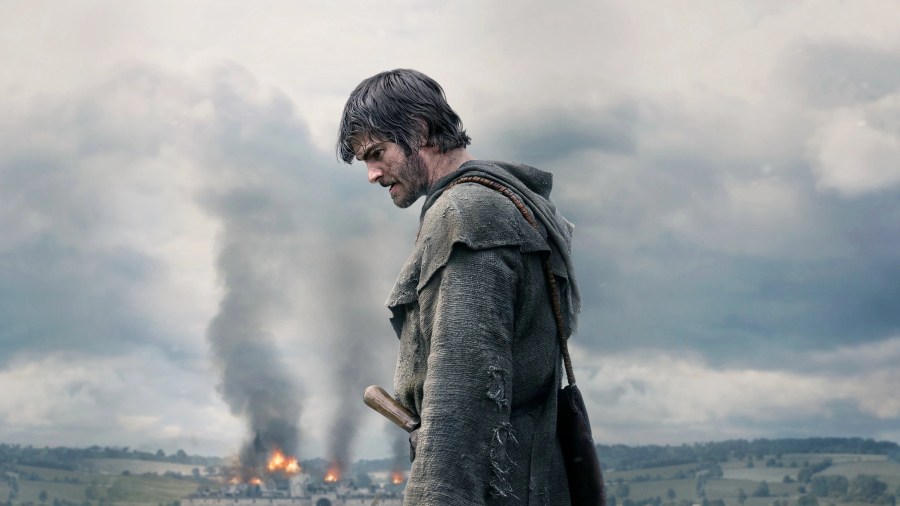
Quick Synopsis: A cinematic retelling of the 1381 Peasant’s Revolt
Sometimes studio executives know what they’re doing. The suggestion that Kevin Smith keep Dante alive at the end of Clerks allowed him to bring the character back throughout his subsequent films, while avoiding the rather bleak shadow that his death would have cast over everything that followed. So why is “studio interference” shorthand for “fucking everything up”? Probably because there’s a long history of decisions along the lines of “we need you to improve on the first film, but with a much lower budget and less time. If you fail, it’s your fault.” Or they market things weirdly. The Uprising was marketed in the US as The Uprising: The Rise of Robin Hood. The ramifications of this decision are incredible. Not only was this apparently decided despite The Death of Robin Hood being released first, but whoever thought Robin Hood films were still a reliable source of box-office gold has inadvertently proved that time travel exists. Because this guy (and it was definitely a guy) clearly travelled here from the 1990s, when those films were still commercially successful.
Any attempt to tie this movie into Robin Hood mythology doesn’t improve it. If anything, it makes it worse. The world doesn’t need another Robin Hood movie. Do you know what it does need? A movie about the Peasants’ Revolt. That’s something different, and it’s relevant to modern times. Unfortunately, the way this film handles that relevance is decidedly strange.
Our protagonist is a ploughman, armed with a sickle. The revolutionaries are poor workers being exploited by rulers whose financial decisions have made their lives increasingly miserable. It’s a story about the power of organised political violence. So why does the film feel slightly right-wing at times? The talk of unelected elites preventing the ruler from doing his job sounds suspiciously like the argument that civil servants were stopping the government from delivering Brexit. And then there’s the suggestion that foreigners are ruining the country. Well, it’s pretty obvious where that one leads.
There’s another thing about this movie that makes me uncomfortable: the action scenes. The Uprising was directed by Paul Greengrass, best known for the Bourne movies. My problem isn’t necessarily with those films themselves, but with what they inspired: the endless shaky cameras and rapid editing that have become staples of modern action cinema. I’ve never been particularly fond of the technique, and it feels especially ill-suited to a film like this.
Because when The Uprising actually lets us see the violence, it can be genuinely shocking. In a good way. This isn’t violence you’re supposed to cheer for. You don’t revel in the blood and gore; you’re supposed to feel slightly sickened by it. So many moments here deliver what the sack of Troy in The Odyssey should have: something vile, disgusting, and deeply uncomfortable.
On the subject of visuals: it would be easy for The Uprising to look like shit. A film set in the 1300s doesn’t exactly lend itself to bright colours and well-lit interiors, and the modern trend of making everything look dark as hell hardly helps. It wouldn’t have been surprising if the result were a film where you could barely see what was happening. So it’s a pleasant surprise that the visuals are generally clear, making it incredibly easy to see what’s going on. The exception, of course, is the action scenes, where the shaky-cam style makes everything unnecessarily difficult to follow.
How about the performances? They’re all fine. This is nobody’s best work, but nobody should be ashamed either. It’s always great to see Katherine Waterston in things, and it’s nice to see Tom Hollander on the big screen. The problem is that the performances are let down by the characters themselves. It’s not that they’re necessarily underwritten; it’s that there’s very little to differentiate them. Beyond “angry”, there’s not much to them. We understand why they’re fighting, and we care about them collectively, but when an individual dies, the loss rarely feels significant because the film has given us plenty of other characters who could take their place.
This is particularly noticeable when Wat Tyler is executed. No, I’m not marking this as a spoiler for a real-life event that happened like 900 years ago. Anyway, his execution is supposed to be a game-changer, and the scene itself is violent and horrific. But among the surviving rebels, there’s no real sense of “oh, we’re fucked without our leader”. Part of the problem is that, while Wat is the central figure of the rebellion, he’s not the central character of the film. Anyone who knows their history understands his importance, but someone coming to this story fresh is more likely to see him as an assistant who helps The Ploughman. The film never really establishes him as the leader, so when he’s executed, the moment falls flat.
This is a shame, because the Peasants’ Revolt is a genuinely interesting subject for a film. There’s something inherently cinematic about ordinary people deciding that enough is enough, taking up arms against those who’ve spent their lives telling them what to do, and discovering that overthrowing a system is considerably easier than figuring out what comes next. A rebellion can win its immediate battle and still leave its participants with the question of what, exactly, they’ve won. You don’t need to invent a legendary outlaw to make that story interesting. The real people involved were interesting enough already.
But there’s one problem with making that film: the revolt ends in defeat. That’s not exactly the triumphant conclusion mainstream audiences tend to expect from a story about ordinary people rising up against their oppressors. So you’d need some creative “and although the rebellion failed, its legacy inspired yada yada blah blah” nonsense to send everyone home feeling good about themselves.
The problem is that I’m not entirely sure what this film wants to be. It wants to be a gritty historical drama about class warfare, a visceral action movie, and (in America) a Robin Hood origin story, all at once. None of those things are inherently incompatible, but they require a degree of focus that the film struggles to maintain. Whenever it starts exploring something genuinely interesting about the political circumstances of the revolt, it seems to remember that there’s an action sequence waiting around the corner. And whenever the violence makes you appreciate the sheer brutality of the period, the film risks reducing that brutality to just another spectacle.
There’s also the question of what exactly we’re supposed to take away from all this. I’m not expecting a historical drama to provide a comprehensive political education, but if you’re going to make a film about exploited workers rising up against the ruling class, perhaps you should have something more interesting to say about the relationship between those two groups than simply pointing out that the former are angry and the latter are bastards. That becomes particularly awkward when some of the film’s political rhetoric seems to undermine the very people it’s supposedly asking us to support.
Ultimately, The Uprising is a frustrating film because there’s a genuinely good movie somewhere inside it. The subject matter is fascinating, the violence occasionally achieves exactly the sort of horrifying impact that historical action films should be aiming for, and the film itself is surprisingly watchable given the setting and subject matter. But it never quite brings those elements together into a coherent whole. It has all the ingredients for a compelling story about class, power, and resistance, but somehow never quite manages to make a meal of them.
I don’t think The Uprising is a disaster. It’s too well made and has too many moments of genuine effectiveness to deserve that description. But it’s also difficult to escape the feeling that the people involved have taken an extraordinary historical event and made something considerably less interesting than the real thing.
The Peasants’ Revolt was a challenge to the established order, a moment when people who were supposed to know their place decided that perhaps their place was somewhere else entirely. That’s a story worth telling. Focus on the brutality, not on turning it into an action spectacle. Give the political circumstances more attention. Even a more thorough examination of the causes would help.
The fact that the revolt was partly triggered by a poll tax is never really highlighted. The film could have drawn a fascinating parallel with Margaret Thatcher’s Community Charge, introduced in 1989 in Scotland and 1990 in England and Wales, whose unpopularity and the protests against it helped bring down her government. THAT’S how you end a movie: by pointing out the circular nature of history, how those in power refuse to learn from it, and how they’re doomed to repeat their mistakes. That would be a much stronger ending than “and the hero let the villain live”.

