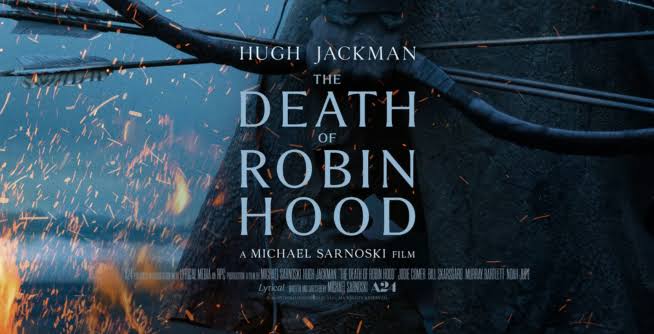
Quick Synopsis: A wounded and ageing Robin Hood retreats to a remote island, where he is forced to confront the violent legacy of his past and the legend he has left behind.
There have been countless adaptations of Robin Hood. Yet, much like King Arthur, the failures far outnumber the successes. My personal favourite? Men In Tights. Robin Hood: Men in Tights, that is. I’m talking about the movie; I’m not saying my favourite thing to see is men in tights. The Death Of Robin Hood (TDORH, pronounced The-door-rah) isn’t even the only Robin Hood movie released this year. I think. There are conflicting reports as to whether The Uprising even counts.
So, how does this compare to other Robin Hoods? Have to say, not well. There’s not much of the Robin Hood you actually know in here. He barely fires an arrow; there’s no Maid Marian, no Merry Men, and he doesn’t even spend any time riding through the glen. Yes, this is a deconstruction of the myth, but I’d like to have seen more of the myth they’re trying to deconstruct. Instead of starting the movie with him killing someone, start with an overly dramatic scene showing a courageous, heroic moment. Let us see him as the hero the myths say he is. Then, later on, show us the reality of that scene. Give us the legend first, so we have something to compare him to.
So that’s it as a Robin Hood movie. How about as a movie on its own merits? Does it work then? Kind of, eventually. But only once he gets to the island. It’s here that the film gets close to showing its potential. It’s atmospheric, haunting, and weirdly beautiful. It’s also where the film finally settles into exploring its themes. The road to get there is far too long, though. As I said, not a fan of the opening third.
It’s also weirdly confusing. Most of the characters look very similar, and the film is lit naturally, with a lot of scenes taking place at night, so it’s hard to figure out who is doing what to whom. You’re constantly having to recalibrate your thoughts about what’s going on. You think someone is being attacked and killed, then it turns out it was another white guy with a beard. It’s a visual mess, and it doesn’t really need to be. Everything in that opening could have been told through flashbacks once he’s already on the island. If Robin Hood wakes up on an island, near death, it would be perfectly believable for him to then explain how he got there.
The entire opening third could even have been told through creative opening credits. They could have tied it into the visual style by telling the story through old-fashioned paintings. Even a voiceover would suffice. This film seems to actively avoid voiceover, to its detriment. It’s like it’s terrified that people may actually understand the film.
The performances are fine. Hugh Jackman is good in the title role, the only negative being that the character draws parallels to his performance in Logan. Bill Skarsgård feels a little wasted in it; I’d have liked to have seen more of him. He’s such a good performer but isn’t really given enough to do here. Jodie Comer is as good as she always is, but the extended opening means she never feels as big a character as some of the others. I was surprised by Faith Delaney. Her performance was tremendously assured and confident for someone so young. I felt sure I’d seen her before, but nope. I think I got her confused with Alisha Weir. The music feels era-appropriate, which I appreciate. Nothing worse than a medieval movie soundtracked by fucking Katy Perry or Eminem.
There’s a lot of interesting ideas in TDORH. But the film never seems confident enough to explore them, preferring the audience to discuss them in the pub afterwards. The idea of myths being more powerful than truth is an interesting one. Maybe we should have seen that. Maybe we should have seen how, despite being a monster, he did inspire people to rise against oppression. The closest we get is Brigid responding to her family’s deaths at the hands of RH by deciding to dedicate her life to healing others. But that idea is said so briefly that it doesn’t really have any weight. We don’t even need something that complicated; even seeing other people tell the story would work. Cut between different groups of people telling the tale of Robin Hood around small fires, showing how his myth lives on.
It approaches guilt in much the same way, flirting with it but not being able to fuck it when they get to bed. It is aware the concepts are there; you can tell that much. In the end, it just feels like a thesis, a proposal, a writer saying, “These are the themes we want to explore,” then forgetting to actually do so.
I would mention how the villain is portrayed, but there’s not really one. There are various people who want to kill Robin, but no big bad. There’s nobody he fears or dreads. Really, the only villain is his own past. The whole “man versus self” narrative is valid, but we need to believe he’s genuinely at war with himself. He doesn’t seem broken enough as a character for that to work. This goes back to what I said about the theme of guilt; the exploration of it is paper-thin. We’re told he’s haunted by it, but he doesn’t seem to be.
This is another reason I think the opening third was unnecessary. We see him brutally kill people, with the implication being that he does this a lot. Yet we’re supposed to believe that he’s haunted by the deaths he’s caused? Compare this to The Odyssey, where Odysseus clearly carried the burden of his past. There’s not even a turning point as to why Robin feels this way. He doesn’t come face to face with the consequences of his brutality. Yes, people try to kill him, but they’ve been trying for a while, so that’s not a change which happens in the film. It needed a “wow, I’m a shit” moment.
The ending is fine. He dies. I’m not putting a spoiler warning because it’s in the title of the movie. And it’s what it should be: powerful, emotive, and with an air of redemption. Yes, it would have been nice if his death had some purpose, if he died defending the island from someone coming to take revenge on him. But there is something nice about how it feels like he just gives up. He’s old, he’s tired, and he’s looking after fucking children. It’s not a warrior dying on his sword, because the film recognises he doesn’t have the nobility required for that. It’s an old farm dog wandering out into the cold to be at peace.
It’s one of the few moments where the insistence on deviating from the legend helps it. The rest of the time, it feels so determined to avoid what we’ve seen before that it fails to present anything worthwhile. It doesn’t provide us with a villain to root against. It doesn’t provide us with a look at the country at the time, so we can understand why someone like him might become a legend. And it doesn’t tell us how his myth permeates among ordinary people. It’s so scared of being standard, it ends up being hollow.
I remember watching Avatar: The Way of Water in the cinema years ago. Just after the moment which should have been the ending, but was actually the bit before the closing section, I saw someone get their phone out. Ordinarily, this annoys the hell out of me, but in that instance all I could think was, “Yeah, fair enough.”
Something similar happened here. There was someone in the room who was asleep; I know this because he was snoring loudly. Whoever he went with felt no need to wake him up. Nothing I put in this review will sum up this movie better than that.
This should be great; it should change how we see the character. As it is, it’s just okay. If Uprising does actually turn out to be about Robin Hood, I can already tell I’m going to get the two movies mixed up. Deconstructions of this nature should be unique and unforgettable; they should not be as bland as this is.
It’s better than some of the other recent attempts at the character, but in a few years, when I’m on Pointless and I’m asked to name actors who have played Robin Hood, I can guarantee Hugh Jackman would be a low scorer.

