
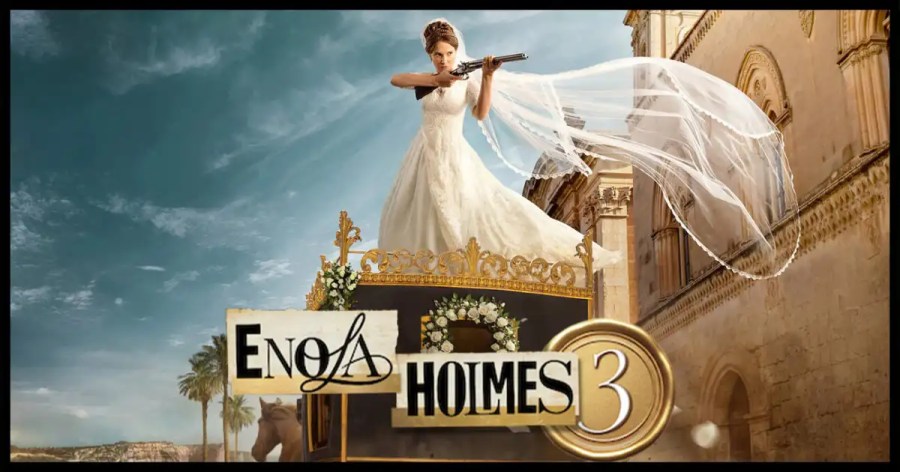
Quick synopsis: Enola is in Malta about to be married when Sherlock goes missing, leaving a mystery to be solved.
I didn’t see them the year of release, so I didn’t review them, but I have seen the other two Enola Holmes films and enjoyed both of them. But I’d definitely fail a quiz on them. I’d be able to answer the names of a few of the actors, and even fewer of the characters (I know Susan Wokoma was in the first two, but can’t remember who she was). I could remember the essence of the movies; a spirited Holmes sister, Sherlock as the more respected older brother, etc. I did enjoy them, but nothing was that memorable. It may not be the case at the moment due to how recently I’ve watched it, but I’m guessing Enola Holmes 3 will continue that tradition.
Enola herself remains a great character. I almost wrote that she feels like the kind of character I would write, but then realised how unbearably smug and self-indulgent that would sound, so instead I just threw in this sentence explaining it, which is definitely much less smug. There’s just something about her that clicks. Intelligent without being annoying, resourceful without coming off as McGuyver, and with a sense of curiosity that is endearing in the extreme. We’re so used to intelligent people being dickheads in media that it’s refreshing to see a character who balances their intelligence with warmth.
A lot of that comes down to Millie Bobby Brown. She has a sense of playfulness that’s more infectious than COVID, elevating every scene she’s in. There’s a charm to her performance that’s almost impossible to dislike. I had a weird thought whilst watching this; she belongs in either the Paddington movies or Doctor Who. She has the sense of sincerity and weirdness for the former, and the eccentric wit for the latter. She must have been asked, surely? If not, then I wonder what the hell the writers of those franchises are doing besides counting their money. That comes off really negative now I think about it. Truthfully, I love the Paddington franchise, and I really enjoyed Doctor Who up to a point.
One structural decision I wasn’t entirely convinced by concerns Enola’s own history. The recurring “who we are” reflections about her identity and upbringing feel like they belong at the beginning rather than emerging later. As an opening narration, they would have grounded both returning viewers and newcomers, establishing the emotional framework before the mystery begins. Instead, they arrive piecemeal, making them feel slightly less impactful than they might otherwise have been.
Where the movie surprised me most, though, was its politics. The spectre of colonialism hangs over almost every aspect of the story, and to the film’s credit it never treats that history as background decoration. Instead, it confronts Britain’s imperial legacy directly. This isn’t one of those adventure films that borrows exotic locations while politely ignoring how Britain came to be there in the first place. It repeatedly forces its characters, and by extension the audience, to reckon with uncomfortable truths. If this were part of a gigantic blockbuster franchise with an even larger online profile, I suspect it would become the latest target for the usual culture-war bullshit. You can almost imagine certain public figures dismissing it as “woke” simply because it acknowledges historical reality. But the film isn’t preaching so much as recognising that these conversations are impossible to avoid when telling stories rooted in the British Empire.
One line in particular genuinely stopped me.
“We saw it as advanced reparations.”
It’s an astonishing sentence because it sounds simultaneously absurd and entirely believable. It’s exactly the kind of bureaucratic moral gymnastics that powerful institutions have always employed to justify exploitation. The horror isn’t that someone says it; it’s that history (and the present) is full of people who almost certainly would have. Another line lands with equal force:
“The Empire cannot admit guilt.”
For me, that’s the film’s thesis. It’s not simply a statement about Victorian Britain but one that echoes into the present day. Britain still struggles to have an honest national conversation about empire. Public memory often celebrates exploration, trade and victory while quietly stepping around conquest, extraction and violence. The refusal to acknowledge wrongdoing isn’t confined to history books; it’s woven into parts of the national psyche. Whether audiences agree with that interpretation or not, the film deserves credit for provoking the discussion instead of pretending it doesn’t exist.
That’s perhaps what impressed me most about Enola Holmes 3. Beneath its lively detective story, witty dialogue and charismatic performances lies a willingness to engage with genuinely difficult ideas. It never forgets that it’s an entertaining mystery, but neither does it shy away from asking what Britain inherited alongside its myths.
I still don’t know whether this franchise will become one I’ll revisit endlessly, but unlike its predecessors, this instalment has stayed with me for a little while. Not because of a particular mystery or plot twist, but because of the questions it asks and the confidence with which it asks them.
That’s a far more lasting achievement than simply solving another case.


