
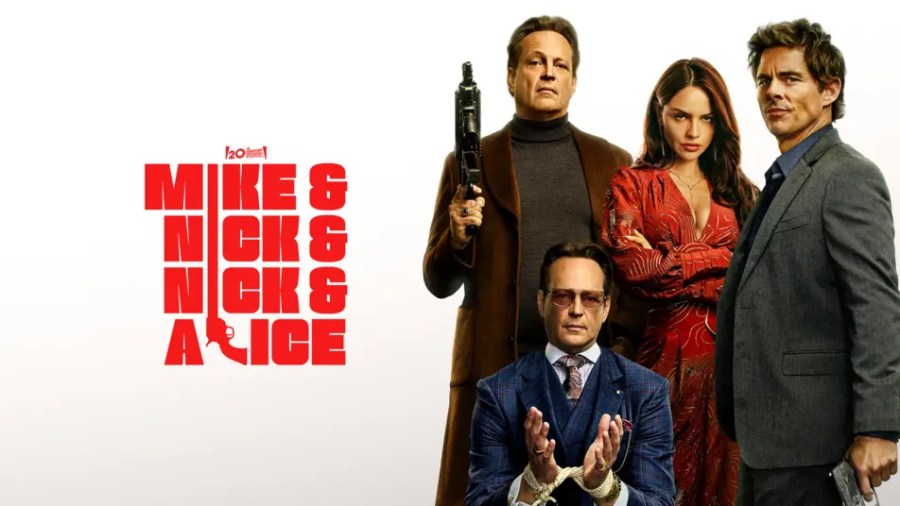
Quick Synopsis: When a mobster uses a time machine to save his best friend from a deadly night, two versions of himself, a dangerous criminal conspiracy, and the woman they both love collide in a chaotic race to rewrite fate.
Mike & Nick & Nick & Alice (or M&N&N&A, pronounced *deep breath* Mandnandnanda) is a weird movie. Mainly because of how normal it is. You’d expect an action-comedy based around time travel would be weird and feature set-pieces and moments which you’ve never seen before, but it doesn’t. So whilst it is original, it does feel kind of like it’s wasted the premise. 90% of what happens in M&N&N&A could happen in any other film, and most of the remaining 10% could be very quickly rewritten to make sense in a standard film. I mean, this is a time travel action movie, and my first draft didn’t even mention the time travel aspects; that’s how little they actually matter. There’s very little discussion of paradoxes or any of the other stuff you expect from movies about the subject.
Wasted potential aside, it is fun. Vince Vaughn is clearly having a blast, but he is hampered by there only being a six-month gap between the two Nicks, so in terms of personality they’re very similar. I also have another issue with Nick’s character. The film states that he and Mike used to be really close. But the way they interact before we’re told that wouldn’t lead you to think that. They interact almost like strangers, and not in a “we have nothing to say to each other anymore, and it’s awkward” way.
On the subject of cast, James Marsden is good at what he does, but he does need to start adding a few more tools to his arsenal, or at the very least take on more diverse roles than what he’s currently doing. He’s not helped by how bland Mike is as a character. Nick, you can imagine Nick outside of this movie; there’s enough there to base a short story around him. Mike? You’ve got nothing to go on. He’s so bland he feels like the default protagonist in a poorly made GTA clone. Eiza González is good (but Alice is sorely underused, often treated more as a prop than a character), with great chemistry with Marsden and Vaughn. Keith David? Well, it’s always nice to see Keith David in things. He elevates everything he’s in.
Using Sheena Easton to soundtrack a fight scene is a great touch. It’s playful, unexpected, and fits the film’s offbeat sense of humour perfectly. That being said, the “action scene set to a country song” has become a bit of a cliché. It feels like every other crime film or action comedy has one now, and the novelty has definitely worn off. It’s the action version of “Horror film trailer set to a slowed-down female vocal cover of a pop song”. At this point, I’d happily support a moratorium on country-song action montages for a few years until they start feeling fresh again.
One thing that stood out was the conversation about Gilmore Girls. It’s such an oddly specific topic for characters to get into in the middle of a dangerous situation, and that’s exactly why it works. It’s almost Tarantino-esque; all it’s missing is superfluous n-words and shots of the actresses’ bare feet. I can understand why some viewers might find scenes like this frustrating, arguing that the characters are too nonchalant considering there’s a mob boss actively trying to kill them. But I never got that impression. The threat is always lingering beneath the surface, influencing their decisions even when they’re talking about something completely mundane (well, as mundane as the end of a relationship can be). It feels less like they’re ignoring the danger and more like they’re coping with it however they can. These are also characters who’ve spent a lot of time around violence and death, so the possibility of being murdered isn’t exactly a new concept to them. Their casual conversations feel like a believable defence mechanism rather than a lapse in the writing.
The playful dialogue doesn’t always work, though. There’s a scene in a convenience store that’s ridiculously dumb, featuring a store clerk dismissing the very notion of “sugar-free candy”. Even if, technically, candy has sugar, you’d know what they meant. It’s like saying, “Vegan sausage rolls can’t exist because sausage is meat. Idiot”, technically right, but overly pedantic, and you’d have to be an idiot to argue it. Mike not being aware of what chloroform is also feels like something that a real person wouldn’t say, especially considering his line of work.
The action scenes are fine, occasionally bloody, sometimes fun. But there’s nothing that stands out, nothing that you’d look at and think “oh, now that’s cool”. Not everything has to be John Wick, but I saw this film less than a week ago, and no action scenes have stuck with me.
The emotional high point is the group singing Oasis to a dying Nick. It’s an unexpectedly sincere moment in a film that’s otherwise full of jokes and criminal chaos, and it’s genuinely quite touching. Unfortunately, the scene slightly undercuts itself because Nick’s death takes just a little too long. The emotional impact starts to fade as the moment stretches on, and what begins as heartfelt edges towards awkward. Had it been trimmed, it probably would have landed much more effectively.
That sums up this movie. It keeps showing glimpses of greatness. With clever dialogue, flashes of invention, and occasional bursts of inspired action. But then it walks back that greatness with jokes that rely on inexplicable stupidity, or scenes that take one good idea and stretch it just a little too far (again, the sugar-free candy bit). Ultimately, it feels like a blockbuster. By which I mean, a movie you’d rent from Blockbuster back when they were still a thing.


