
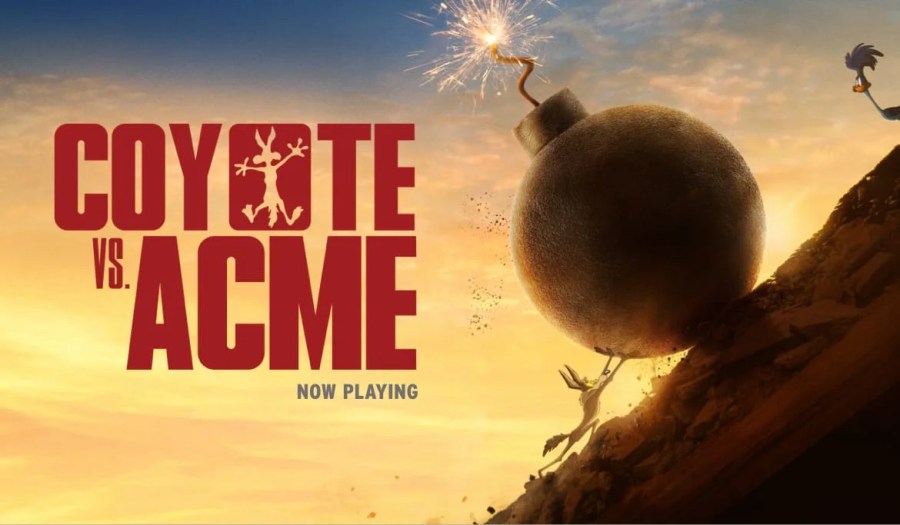
Quick Synopsis: After years of failure, Wile. E Coyote decides to sue Acme over their products failures to aid him in eating a bird.
In the last few years, it’s become increasingly obvious that people judge films by their context. I try to avoid doing that in my reviews; I think a lot of films that are negatively reviewed and dismissed as “woke” are films nobody would have been particularly bothered by if they’d been released before the Internet Bad Times. But sometimes context is impossible to ignore. It’s difficult to enjoy a film if you can’t separate the actor from their sex crimes. Similarly, part of my dislike for Ella McCay was that I thought it was socially irresponsible to make a film about US politics in 2025 and have it be utterly toothless. I’m mentioning that for two reasons: 1) to fill my word count (which doesn’t matter because I don’t have a prescribed word count; it’s just “write until I run out of ideas”); and 2) because the context of CvA’s release is vitally important.
For those unaware, the film was completed in 2023, then Warner Bros. cancelled it for tax reasons/because they’re assholes (my editor made me refrain from using the c-word there, but in my opinion it would be fully deserved), alongside Batgirl and Scoob! Holiday Haunt (although the latter two were still in post-production). Clearly, WB decided to focus on high-quality films that would enhance their reputation. Films like Joker: Folie à Deux, Beetlejuice Beetlejuice (the film that redefined how to do a sequel to a film where one of the main characters is a paedophile, and that’s not a compliment), and the nepo-film of the century, Trap. The decision was baffling, especially since early reviews were positive. Highly so, in fact. Some people were even calling it one of the best animated movies in recent memory. CvA was eventually saved by distributor Ketchup Entertainment, to the relief of everybody who likes good movies (so, presumably, nobody who works at Warner Bros.).
So it’s fair to say expectations were high. Does it meet them? Early reviews indicate yes. But those are professional reviewers; I’m not. I don’t give a shit about a lot of films that “proper” reviewers care about, and there are plenty of times when our opinions differ.
Not here though. CvA is a joy. It put me in mind of Who Framed Roger Rabbit? but with fewer scenes that will traumatise you or turn you on. It’s genuinely heartwarming at times. It’s not exactly a complex movie, but there’s considerably more going on beneath the cartoon chaos than you’d expect. Beyond the obvious cartoon stuff, there’s a story about the dangers of corporate capitalism, what makes a conscious being deserving of rights, and the tragic tale of Sisyphus. That’s not exactly surprising, though. People have this misguided idea that Shrek was the first kids’ movie that had higher concepts and jokes for adults to understand, yet Looney Tunes has been doing that kind of thing for years. Bugs Bunny has been a lot of people’s first introduction to classical music for decades. Bugs Bunny wasn’t sitting around waiting for Shrek to show up and give him permission to be funny to adults. Looney Tunes has always been perfectly happy to put something ridiculous in front of children while also slipping in references that they’re not expected to understand. CvA feels like it actually understands that rather than trying to replicate the formula of modern animated films and occasionally putting a fart joke in to prove it’s still fun.
That attitude is why CvA is not just a great kids’ movie, but a great movie. I say that having looked around the screening and realised how many childless adults were there. It wasn’t exactly a cinema full of parents being dragged along by their children; there were a surprising number of us who had apparently chosen to spend two hours watching Wile E. Coyote sue ACME entirely of our own free will. CvA works because it operates under the assumption that kids aren’t idiots, while recognising that parents are the ones buying the tickets and need to be entertained too. Crucially, it’s not cynical; there’s no dark mysterious undertone. It’s also not ashamed of being a Looney Tunes movie. There’s a tendency with some films based on properties like this to make them too self-aware or retcon everything to make them darker. CvA just lets the characters be themselves. The closest it gets to a Cerebus-style reinterpretation is implying that Daffy Duck’s behaviour is because ACME drove him mad.
The film does expand the characters, though. That’s to be expected with the increased runtime. Coyote is no longer a two-dimensional villain. The character has spent most of his existence being defined by one thing: trying to eat the Road Runner. That’s basically it. He’s not exactly Tony Soprano in terms of character development. Giving him a proper personality works, and you actually feel sorry for him. He’s been repeatedly sold products by ACME that are either defective or catastrophically dangerous, and rather than anyone asking why the company is allowed to continue operating, everyone just accepts that Wile E. is an idiot. At some point you have to wonder whether this is actually a Road Runner problem or whether the coyote has just been the victim of one of the longest-running corporate scams in history. He’s sympathetic, vulnerable, and, importantly, he’s allowed to be right. There’s an actual injustice here. Watching Coyote fight against injustice adds a lot of emotional weight, more than you’d expect from a film based on short films where the punchline was usually “gravity”.
The performances? John Cena is perfect for stuff like this. His comically serious demeanour suits the ridiculousness of the film. I mean, he’s basically a cartoon anyway. Surprisingly, Will Forte brings the drama. More so than I expected. He seems genuinely beaten down by life, almost as if he’s spent decades pushing a boulder up a hill only to watch it roll back down again. He adds a sincerity to Coyote that would otherwise be lacking. I kind of loved Lana Condor. This is the third film I’ve seen her in this year, and the first one I’ve positively reviewed. She shows a warmth that was missing from the previous films. She wasn’t in it long, but I loved Kristen K. Berg as the court reporter. She kind of reminded me of Sarah Baker.
Those performances are helped by the script. It’s incredibly sincere. Beneath the standard cartoon jokes, there’s a story about someone being told his suffering doesn’t matter because of who he is. Not many animated films tackle this kind of complex philosophical debate, and even fewer would do it at a time when we’re increasingly likely to have debates about whether robots deserve rights while still denying those rights to people who are non-white or part of the LGBTQ+ community. It’s not the main thesis of the film, but it does underlie a lot of the characters’ motivations and narrative choices.
It’s also surprisingly anti-corporate. ACME is exaggerated, but compared to companies in the real world, not by that much. In-universe, ACME is a company that can sell you something that kills you through negligence, then refuse to accept responsibility. Meanwhile, in the real world, aircraft manufacturers can ignore safety concerns which lead to the deaths of hundreds of people, and have their main punishment be a fine that’s a fraction of the money saved by ignoring those concerns. It’s not exactly subtle, but in modern times we need stuff that’s unsubtle.
That depiction of large corporations has only become more relevant when you consider how Warner Bros. treated the film. It’s a film about a corporation screwing over an individual because it has enough money and power to do so. The film itself was nearly denied an audience because a massive corporation decided it was financially more convenient to make it disappear. I’m sure somebody at Warner Bros. has already explained why this isn’t ironic. I’m also sure their explanation involved the words “strategic” and “content”, which means I don’t want to hear it. Their actions only made the message of the film feel more relevant. It’s like when a guy argues he’s not violent, and if you say he is, he’ll punch you in the face.
That’s probably why the emotional stuff works. Underneath all the jokes, this is a story about somebody who has spent his entire life losing and finally deciding that he’s had enough. It’s not particularly complicated, but it doesn’t need to be. Sometimes a simple story works better than one with twelve twists, three cinematic universes and a post-credits scene teasing a spin-off that nobody asked for.
The Sisyphus references are obvious, but they’re also explained in case you’re not too familiar with Greek mythology. There will be people who learn about that tale through this movie. Whilst also learning how corporations suck. What more could you want from a film like this?
Even without the background noise of its production and release, this is still worth paying attention to. The early reviews were right. Annoyingly, sometimes critics actually know what they’re talking about. Coyote vs. Acme is great. Not “great considering it was almost cancelled”, not “great for a film based on a cartoon”, and not “great if you’re a fan of Looney Tunes”. Just great. It’s funny, it’s surprisingly sweet, it has more going on beneath the surface than I expected, and it manages to make a film about Wile E. Coyote suing ACME feel like a completely reasonable thing to spend two hours watching. The biggest problem with the film is therefore also the biggest problem with its release: I wish I’d been able to watch it sooner. Warner Bros. spent years sitting on a film that people actually wanted to see, while releasing films that made plenty of people wonder whether they’d accidentally walked into the wrong cinema. I don’t know what the exact financial calculations were, and frankly I don’t care. I’m a film reviewer, not an accountant. If your decision means I get to watch Trap instead of Wile E. Coyote suing ACME, I think I’m entitled to conclude that somebody, somewhere, has made a terrible mistake.
It’s not often that I finish a film about a cartoon character whose primary achievement is repeatedly running into walls and think, “That was considerably better than it had any right to be.” But here we are. And after everything this film went through just to be released, perhaps Wile E. Coyote finally got the one thing he’s been trying to get his entire life.
A win.

