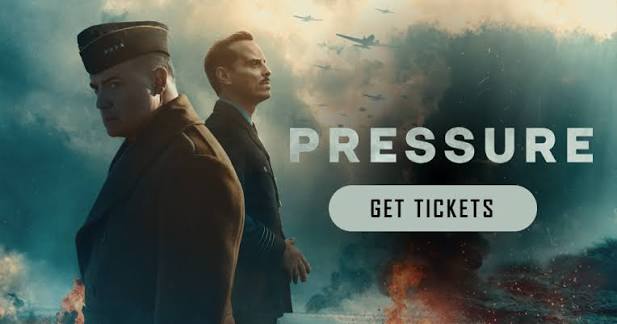
Quick Synopsis: The massive Allied seaborne invasion of Normandy is completely prepared, but one vital detail remains unconfirmed: the unpredictable British weather
People talk about superhero fatigue. They say audiences are fed up with superhero movies, and that’s why the MCU has gone slightly downhill in the last few years (nothing whatsoever to do with a lack of planning whilst trying to plan out a multi-film saga). I get it. Going to another movie where people in costumes make quips between punching people in the face can make you feel like you’re living in a cinematic Groundhog Day. I have something similar: I’ve seen too many World War 2 movies. If I put together all the films I’ve seen about the war in one continuous playlist, it would probably end up being longer than the war itself. I know there are lots of stories to tell about that war: nationalism, pride, heartbreak, humanity. But those stories could be told against the backdrop of almost any war. Personally, I think part of the reason filmmakers keep returning to World War 2 is that it’s one of the few wars with an unambiguous villain, one that was conveniently distinctive enough to give filmmakers a visual shorthand that audiences instantly recognise.
A big reason I’ve grown tired of World War 2 films is their predictability. It’s hard to find tension when we know what’s going to happen. That hurts films like Pressure, because we already know what happened; it’s like watching a football game where you already know the score. Although I should point out, for a film that relies so heavily on us knowing the significance of D-Day, it doesn’t actually do much to explain what D-Day was in the first place. But back to the point. We know how it ends; D-Day was a success. So either their weather predictions were wrong, and the attack was launched anyway, or they were right, and it didn’t matter. The film can make me worry about the weather, but it can’t make me worry about D-Day.
That’s an issue I’m not really sure how you get around as a writer. You can tell that Pressure is trying, though, by adding interpersonal conflicts and a possibly dead wife. The interpersonal stuff works well because, unlike D-Day itself, we don’t know what’s going to happen. Does his wife give birth? Do the different countries start to respect each other? We don’t know, and we need to watch the film to find out. It’s a small moment, but it adds so much. That’s probably the smartest thing the film does. If it can’t make me wonder whether D-Day will happen, it can at least make me wonder what happens to the people who are trying to make it happen. The problem is, the film is fighting against history itself. You can put as many arguments, disagreements and personal dramas between the characters as you want, but there’s still a giant historical event looming over everything, telling us roughly how this story ends. Weird to say, but sometimes the biggest problem with history is that we’ve already seen the ending.
That doesn’t make Pressure a bad film. Far from it. The performances are solid, and the film does a good job of making something as potentially boring as weather forecasting feel important. Plus, the pacing is surprisingly good. Even though the whole thing is basically men looking at charts, it never feels slow or boring. Even though, as I said, it’s predictable, that doesn’t mean I wasn’t invested in the characters throughout. I knew what would happen, but I never wanted to leave the room.
As for the performances, there’s not a weak link here. Andrew Scott proves his leading-man chops, although his character is a bit too similar to the sort of roles his Sherlock co-star Benedict Cumberbatch often plays. I’m glad Brendan Fraser’s comeback is continuing; he’s finally getting the kinds of roles he deserves. He’s become an actor who can bring real gravitas and emotional weight to these kinds of roles. He throws himself into it, giving the character the emotional weight the role requires. Surprisingly, I found the best performer to be Kerry Condon. I’ve previously seen her in the MCU (hey, I’m referencing Marvel again) and the haunted swimming pool movie Night Swim. She’s much better in this, giving a performance that carries the historical weight of the story. Her character is basically a side character, but she’s so important to resolving the interpersonal conflicts that you wouldn’t be surprised if the film ended with her winking and floating into the sky with angel wings. Although that may have hurt the historical accuracy.
In terms of directing, Anthony Maras does a decent job. But this is another World War 2 film, and visually, it suffers from the same problem I’ve had with so many others: it all looks incredibly familiar. The storms themselves look dangerous; even the biggest idiot wouldn’t sit there thinking, “but it’s just a bit of rain”. We don’t see a lot of battle scenes; this isn’t that kind of movie. But the ones we do see are horrific, with none of the violence presented as glorious. The scenes of people being shot down en masse are deliberately ugly.
I didn’t know anything about Exercise Tiger. I was much more invested in the brief moments covering it than I was in the D-Day landings. That’s probably because I didn’t know the outcome. There’s something refreshing about being given a piece of history where I can’t sit there mentally ticking off the things I already know are going to happen. It’s the only part of the film that made me sit up and pay attention, because for once I felt like I was actually learning something.
Unfortunately, Pressure can’t completely escape the shadow of the event it’s building towards. It’s essentially a film about whether the weather will allow D-Day to happen, even though we already know that D-Day happened. That’s a pretty sizeable spoiler sitting in the room, and unfortunately it’s wearing a swastika. Still, there is enough here to make Pressure worthwhile. It’s well acted, competently directed, and somehow manages to turn meteorological data into something resembling a thriller. That’s quite an achievement when you consider that the main antagonist is essentially the British weather.
I just wish it had given me a little more of something I hadn’t already seen.
Maybe that’s my own problem. After watching this many World War 2 films, perhaps I’ve developed my own version of superhero fatigue. I don’t need another film to remind me that war is horrible, that ordinary people were put in extraordinary situations, or that the Nazis were bad. I know. I’ve got the message. You can stop giving me the pamphlet. What I do want is a story that makes me curious. Give me the weird little corners of history. Give me the events I’ve never heard of. Give me the people whose stories haven’t already been turned into three films, a miniseries and a prestige television drama. Pressure comes close to that. The weather forecasting gives it an unusual perspective, and the cast makes it easy to spend time with these characters. But ultimately, it is still another film standing on the beach at Normandy, pointing at something I’ve already seen coming from miles away. Plus, the omission of Sverre Petterssen’s work means the film isn’t even as useful as a history lesson as it could have been.
It’s good. It’s interesting. It’s well acted. But I think I’ve finally reached the point where, whenever I see another trailer for a World War 2 film, my only thought is, “Haven’t I already seen this?”