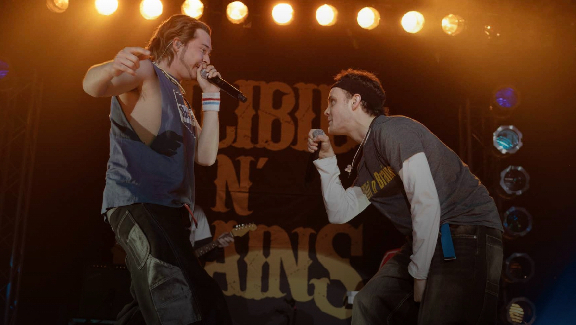
Quick Synopsis: The true story of how two men from Scotland convinced the music industry they were American.
This is unfortunate. If I reviewed California Schemin the same day I saw it, or even the next day, it would have been highly praised. It’s now been 3 days, and my feelings towards it have lessened. It’s not that I now dislike it; I’ve suddenly thought of things I hated about it, or it turns out someone involved is a sex pest. I don’t harbour any dislike towards it, but the warmth I have towards it is no longer at the same level.
It’s still good, though. It’s incredibly funny. It’s a concept that is ridiculous, but it leans into it. There’s a general air of “I can’t believe this happened” The music industry does not come off well. It comes off as shallow, stupid, and callous. I’m not exactly sure what is real, though. There are some parts I know happened differently due to extensive research (I quickly looked at the band’s Wikipedia page), but I’m not sure about the truth of everything. There is a documentary available on Netflix that I’ll watch, and then use that to ascertain where this film ranks at the end of the year.
But that’s viewing it as an adaptation of the truth; on its own merits, it stands up. Key to this is the relationship between Billy, Gavin, and Mary. The relationship between the three feels very honest; their reactions with each other all ring true. It helps that they have tremendous chemistry. You can sense the closeness between the characters. Seamus McLean Ross has one of the most difficult jobs: making the journey from a nervous, likeable wannabe to egomaniacal douche, but staying consistent throughout. You can easily see how this character makes that transition, looking back, all of the character traits that become visible later on, the jealousy, the anger, the entitled nature? The seeds are planted very early on, so his descent into darkness actually makes sense. Even when he’s at his worst, you still feel sympathy for him because you know that under all that bravado is still the scared, insecure person we saw at the start of the movie. For some reason, the whole thing reminded me of a wrestling angle, and I still have no idea why. But now I want to start a project where I rewrite classic films as wrestling angles.
On the downside, it could do us more to sell the illusion. We see how the band responds to it, we see how Mary responds to it, we don’t see how others do. It would have been nice to see media attention; journalists writing about them, fans saying how excited they were by the gig. John Malkovich’s character in Opus felt more real than the characters do in this. I know they didn’t exactly get front-page headlines and number-one singles, but enough people were fooled to make it notable.
I also feel it ended a bit suddenly. One of the characters attempts suicide near the end, and it’s never really touched upon. His former manager comes to see him, but his former best friend (and his sister) never acknowledges it. Are they aware? We don’t know. They only see each other once afterwards, and no words are spoken; they just stay whilst he sings a song apologising. It feels like there was a heart-to-heart between the characters that’s missing from the script.
In summary, this is delightful. More than anything else, it will make you want to know more about the real story. As a director, it won’t be enough for James McAvoy to be known as one of the best directors in the world, but it is a remarkably solid base for him to build a career on. He’s not going to be handed the reins to a new blockbuster franchise, but it will put him in the discussion when it comes to dramas and comedies.

