California Schemin’ (2025) Review

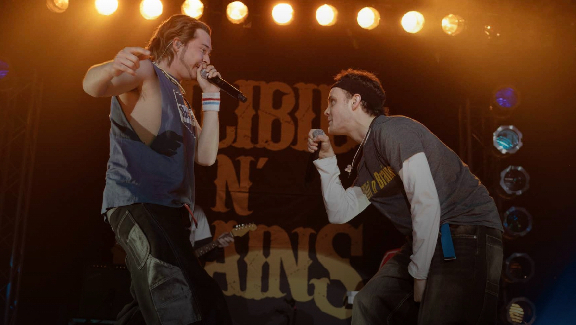
Quick Synopsis: The true story of how two men from Scotland convinced the music industry they were American.

This is unfortunate. If I reviewed California Schemin the same day I saw it, or even the next day, it would have been highly praised. It’s now been 3 days, and my feelings towards it have lessened. It’s not that I now dislike it; I’ve suddenly thought of things I hated about it, or it turns out someone involved is a sex pest. I don’t harbour any dislike towards it, but the warmth I have towards it is no longer at the same level.

It’s still good, though. It’s incredibly funny. It’s a concept that is ridiculous, but it leans into it. There’s a general air of “I can’t believe this happened” The music industry does not come off well. It comes off as shallow, stupid, and callous. I’m not exactly sure what is real, though. There are some parts I know happened differently due to extensive research (I quickly looked at the band’s Wikipedia page), but I’m not sure about the truth of everything. There is a documentary available on Netflix that I’ll watch, and then use that to ascertain where this film ranks at the end of the year.

But that’s viewing it as an adaptation of the truth; on its own merits, it stands up. Key to this is the relationship between Billy, Gavin, and Mary. The relationship between the three feels very honest; their reactions with each other all ring true. It helps that they have tremendous chemistry. You can sense the closeness between the characters. Seamus McLean Ross has one of the most difficult jobs: making the journey from a nervous, likeable wannabe to egomaniacal douche, but staying consistent throughout. You can easily see how this character makes that transition, looking back, all of the character traits that become visible later on, the jealousy, the anger, the entitled nature? The seeds are planted very early on, so his descent into darkness actually makes sense. Even when he’s at his worst, you still feel sympathy for him because you know that under all that bravado is still the scared, insecure person we saw at the start of the movie. For some reason, the whole thing reminded me of a wrestling angle, and I still have no idea why. But now I want to start a project where I rewrite classic films as wrestling angles.

On the downside, it could do us more to sell the illusion. We see how the band responds to it, we see how Mary responds to it, we don’t see how others do. It would have been nice to see media attention; journalists writing about them, fans saying how excited they were by the gig. John Malkovich’s character in Opus felt more real than the characters do in this. I know they didn’t exactly get front-page headlines and number-one singles, but enough people were fooled to make it notable.

I also feel it ended a bit suddenly. One of the characters attempts suicide near the end, and it’s never really touched upon. His former manager comes to see him, but his former best friend (and his sister) never acknowledges it. Are they aware? We don’t know. They only see each other once afterwards, and no words are spoken; they just stay whilst he sings a song apologising. It feels like there was a heart-to-heart between the characters that’s missing from the script.

In summary, this is delightful. More than anything else, it will make you want to know more about the real story. As a director, it won’t be enough for James McAvoy to be known as one of the best directors in the world, but it is a remarkably solid base for him to build a career on. He’s not going to be handed the reins to a new blockbuster franchise, but it will put him in the discussion when it comes to dramas and comedies.

Queen Of The Ring (2024) Review

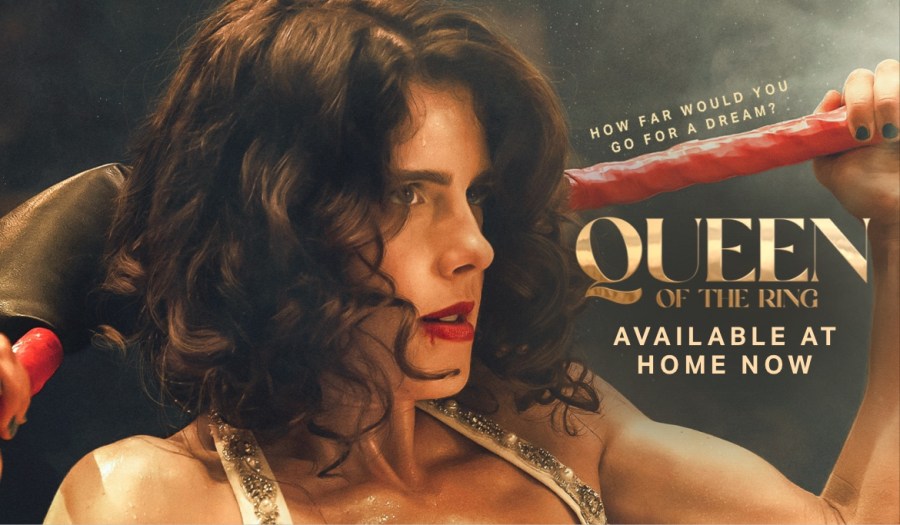
Quick Synopsis: The tale of Mildred Burke; those who know, know why she’s important. Those who don’t? Prepare to find out.

I know a little bit about Mildred Burke, I could probably BS my way into a small essay about the impact she had on professional wrestling, as long as I kept some details incredibly vague, especially when it comes to names and dates. But I will always watch a film about professional wrestlers, mainly because it attracts such weird personalities. In what other performance medium could you have a lottery winner buy their way in and then later die whilst running around a hotel covered in baby oil and carrying a baseball bat, and not have it be one of the most iconic stories? So really, I’m the perfect audience for this. I will understand the basics, but won’t know the exact details, so I’ll still be surprised.

I’m not sure how this will fare with non-wrestling fans. On the plus side, it explains the wrestling business well; its history in relation to the carnival circuit is something that a lot of films about the subject overlook. I hope this becomes the biggest film ever because then it will seem normal when I use the phrase “heel turn” in reviews (there’s really no better phrase). On the downside, it could have done a better job of explaining who some people were. It feels like it expects you to know who some people are based on context, waiting far too long to name on. I know the NWA and the territory system, but a lot won’t, and the lack of knowledge about that could also hamper some people’s enjoyment. Even with that in mind, I think there’s still enough here for non-fans to be interested and to learn. That’s based on my assumption that this is accurate. Considering Jim Cornette is involved, that’s a pretty safe assumption as he’s notoriously respectful of classic wrestling.

There are really only two moments where I felt my being a fan changed my perception a lot. One, it’s fascinating to see a representation of a younger Mae Young. I’m used to her being in her 70s and still being tougher than a burnt stake, so it’s interesting to watch a time period where she had the body you’d expect someone with her physical resiliency to have. The other one is one I’m possibly wrong about: the racially mixed crowds, I know that was still illegal in some parts of the country, it’s why the work of Sputnik Monroe and his efforts to desegregate the audiences in 1957 were so controversial., so there’s a chance that was bad choice, but I’m willing to be told I’m wrong, and I probably am.

One thing that is clear to everyone: Mildred Burke really got screwed over. I wish she had got her flowers while she was alive. Her story is iconic; what she did was something that cannot be overstated (despite the best efforts of some people). I thought this was surprisingly fair in how it dealt with controversial characters. It openly states, “Despite his many flaws, Billy Wolfe helped popularise women’s wrestling”, see THAT’S how you do it. He was a complete prick, but he did change women’s wrestling for the better, so there’s no turning him into a cartoonish villain or diminishing his efforts.

I thought her time in Al Hoft’s territory went by too quickly in the film. She goes from unknown to headliner way too fast, and the montage isn’t good enough. But if it went slower, then it might have caused a bigger gap between the explanation of what a “shoot fight” is, and one actually occurring, so I can see why it was done that way. That’s what most of my criticisms are, just small imperfections that stop it from being great; scenes which feel needless (the shoe-horning of Vince McMahon Sr feels weird), the way some characters you’d feel are important are neglected, and how for a lot of events we’re not really given enough context to understand WHY certain things are big deals.

There’s a really small moment which I liked; she was showing off her skills, beating a random guy, and a tiny girl flexed her muscles nearby, showing the influence she was having. There’s no “and that little girl grew up to be……”, it helps emphasise how important role models are to everyday people.

The performances? They’re hard to fault. Emily Bett Rickards is in great shape. Weirdly, she looks tougher than some of the actual wrestlers cast in the movie. Josh Lucas is a suitable mix of charming and scummy. Due to the way characters revolve in and out of the narrative, it’s hard for many of them to leave an impression, but none of them are negative, so that’s a plus.

One thing I didn’t expect to find myself enjoying so much was the music. It’s mostly new songs, but with an old-fashioned feel to them, like modern takes on old tales. Which is thematically perfect for this story. This feels like the perfect time for a movie like this to be released, and I’m glad it was. I had to watch it on Amazon, but I’d have absolutely loved if I got a chance to see this at the cinema. Ah, well, maybe in 10 years, when it becomes a cult classic. I’d love Avi Avildsen to take a chance on some of the other characters. I trust he’d do well with telling the story of Gorgeous George, Fabulous Moolah, or Ethel Johnson. But seeing as those stories are unlikely to be told, we’ll have to settle for this one brilliant one.

The Thursday Murder Club (2025) Review.

Quick Synopsis: Four retirees spend their time solving cold case murders for fun, but their casual sleuthing takes a thrilling turn when they find themselves with a real “who has done this” on their hands

It’s possible I did The Thursday Murder Club (TTMC, pronounced Ta-too-muk) in the wrong order; I watched the film, read the book, then I wrote the review. In some ways, this did help, as most of the casting is pretty spot on and easy to imagine. However, the film makes some things difficult to unsee, one of which is the size of the building. In the book, it’s almost normal, yet in the film? It basically looks like Downton Abbey. This wouldn’t be a problem for most films. But for this? It does bring out the worst aspects; the middle-class tweeness of the whole thing. The feeling that it’s watched by people who spend half their conversations going “I miss the old days when people weren’t so black”.

It’s a shame, as that does a disservice to TTMC. Yes, I expect it to pale in comparison to Wake Up Dead Man when that comes out, but that’s not for a while, so TTMC has a few months of being the best murder mystery film of the year. It’s a pretty good mystery too, especially once you realise that they’ve completely gutted a sub-plot from the boo,k which means they’re either going to change the murderer or change their motivation, otherwise the motivation will be “he’s responsible for this awful thing that nobody has decided to mention for some reason”.

Like all good mysteries, the solution seems incredibly obvious once you’ve figured it out. The clues make sense, and it is possible to make an educated guess before the solution. In fact, I’d say it’s TOO easy. There aren’t enough suspects. The book has quite a few characters who you could easily imagine being the killer. The film has around two. I know stuff has to get cut when you adapt a book, but removing suspects from a murder mystery feels like shooting yourself in the face and leading a bloody corpse (I’ve just been informed the phrase is actually “shooting yourself in the foot”).

The deletion of some of the subplots also means a key scene in the book (and the film-makers obviously realise its importance when you see who they cast for this one scene) is rendered as nothing more than a diversion, albeit a quite entertaining one. That’s the film in a nutshell: not essential, but damn charming and entertaining. It’s the cinematic equivalent of a lovely drive through the country. Really, this is perfect for Netflix, and is probably the best film they’ve released this year.