
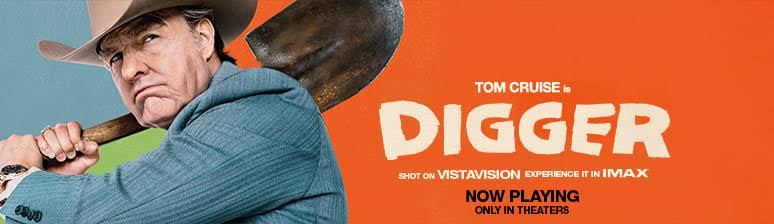
Quick Synopsis: An eccentric oil tycoon scrambles alongside the US President and a brilliant scientist to spin the narrative and position himself as humanity’s savior after a catastrophic explosion at an Arctic oil field triggers a massive ecological crisis.
Film reviews can be many things. Some writers treat them as deep analysis, poring over every frame and judging it against the masterpieces that came before. Others use them as an excuse to push a political agenda, declaring any film which features a non-white lead to be “woke”. I do neither. I don’t have the patience to treat my reviews as serious analysis, and I couldn’t give a shit about a film being “too woke”.
I treat every review I write as an opportunity to do two things: write dumb jokes and answer the simple question, “Should I watch this film?”
Which makes it rather tricky to talk about Digger.
I was astounded by what I saw. The performances are good, the film is very funny, and it has an important message. I know for a fact I’ll watch it again. But as soon as I came out of the cinema, I messaged some people who hadn’t seen it to ask what they thought. They told me they were wondering whether they should watch it.
Despite all my positive feelings towards this film, all I could reply was, “Maybe not.”
I’ve mentioned before how some films fail to win me over, yet are still relatively easy to like. Digger is the opposite. I bought what this movie was selling, but I recognise it’s a very easy film to hate. It’s pretentious, the colour grading seems designed to be actively off-putting, and there’s a very important part of the story that wasn’t even hinted at in the trailer. A part that WILL put people off.
It’s hard to talk about that moment without spoiling things, so this will probably be the paragraph I rewrite the most. I can talk about how it affected my viewing experience, though. Essentially, it made everything that happened feel inconsequential, as if nothing in the movie had any actual consequences. There are times when it feels like this particular storytelling device exists primarily to transition between scenes more smoothly, rather than serving any meaningful purpose of its own.
The cast? They’re fine. The trouble is, everyone is ACTING! Which makes it difficult to see them as anything other than caricatures. I understand that’s the point, but much like my feelings about performances in Wes Anderson films, just because I understand the reasoning behind those performances doesn’t mean I agree with it.
The humour will also be divisive. At times, it’s very funny. At others, it feels like it’s trying too hard, with everyone involved seemingly determined to tell you it’s funny in the hope that you’ll believe them. Essentially, it’s a Saturday Night Live sketch at times, complete with loud noises. When the jokes work, they’re brilliant. When they don’t, it’s just a bunch of people behaving like idiots.
So that’s the general concept, the storytelling device used, and the performances all criticised. So why did I still kind of dig it? I think because it’s done so confidently. This doesn’t feel like a film designed to make money (which, considering the box office, is probably a good thing). In a world where corporate buzzwords are being applied to films, where studios can cancel movies for tax reasons, and where every film feels like you’ve seen it before, it’s refreshing to see something like this. A film which is open in its ambition and scope. A film that doesn’t compromise what it wants to be in order to appeal to those who wouldn’t want to see it anyway. So many films seem to be made by committee, with every decision being made by the studios. Digger has the opposite problem. It’s so committed to doing things its own way that I suspect plenty of people will spend the entire runtime wishing somebody had told the filmmakers to calm the fuck down.
The message is probably the most interesting thing about the film, and also the thing that makes it difficult to discuss without giving too much away. There’s a lot to chew on here, and I suspect the film will stick with me longer than plenty of technically better movies I’ve seen this year. That doesn’t necessarily mean I think it’s a masterpiece, or that I agree with every decision it makes. I can appreciate what a film is trying to do without pretending every attempt is successful. And Digger certainly has its fair share of moments where I found myself questioning what the hell I was watching. It has one of the simplest yet most powerful endings I’ve seen in a long time, and the choice of song is perfect.
Which brings me back to that original question: should you watch Digger?
Honestly, I don’t fucking know.
I loved it. I also completely understand why somebody else might hate it. I want to watch it again, partly because I think there’s more to unpack here, and partly because I’m curious whether certain moments will land differently when I know what’s coming. But recommending it to somebody else is a completely different matter. I can easily imagine somebody walking out of this film wondering why they wasted two hours of their life, and I wouldn’t even have a particularly convincing argument to change their mind.
Digger is one of those films where I suspect your enjoyment will depend less on whether it’s good and more on whether you’re willing to go along with what it’s doing. If you’re looking for a conventional comedy, a straightforward story, or characters who behave like actual human beings, I’d probably give it a miss. If you’re willing to put up with something strange, pretentious, occasionally hilarious, and frequently frustrating, there’s a lot here that might appeal to you.
As for me? I’m glad I watched it. I’m glad films like this still get made. And I’m absolutely going to watch it again.
But if you ask me whether you should watch it, I’m still going to say maybe not.


 combined with his veneer of a can-do attitude, echoes many promises the recession generation were educated on, but didn’t have delivered. Showing how ruthless someone really has to be to achieve the ever elusive American dream.
 manipulative, and downright evil at times. “If it bleeds, it leads” as is repeated multiple times in the film, with Rene Russo giving a chemical turn as the News show runner, clearly taking inspiration from 1996’s Network, with the satirisation of the ultra-violet media being the focus of that film, but as I haven’t seen it, can’t comment further.

 Gyllenhaal, giving still a career best performance in an already well versed one, dropping 20 pounds and digging deep to portray a mere reflection of a real man. The other being Dan Gilroy’s dark, clever and witty script; both married perfectly to fully realize and bring this character and story to life, and give us a sociopath for the digital age. (Move over Sherlock)

 Behind the camera Dan Gilroy does a clean job of making the L.A. nightscape a very cold and isolating place, reflecting its lead character, and sharing many shades with Michael Mann’s Collateral, which was clearly an influence. It’s a high-class and pristine looking film, especially for a directorial debut, having a gorgeous neo-noir style; and his motifs of focusing on camera screens to establish how the camera sees things – instead of exactly how they actually are – works as a great and sometimes surreal effect.
 anything wrong with the direction, just compared to its other elements. It doesn’t seem like it pushes the envelope as much, and has left me wondering how the film would have turned out in the hands of a David Fincher or a


