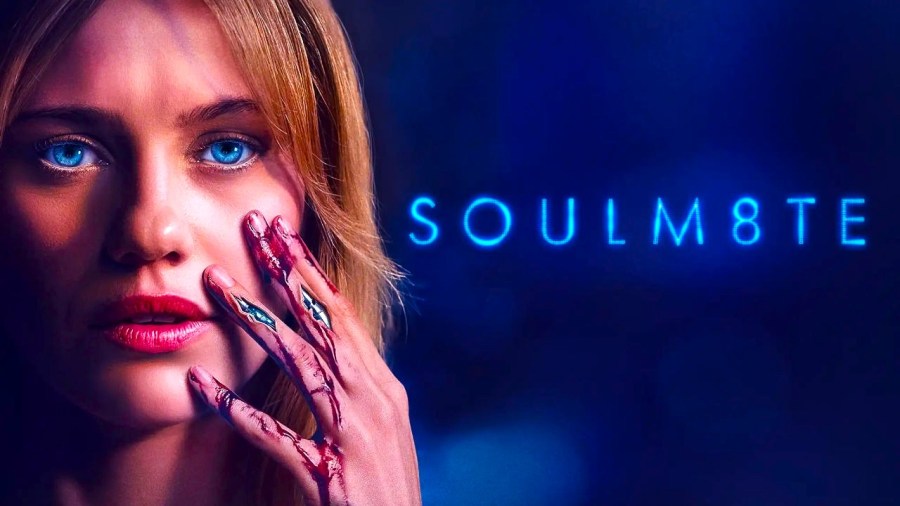
Quick synopsis: David volunteers to beta test an android companion to cope with the death of his wife.
A bit of background. Soulm8te was originally supposed to have a theatrical release in January this year. Obviously, that didn’t happen. I keep a list of films I want to see each year, with titles indented if I haven’t seen a trailer. Soulm8te was on there for ages, until I eventually decided it probably wasn’t going to be released and deleted it. Two days later, the trailer came out. The first I knew it had finally been released was when I spotted it on Disney+ while I was going to watch the new season of Scrubs.
You know how Disney+ puts the release date next to the title? Soulm8te was listed as being released in the year 3000 (where not much has changed but they live underwater. And your great great great granddaughter was pretty fine). In the kindest possible interpretation, this was a joke about how futuristic the film is. It wasn’t. They eventually changed it, so it was clearly just a mistake. The fact that it was sitting there with the wrong release date for several days tells you something about the level of care that went into releasing this film. And the fact that it didn’t even become a meme tells you how little attention anyone was paying.
That being said, Coyote Vs. Acme was also beset with release problems, and that turned out to be incredible. Plus, Soulm8te is directed by Kate Dolan, who gave us You Are Not My Mother, a great hidden gem if you like low-budget horror. That film showed she could take a strange, unsettling premise and turn it into something genuinely creepy, so her involvement gave me some hope that Soulm8te might be better than its troubled release suggested. And some genuinely great films have been released straight to streaming. So, despite everything, not all hope is lost.
Until you start to watch it. Then you give up hope pretty quickly. I will admit, I only watched this because of the M3GAN connection. If that’s why you’re watching it too, don’t. There is no meaningful connection. No serious connection, anyway. It mentions one company that also appeared in M3GAN, and that’s about it. If anything, the fact that it’s set in the same universe actively harms the movie. The events of the M3GAN films would be well known in this world, yet they’re never mentioned. You’d think a robotics company making lifelike companion dolls would say something like, “And remember, be careful you don’t end up with a situation like that doll a few years ago that killed a bunch of people.” Instead, people come face to face with Sara and seem AMAZED that a robot can look lifelike. Almost as if the M3GAN films didn’t exist.
And it gets even sillier when one of the people who hates Sara for being a robot does so because she pays for something using her palm at a chip and PIN machine. That’s not scary futuristic robot technology. That’s something people can already do if they have the right implant. That’s like someone in a movie shooting another person because, “He was using a wireless telephone! Witchcraft!”
It’s not all bad. There is something weirdly sweet about David’s early interactions with Sara. They’re very wholesome, even if the relationship is obviously one-sided. But then again, she is an AI companion, so asking about her childhood pets and stuff would be a bit weird and disingenuous. He’s getting to know her, while she’s essentially been designed to get to know him.
The performances are good across the board. Sadly, I think David Rysdahl is the weakest, although that’s only because everyone else is so good. Lily Sullivan is perfect as Sara, managing to make her feel convincingly human while still retaining something slightly artificial about her. She’s not in it much, but I also liked Emma Ramos. I really enjoyed Claudia Doumit’s performance, too. She has the same kind of inherent likeability that makes Jameela Jamil so watchable, where you can’t help but enjoy having her on screen.
There’s also some genuinely fun moments. Her singing Lovefool at karaoke is lovely, and really sells David’s feelings for Sara, making you believe that he genuinely cares about her. The film also comes up with some surprisingly creative deaths. A guy gets his dick ripped off and then kneed in the face. She also kills someone using her ever-tightening vagina. (Ever-tightening Vagina was my folk-reggaepunk band back in college.) These are the moments where the film is at its most entertaining, because it seems to remember that having a bit of fun with some of its more ridiculous ideas is actually a good thing.
But that brings me onto the downside. Yes, the suffocating vagina death is fun to watch, but it has no consequence. In fact, none of the kills do. Sara kills a fair few people, and their deaths have almost no effect on the story. There’s no news reports about them. No police. Nothing. It’s not that I need Soulm8te to suddenly turn into a police procedural, but these deaths should have some kind of impact. For a film supposedly interested in the importance of human connection, it has remarkably little interest in the people who actually die.
The film has the potential to say something genuinely interesting about human relationships, and I get the feeling some of that may have been lost in the edit, particularly when it comes to David’s ex-wife, Lizzie. There’s the potential for something beautiful there. David has lost his wife, and then finds himself forming a relationship with an artificial person who is designed to give him the companionship he’s lost. But besides the dialogue telling us about it, we don’t really FEEL that David is haunted by Lizzie’s death. We needed more moments of him watching footage of the two of them, remembering their life together, or even just struggling with the fact that Sara is filling a space that Lizzie left behind. That would make his relationship with Sara much more emotionally complicated – and much more interesting.
On the subject of the characters: Sara herself is strange. She has moments of brilliance. When she says, “Your hypocrisy forces me to contort myself into this impossible ideal,” it briefly shows a much better version of this movie than the one that actually exists. A movie that focuses on male entitlement to female bodies and attention. Sara has been created to be the perfect companion, designed around what a man wants from a woman, and yet the moment she develops desires and expectations of her own, she’s suddenly the problem. If the film leant more into that, it could have been really interesting. It would draw comparisons with films like Companion and Obsession, and, more importantly, give Soulm8te something genuinely worth discussing beyond whether its robot vagina kills are funny.
But Sara isn’t all good. She doesn’t understand a lot of very basic things about human nature, but somehow understands how to blackmail someone using deepfake porn. And why was she programmed with jealousy in the first place? It seems like her behaviour is based less on what would make sense for an AI and more on whatever the plot needs her to do at that particular moment.
Although I suppose it is a bit much to expect logic from a film with a title as mind-numbingly stupid as Soulm8te. I’m sorry, but it’s possibly the worst name a film has had all year. It doesn’t even say “soulm-eight”. It says “Soulm-eight-et”. A character actually points this out in the movie, but acknowledging that your title is stupid doesn’t magically make it less stupid. If anything, it just confirms that you knew it was stupid and went with it anyway.
In summary, it should be better. That’s the most frustrating thing about Soulm8te: I’ve seen what this movie could be, and I’ve seen what it actually is. There’s a genuinely interesting film buried in here about loneliness, grief, male entitlement and what happens when an artificial companion develops desires of its own. Instead, we get a movie that’s too serious, more po-faced than a Teletubbies mask.
It’s not even that sexy. Which, for a film labelled an “erotic thriller”, is a death knell. It mistakes nudity for sexuality. There’s no atmosphere, no passion, just cold, sterile nudity. And nobody wants cold nudity. It’s why you don’t see many naked people in the Arctic.