
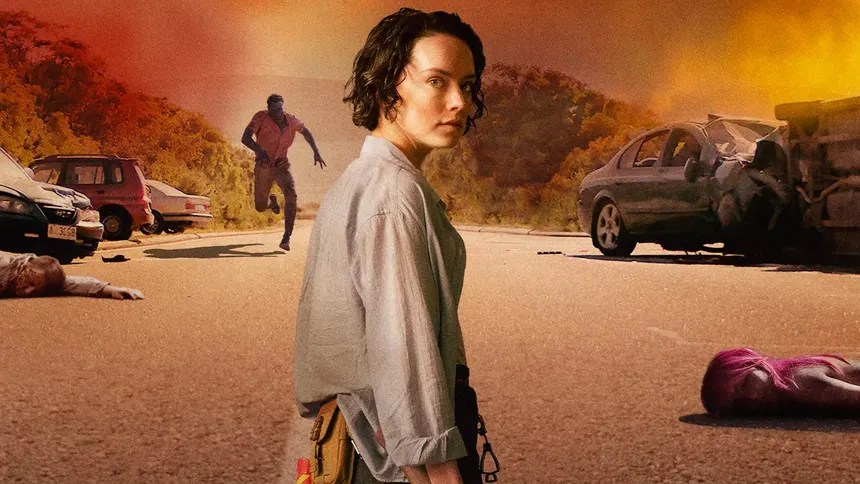
Quick synopsis: During a zombie outbreak, a woman travels across a devastated Australia to find her missing husband and confront the unresolved fractures in their marriage.
It’s weird to say about someone so famous, but Daisy Ridley is underrated. Much like R-Patz after Twilight, she’s still shaking off the stink from starring in a franchise that wasn’t well received. It’s a shame as she’s really good. She is consistently excellent, gravitates towards interesting projects, and usually nails her performance. I’ll be upfront, this isn’t as good as Sometimes I Think About Dying (a film I’ve come to appreciate more and more over time, and one I definitely underrated when I first saw it). But it is worth a watch.
That recommendation comes with a relatively sizeable “but”.
If your ideal zombie movies are fast-paced, violent, and intense, you will absolutely despise this. The zombies aren’t the focus; the characters are. We Bury The Dead (WBTD: pronounced Woo-bah-ted) isn’t a zombie movie; it’s a movie that just happens to be set during one. It’s mainly about a woman travelling to meet her stranded husband in the aftermath of a social apocalypse. Much like society, their marriage is also on the rocks; damaged by infidelity, dismissiveness, and resentment. The end of the world hasn’t solved or caused their problems; it’s just meant that every excuse and distraction that they had is no longer there.
Obviously, there are zombies, but they’re not traditional lumbering monsters awaiting destruction. They’re more like a manifestation of pain, regret, and grief, physical reminders of things that refuse to stay buried. And if that sentence repels you, WBTD isn’t the movie for you. It’s not a film about survival; it’s about what happens when people lack closure; what happens when they have unsaid conversations and unfinished business. The relationships they assumed they’d have time to fix, the apologies they wished they made, and the lifetime they assumed was still ahead of them. You could tell pretty much the exact same story by having Daisy Ridley die at the start and have her character be a ghost. She spends most of the time just wandering, coming to terms with the sudden change, carrying the weight of her damaged relationship. The end of the world doesn’t make her problems disappear. If anything, it exacerbates them. WBTD asks whether reconciliation is possible when time has effectively run out. It also highlights how, when the world has gone to shit, sometimes the most important part of your life are the friends you’ve made along the way. That’s an oddly optimistic and hopeful approach, but it is one you have to dig among the grief to find.
Like I’ve said (many times, and will say many more), this isn’t for everyone. The pacing is glacial (enjoy that metaphor while you can, because in 5 years time, global warming will render it nonsensical). There are stretches where it feels like nothing happens, and then nothing continues to happen, only to be interrupted by, you guessed it, nothing happening. The characters aren’t fighters; they’re traumatised victims trying to come to terms with what’s happened. Personally, I liked it. But I understand how it would be divisive to some. The pace gives the emotions time to breathe, reinforcing the isolation the characters find themselves in.
Not to say it isn’t brutal when it needs to be. But it doesn’t enjoy its brutality. Characters don’t whoop and cheer when they are face to face with decaying corpses; they throw up and refuse to continue. Death isn’t entertaining; it’s tragic. The characters recognise that every zombie they approach isn’t an anonymous monster to be killed; they were humans, every single one had a life full of hope, potential, and family. They were neighbours, friends, eaters of cheese. The violence has an uncomfortable feel to it. There’s no triumph when zombies die. Relief, but not triumph. The characters aren’t becoming badass with every kill; they’re becoming more emotionally exhausted.
As a zombie film, WBTD is unconventional to the point you could argue it barely counts as one. As a meditation on grief, regret, forgiveness, and the possibility of reconciliation when time has effectively run out, it’s far more successful. I recognise I may have repeated myself a lot during this review. Truth is, there’s not that much to say about it. That’s not because it’s not interesting; it’s because it’s so atmosphere-based, it’s not a film to watch, it’s an experience to get lost in.
It’s slow, sombre, occasionally frustrating, and absolutely not for everyone. I liked it. But didn’t love it. It did sometimes feel like it was so desperate to be understood, it wouldn’t move on after it made its point; instead it would repeat them. There’s not a lot in this 95-minute film that couldn’t be said in a 30-minute one. The supporting characters are underutilized to the point of almost being invisible.
Plus, the fact that it’s caused by America accidentally detonating a weapon is uncomfortably realistic in 2026, where wars are threatened on a whim. And more importantly, I can finally get “Bury Our Friends” by Sleater-Kinney out of my head whenever I see this film in my “to-watch” list.

