Minions And Monsters (2026) Review

Quick Synopsis: Those annoying little yellow shits that you may know from memes your relatives post on Facebook decide to make a movie.

As I sometimes do with sequels, I’m going to post a segment from my review of the previous movie, this time, 2022’s Minions: The Rise Of Gru:

I was ready to slate this; I was ready to come down on this harder than the next UK Prime Minister comes down on an unemployed person not applying for jobs in their sleep. I was going to use every insult that exists, and a few that I made up just to express my anger at this film.

But then it ruined my plans by having the audacity, the sheer gall, to actually be okay. How very dare you! I mean, it’s not going to end up on my “best of 2021” list, mainly because it’s 2022, but also because the best it ever gets is “okay”. I’ll admit, I’m not a huge fan of the franchise; I think it’s because it’s basically old Buster Keaton skits, but in animation so there’s no sense of danger or risk. There’s also always the sneaking suspicion that it’s a merchandise-driven series rather than a creative one. It’s strange as it’s when this film links to the others in the franchise that it’s at its weakest. The timeline doesn’t line up AT ALL with the first Minions film, and when it makes references to the other films it falls flat, and like every prequel ever made has moments where the audience reacts with “what a useful skill/gadget, that would have been useful in [scene in a film made earlier but chronologically takes place later]”.

I try to keep politics out of reviews unnecessarily, but I have to commend Minions and Monsters (MAM) for allowing me to use less energy by recycling my own review. Hashtag, we only have one planet. Really, the only thing I would change from that review to make it applicable to this is remove the year 2022. Everything else is still accurate. It’s still a franchise that feels like it was conceived as a series of Happy Meal toys rather than a movie, with all the continuity of a drunk person explaining the Halloween franchise. In my review of Black Phone 2, I said: “As a stand-alone film, it’s pretty good, as a sequel, it’s a mess”. MAM is similar; the weakest parts are when it remembers it’s a Minions movie.

One sentence from that earlier review rings a lot more true this time: the Buster Keaton comparisons. Parts of MAM don’t just resemble a Keaton short; there are a few parts where it grabs you by the shoulders and tries to sell you a box set of his greatest hits, so much so that it feels like he should appear in the credits under “special thanks”. I watch a lot of films that people would describe as pretentious, and I can’t remember the last time I saw any film (let alone a mainstream animated film featuring yellow kidney beans) craft such a heartfelt love letter to silent movies. I’m used to animated films putting in references for adults, but even the parents would be too young for a lot of these references. Is there a crossover between “people who watch Minions” and “People who would recognise a reference to the 1902 Georges Méliès A Trip To The Moon”? That fills me with hope. Because it means that there’s a chance a kid will watch those scenes and then catch a glimpse of one of the original works, and be inspired to look into it, and find themselves falling in love with silent cinema.

Don’t worry, though. It doesn’t stay classy for too long.

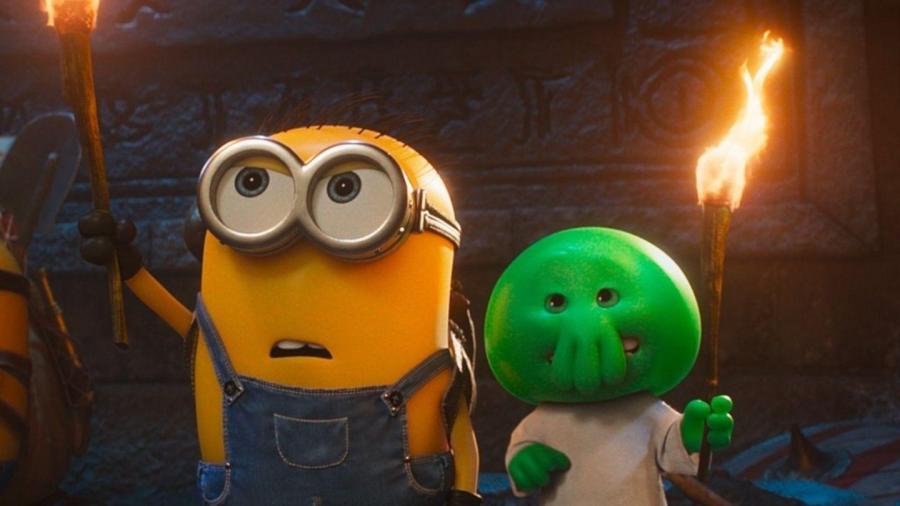
Much like the introduction of talkies killed silent cinema, the introduction of them into the plot of MAM also kills any sense of originality, and it quickly becomes more of the same. Goomi, the tiny Cthulhu from the trailer, is introduced more than halfway through the movie. So he’s the villain? Nope, after more shtick than you shake a stick at, he gets them to free two sea monsters who are intent on taking over the world and destroying everything. So they’re the big villain? Nope. After more narrative faffing around, the three monsters summon Irene, a large orange blob monster with more eyes than a narcissist’s diary (that joke only works when you say it out loud, but I’m sticking with it). She appears, has one moment of chaos, then is destroyed by an alien who’s flanked by minions in a spacecraft. There are throwaway jokes longer than the villain’s appearance in this movie.

It’s like watching a relay race where every runner immediately hands the baton to someone else because none of them actually want the responsibility of being the antagonist. Every time the film introduces what you think is going to be the threat, it immediately goes, “Actually, no, THIS is the threat.” By the end, it’s burned through more villains than an arsonist superhero; you half expect the closing credits to reveal there was another one waiting in the car park.

I will say this: Minions is very rarely boring. Something is always happening, even if that something doesn’t advance the plot at all and is just the narrative equivalent of jingling keys around. It never builds towards anything; there’s no natural progression, it’s just a series of stuff happening. The closing section is not just bad; it’s disappointing. Worse than that, it’s generic. None of it is unique or memorable.

Which is why the silent cinema sections stand out even more. They feel like they belong to a different film entirely, one made by people passionately paying tribute to the history of cinema rather than fulfilling a contractual obligation to set up the next line of plush toys. If the entire film had committed to that style, this could have been one of Illumination’s most interesting projects. Instead, it eventually remembers it’s supposed to be a Minions movie, panics, and throws every monster, spaceship and glowing MacGuffin it can find at the screen until the credits arrive.

Now onto the closing scene and the credits. The closing scene reveals that the entire movie (including the framing device) is actually a film-within-a-film, directed by James and Henry, two of the minions from this movie. Oh yeah, the minions in this are different from the ones in the previous movies. Same species, different characters, that all happen to look exactly the same, have similar mannerisms, and wear similar clothes. So, none of the events of this movie happened? Fine, I’ll go along with that. But then the closing credits reveal that the magic book is real. It’s less “twist”, and more “different writers took a scene each and didn’t collaborate to make sure their visions lined up”. So did the events happen or not? The film seems to want to have it both ways: if you point out that at no point in this franchise has anybody realised that Gru’s minions look like a similar species that appeared in multiple films from the 20’s, then “it didn’t happen, it’s just a movie”, but for the sake of some mid-credits jokes, it definitely happened.

There’s another small problem I have, not just with this movie, but the franchise as a whole. It doesn’t really feel like they want to help villains. They say they do; they act as if their main motivation is to help evil and enslave humanity. But most of the time their actions don’t align with that. For one thing, they stop the runaway train from running people over. If they were truly evil, wouldn’t they have welcomed it? The franchise never treats them as the villains it tells us they are; they are only ever heroic.

Ultimately, Pierre Coffin’s biggest mistake with this Minions movie was making it a Minions movie. If it belonged to an original franchise, then it wouldn’t have needed to fall apart in the final third to live up to expectations, and it wouldn’t have needed to tie itself in knots to stay in continuity.

I suppose that’s enough about the writing. How about the technical aspects? They’re more difficult to judge. The lighting, colours and character animation are perfectly competent, but there’s never a shot that makes you stop and admire it. There’s nothing visually exciting about it. Also, the music doesn’t stand out at all. It’s not that the visuals or the score are bad, but they both feel as if they had no love put into them. There’s no flair, no style, and no substance. Ironically, the only sections with any visual personality are the ones borrowing techniques from filmmakers working over a century ago. That’s a shame, because the film leaves so much on the table. If it had committed to the silent movie motif, the score could have become one of its strongest assets. There’s a moment where a shark attacks the minions; imagine how much more memorable that sequence would have been with an old-fashioned reimagining of the Jaws theme.

Fans of the franchise will enjoy it, and the section set in old Hollywood is something worth not just admiring, but studying. But it doesn’t matter how delicious a steak meal is if the dessert is a literal steaming pile of shit.

The Invite (2026) Review

Quick Synopsis: A struggling married couple’s dinner with their free-spirited neighbours spirals into a provocative night of awkward revelations that forces them to confront the cracks in their relationship.

I love dinner parties in movies. They’re so fun to watch because they naturally allow group conversation, and there are certain unspoken etiquette rules that are always entertaining to watch get broken. If you want to expose your characters’ conflicts, put them around a dinner table and let what happens happen. The Invite takes that idea and makes it the entire concept.

It’s an English-language adaptation of the 2020 Spanish film The People Upstairs. It’s fairly obvious this is a remake of a non-American film. There’s something about it that feels slightly unconventional. It’s not just that it’s a summer movie driven by characters and dialogue rather than big action setpieces. It kind of feels like the cinematic equivalent of ordering food in a foreign country by speaking English with an accent. Familiar enough to understand, but just different enough to feel a little strange.

That sense of oddness is backed up by Olivia Wilde’s directing style. It’s incredibly static, with some weird blocking choices. Sometimes it feels like a play that we’re watching from the audience, sometimes it feels like someone just plonked a camera down randomly with no thought or care, and other times there’s a voyeuristic quality, as if we’ve wandered into a private argument we shouldn’t be witnessing. With that in mind, it’s difficult to criticise the film too harshly on a technical level because it’s clearly not trying to impress with flashy filmmaking. It’s aiming for a naturalistic style that occasionally feels awkward, but intentionally so.

What will chiefly inform your opinion on The Invite is the characters and the dialogue. The audience I saw it with loved it, and it’s easy to see why: it’s incredibly funny at times, with some truly incredible dialogue, and a cast who clearly enjoy bouncing off one another. The conversations have an energy that keeps scenes engaging even when very little is happening. That’s the issue, though: very little does happen. There’s almost no narrative progression for most of the runtime. Rather than pushing the characters into new emotional territory, the film spends much of its time having them elaborate on feelings they’ve already expressed. To be honest, it spends most of it catching up with the trailer. I’ve seen the trailer; I know this film involves the neighbours proposing group sex. I assumed that would be the inciting incident and it would lead to things. Instead, it’s the destination, and it’s a destination the film takes far too long getting to.

That lack of progression also affects the central relationship. Joe and Angela don’t feel like real people so much as vehicles for clever dialogue. Every conversation is packed with witty observations, but it rarely feels spontaneous or lived-in. Also, there was no warmth to the relationship between the two main characters. I understand that the point is they’re trapped in a loveless marriage fuelled by resentment, too afraid to admit it’s over. That doesn’t mean spending nearly two hours with them becomes any easier. I kept waiting for just one moment of genuine warmth, some glimpse of why these two people fell in love in the first place. There’s a brief moment where it seems they might unite against the bickering of the other couple, but it disappears almost as quickly as it arrives.

That lack of warmth really hampers the ending. Joe finally returns to the piano, Angela joins him, and they seem to reconcile. It’s a sweet scene in isolation, but after nearly two hours of anger, bitterness and emotional distance, it feels too small to justify such a dramatic shift. It’s like trying to fix a leg amputation with a piece of sellotape.

For all my issues, there is still a lot to enjoy about The Invite. Beneath all the bitterness is an impactful look at people and keeping the spark alive in long-term relationships. For a film that’s so bitter, it just may save the relationship of someone watching. They may see it and be inspired to try more, to treat their partner with love, to keep wooing them and trying to impress them instead of confusing stability for fulfilment. The ensemble also works well as a true four-hander, with every actor getting plenty to do. Although, interestingly, despite having a female director and co-writer, the film subtly privileges Joe’s perspective. He’s the only character we spend meaningful time with alone, and the only one we follow outside the apartment. It’s a small imbalance, but one that makes the supposedly shared story feel slightly weighted towards him.

I won’t begrudge anybody enjoying this. Mainly because being annoyed at someone for their film opinions would be weird. Maybe a younger, more cynical me would have loved this. It will find its audience, of that I’m certain. But I’m not part of that audience. I appreciate what it’s trying to do, but it never quite invited me in.

Saipan (2025) Review

Quick Synopsis: A recreation of the Saipan incident involving the Republic Of Ireland national team during the 2002 World Cup. If those words mean nothing to you, this film isn’t for you.

The last football movie I watched was Balls Up. That movie was fucking terrible. All Saipan had to do was be better than that. Obviously it managed that; if it hadn’t, you wouldn’t be reading this; you’d be reading a news headline saying “Makers of film attacked by a crazed/idiot reviewer”.

That’s not to say it’s a fantastic watch. For all its faults (of which there were many), at least Balls Up was memorable (except for the title, because I’m still not 100% on whether it’s called Balls Up or Balls Out). Saipan isn’t. It won’t move you, teach you, or linger in the memory. It’s just there. It’s the film equivalent of the 90’s song Save Tonight, by Eagle Eye Cherry. In the moment, you’ll enjoy it, and it’s hard to find many faults. But it won’t take long for memories and warm feelings to fade. That’s both a positive and a negative. Saipan never embarrasses itself. You never sit there bored, or annoyed. But it also never threatens to become anything more than “just okay”.

On the face of it, it rivals Seinfeld for being a piece of media about nothing. I mean, really. “A footballer shouts at his boss and quits mid-tournament” doesn’t sound like the sort of event that legends are built around. Nobody was physically harmed. Nothing was damaged. Ireland came second in their group (eventual finalists Germany topped the group), and ended up going out of the tournament on penalties to a Spain side that were on the cusp of being one of the greatest international teams of all time. There’s no Sliding Doors “but what would have happened if he stayed?” alternate history. All that would have changed is how they played, the final result wouldn’t change.

But that’s missing the point somewhat. It’s not just about that incident. It’s about professionalism, national identity, and personal pride. The reason the incident dominated headlines wasn’t because of what happened; it was because of what people thought it meant. There’s no clear-cut right-and-wrong side. To some people, Roy Keane was a selfish egotist who had no idea how to be part of a team. But to others, he was a perfectionist who refused to lower his standards and was extremely disappointed when it seemed like everybody else wasn’t taking the tournament seriously. To some, Mick McCarthy was a realist, attempting to deal with an egotist (Keane) who was being encouraged by his club manager to treat the international team. Whereas to others, he was woefully out of his depth, weak, and should have never got hired in the first place.

Saipan understands this. It doesn’t portray either side as wrong. They’re both right, but they’re having different arguments. I genuinely have no idea where the writers or directors stand on the issue. The script is impressively neutral. Perhaps that’s because all the principal figures are still alive and theoretically capable of hiring lawyers, but whatever the reason, it works. The film trusts the audience to make up their own minds.

There are a few issues. The main one is that Eanna Hardwicke looks nothing like Roy Keane. That, in of itself, isn’t an issue. Michael Sheen has shown time and time again that it’s more important to capture personality than accuracy. And it wouldn’t be an issue here if it wasn’t for one thing: the film opens with a montage featuring the real Roy Keane multiple times, repeatedly reminding the audience what he actually looks like before cutting to an actor who bears very little resemblance to him. It’s an odd decision. Why not keep Keane at arm’s length at first? Show him from behind, in silhouette, or at a distance. Build up the myth before revealing the actor. Instead, the film practically invites the comparison, and it’s an invitation that you can’t receive well.

The other issue is that it doesn’t do enough to explain why any of this mattered.

The film assumes a certain level of prior knowledge and doesn’t spend much time bringing newcomers up to speed. Non-football fans will still understand the basic facts. They’ll grasp the what and the when. But I’m not convinced they’ll fully understand the why. Which is a shame, as the why is the most important part.

Ultimately, it feels like a TV drama, albeit a very good one. It’s consistently engaging, well-acted, and intelligently written. It’s also surprisingly difficult to feel strongly about. The real incident sparked years of anger, debate, and discussion. I don’t think it’s particularly cruel to suggest that the film probably won’t. That sounds harsher than I intend it to. I’d still recommend it. It’s a solid, thoughtful piece of filmmaking that treats its subject with far more nuance than I expected. I’d say you should watch it, but watch it with someone who remembers the actual event. You might find their talks as every bit as interesting as the film itself.

Passenger (2026) Review

Quick Synopsis: A travelling couple are haunted by what’s essentially a hitchhiking demon.

The last André Øvredal film I reviewed was Scary Stories To Tell In The Dark back in 2019. I thoroughly enjoyed that, although I was surprised by it because I assumed it would be more kid-friendly/my first horror. I’ve also heard very good things about The Autopsy Of Jane Doe, The Last Voyage Of The Demeter, and Trollhunter, with all three of them being on my list to watch. I didn’t love Passenger, but it didn’t dampen my enthusiasm for his work. The most interesting things about Passenger are the things he brings to it. It’s far more visually interesting than similar films; at times, it’s close to art. Disappointingly, it does dip into the “random face jumps at the camera” scares, which are cliché to the point of boredom. Weirdly, there are times when I think it does a bit too much. Some scares are heavily signposted, and maybe it would have been better if they were a bit more subtle. The perfect example of this is a scene where Maddie (played by Lou Llobell) is trying to get to the van. She hears a noise and turns to look at the source, then turns back, and the van is further away. There are dramatic scare chords accompanying this happening. Personally, I would have liked it to be a bit more subtle, so the audience had to pay attention, putting them in the same place as the character: wondering if it is actually further away, or if her mind is playing tricks on her.

I didn’t know that much about Passenger. I saw the trailer months ago, but for some reason, the trailer wasn’t available online at the time, so I haven’t watched it again. I mainly remember it focusing on someone driving and seeing the same figure again and again by the side of the road. That kind of intrigued me, but I was curious as to how that could extend to a feature-length film. I mean, how can you get 90 minutes of someone driving and NOT picking up a hitchhiker? So I was doubtful it would have enough meat on its narrative bones. Good news, that’s not what the film is about. Bad news, it still doesn’t have enough meat. The main characters are cursed because they decide to stop their car (which kind of seems like this film is saying that stopping to help people is a bad thing and should be avoided, but what do I know?). So it’s somewhat ironic that the film itself keeps stopping. Weirdly, those are the parts of the film I think worked best. There’s an incredible scene where the two are watching Roman Holiday on a projector in the woods. It’s very sweet, the scares are subtle enough that they gradually build, and there’s actual tension. But then they get back into the van, and it turns into visual noise.

In contrast, the dumbest part is when they’re in the van and time suddenly skips forward to night. The set-up for this is that the entity is powerful at night and weakened during the day, so the characters think they’re safe in the day, but that safety is disrupted by the time skip. I would argue that manipulating time in such a manner requires immense supernatural power, much more than it would take to, say, loosen a wheel and cause a car crash. Or did he just make them fall asleep for that long? If that’s the case, why not kill or hurt them then? Also, why wake them up? They’re heading to the church of Saint Christopher, patron saint of travellers and the only place where someone would stand a chance of killing the entity. The characters don’t know where it is, so they have to look out for symbols and clues to try and find it. The characters appear to have travelled in the missing time. Here’s my issue: the demon wakes them up BEFORE they get a sign with a symbol on that tells them where the church is. If he can only timeskip a certain number of hours, why not wait until they’ve travelled a few more hours, THEN jump ahead so that they unknowingly drive past the only clue that’s visible from the roadside? They might have even taken the wrong exit and ended up avoiding it entirely. If anything, he got them closer towards it. He’s a video game boss who just happens to have the only weapon that defeats him in the hallway outside his dungeon.

On the upside, the lore is fantastic. It FEELS like a genuine urban legend. Specifically, an American one. It appears to be based on a few different ones rather than a single one. But when you watch it, it feels real, like the kind of thing travellers will tell each other. I’d have loved to have seen this as part of another movie, where we see new urban legends get told. But as a full movie? There’s just not enough to it to justify it. It says a lot that the best scares and most memorable scenes were all ones that could have come from any movie, not many that are unique to a road trip horror.

War Machine (2026) Review

Quick synopsis: America fights aliens.

I’m not a complete idiot (that sound you hear is my family and friends laughing), so I am aware of the influence the US military has on films. The US Department of Defense even has an entertainment unit that handles requests when filmmakers want to utilise military equipment or locations. It’s not just “we need to make sure you use the equipment safely”; they denied support to Independence Day because the director refused to remove references to Area 51. The 1954 animated movie Animal Farm was purchased by the CIA and had the ending changed, which is ironically, very Orwellian. It’s not just film; the DoD also has agreements with TV shows such as The Price Is Right, America’s Got Talent, and The Kelly Clarkson Show. So, yeah. I’m used to American media figuratively fellating the US military. But few have done it so obviously as War Machine.

War Machine (WM, pronounced Womb) is not a movie; it’s a recruitment service. To the point where it almost seems like a parody. The villains? Alien machines that land on Earth. Now, and I believe this is very important, they don’t attack first. The machines just sit there. The US military decides to attach explosives to it to blow it up, after which, the machines rise and attack. So to reiterate: the good guys attempt to kill something, then claim to be victims when they get attacked in revenge. If that doesn’t showcase US foreign policy, I don’t know what does. I know Hitler Simpson wants to be heavily involved in the making of Rush Hour 4, but if it turns out he was involved in this, I would not be surprised. That’s how blatant the propaganda is.

WM feels like an early 90’s action movie, and that’s not a compliment. The villains are basic “others”, the characters are ultra masculine to the point of being laughable (the main character refuses to go to therapy after the death of his brother), and it all boils down to “one straight, white, American male will save the entire world”. How does he save the world? By blocking the machine’s ventilation ports. Did the visitors not realise that would be a problem? This keeps happening in movies like this, and it feels like it comes down to writers not understanding the ending of War Of The Worlds, where the aliens were defeated by a random virus. That’s not “invaders will all have one fault we can exploit”, it’s “invaders can be so cocky they neglect to take into account everything”, and that has historical precedent: think of the empires built where the first contact involved a lot of people dying of unknown diseases that their bodies weren’t used to. “Leaving a port open” is not like that; they would know that Earth has dust, rocks, and dirt. It feels slightly cheap to have a big threat defeated by what’s essentially a banana in a tailpipe. What’s weird is that this only happens once. At no point in their invasion of Earth did the alien machines get clogged up with sand in the desert, rocks from a collapsing mountain, or glass bottles full of piss thrown by English football hooligans.

How about the characters? Do they salvage this? Nope. For one thing, they’re all given numbers instead of names. Which strips them of their humanity. I get it, that’s probably the point, the military dehumanises you so you work as part of the machine. But for films? You’re supposed to give a shit about the people you’re seeing. Compare the two sentences:

  1. “It absolutely devastated me when Martha died”
  2. “I still haven’t fully recovered from the death of number 81”.

One sounds reasonable, one sounds stupid. You remember names; they’re unique, they have emotional resonance to them. Numbers don’t. It makes you feel like these characters don’t matter

So yeah, it’s dumb. But you wouldn’t know this by the Wikipedia page, which I feel has been edited by the production company. The top line says “the film received generally positive reviews from critics, praising it as a fun, old-school, throwback action movie despite its familiar, formulaic storyline”. Even the positive reviews are 3 out of 5, etc. The kindest response would be “mixed”

On the upside, it looks good. The action scenes themselves are fine, and the villains look menacing. The performances are fine, but nobody is really given enough to do. I also like the brief insight into survivor’s guilt, especially when 81 mentions how the medal he was given is just a constant reminder of the worst day of his life. That’s a fascinating look into both his character and American culture.

I’ve seen worse films this year. But it’s hard to think of films where I’ve given less of a shit.

Glenrothan (2025) Review

Quick Synopsis: After 40 years abroad, Donal returns to Scotland to make amends with his brother, Sandy.

In case you weren’t aware, there’s an app called Runpee. What it does, simply, is tell you the best time to pee during a movie so you don’t miss too much. Some films are so densely packed that they have a few very short windows you can use. Glenrothan would be the easiest film to find peetimes on, because no matter what happens, no matter when you leave, you’re not going to miss much. Sure, you’ll miss some jokes or heartwarming moments, but it’s like falling asleep on a plane. Sure, you missed the in-flight movies, but you know where you are when you land.

That’s a somewhat negative way to start this review, and considering the Rotten Tomatoes score (17% at the time of writing), you’d be forgiven for thinking the rest of this review would be negative. It’s hard to argue against some of the points the negative reviews make. The characters feel like sitcom characters: not in terms of jokes, etc., but because they go through stuff which should change their character, yet for some reason it doesn’t. Donal (played by Alan Cumming) is constantly having his flaws pointed out to him, and he seemingly acknowledges them, but then in the next scene it’s like he’s never been told them. It doesn’t do a good enough job of explaining WHY the two brothers are estranged. The way the flashbacks are lined up, you’d think it’s building up to a revelation that explains and changes everything, but it never comes. There are minor disagreements, but mainly it’s Donal being generally fed up with living there and feeling the need to leave. It’s teenage petulance, but one the character never comes back from. I know sometimes family disagreements happen, but the events we see don’t seem big enough to cause a generational rift like that. It feels like it’s missing ONE scene, one scene that changes everything.

The biggest downside is that you’ve seen this movie before. I know there are not unlimited ideas and concepts in the world, but everything about this is too familiar to be interesting. Two family members are reunited by disastrous health news, a somewhat snobby family member sees the errors of his ways and the importance of home, the notion that “no matter where you go, this will always be home”, which in Western media is limited to a few countries (you never see an American film about how someone really misses their home country of Luxembourg). These are all narrative paths that everyone is familiar with. So it’s hard to get that excited by what we’re seeing.

On the upside, whilst it does have all the originality of a cover song by a tribute band, it is expertly made. Everyone does their job well. At 79 years old, it may be a bit optimistic to say that Brian Cox can transition into a director capable of cinematic genius that will make the works of Hitchcock and Cameron look like warmed up piss on a cold plate, but if there’s a story he’s been pitching for decades, one that’s incredibly personal to him that he would consider his lifes work to complete, Glenrothan does enough to convince studios that they should let him. Alan Cumming has a lot riding on his shoulders, and he manages it. In fact, he’s so good that I finally realised he’s not Michael McDonald of “Killed by a leprechaun” fame. Well, I say “fame”.

The script isn’t good enough for Cox to showcase the story. But what he does showcase is the landscape. The shots are so beautiful that at times it doubles as a tourist advert for Scotland. So whilst I can’t see Glenrothan inspire someone to start film-making or performing. I can see it inspiring someone to finally take that holiday Scotland they’ve been dreaming of. To phone that family member or friend they haven’t spoken to in decades over something stupid. To cherish the time they have. So whilst this won’t be the best film anybody will see (tbh, it’s just a step above “White Male British people do things” fare like Mothers Pride or Fisherman’s Friends), it could end up being one of the most important movies in someone’s life.

And really, it’s hard to muster hate for something that could do that. Plus, it has the balls to have an anti-monarchy song in a pivotal scene. So it has that going for it. It’s not perfect. But it’s nowhere near as bad as the critic score says.

Lee Cronin’s The Mummy (2026) Review

Quick Synopsis: A teenage girl who has been missing for 8 years is suddenly found. But she’s come back a bit more possessed and nonverbal than they remember.

It’s really hard to make a Mummy movie (and in the case of the 2017 version, it can be difficult to watch, too). I think it’s because, well, essentially, what do they do? Especially compared to other similar properties. Look at the intended movies in Universal’s attempted Dark Universe. Dracula. He can fly, bite people, slight hypnotic powers. Wolf Man, animalistically bites and mauls. Invisible Man? His powers are pretty much stated in his name. The Mummy? The powers there depend entirely on who’s writing them. Sometimes they control undead armies, sometimes they have magical powers, and sometimes they’re basically zombies with toilet paper. Also, they’re fairly localised. Vampires can travel, werewolves are usually attached to woods and villages, but there are a lot of them in the world. The mummified corpse of an ancient Egyptian pharaoh? They’re usually only found in Egypt or the British Museum. You’re highly unlikely to see one in Berwick-Upon-Tweed. To the general public, if asked to define a Mummy, they will go to the 1999 Stephen Sommers film. That’s kind of scary, but it’s mostly a fun adventure movie.

Lee Cronin’s The Mummy (LCTM, pronounced Lick-toom) is DEFINITELY a horror, unashamedly so. But is it a mummy movie? I have no idea. It just feels like an Evil Dead movie with added sand. It’s absolutely disgusting, in the best possible way. There’s a sequence involving a toenail which still makes me wince when I think back to it. The body horror is off the charts and will make you feel uneasy. Cronin is great at making stuff seem like it actually hurts: the sound design, the make-up, etc., it’s all perfectly crafted for maximum efficiency.

The editing? Not so much. At times, it feels like the horror movie version of the Bourne shaky action cam. There’s a moment near the end which is near incomprehensible due to the way it’s edited. I know some people like that; they like the sense of unease that it creates, and how energetic and jumpy it is. I’m not a fan; I like to actually see what’s happening during scenes. Not in a “no, light everything like daylight so I can see the monster before it jumps out”, but if I can’t tell whether a character is on top during an action scene, am I supposed to be pleased the good person is winning, or scared because the villain is? We can’t tell. I had a similar issue with the Transformers movies, which often just felt like car parts rolling around.

It doesn’t feel like a Mummy movie, though. The moments which make it so feel incredibly tacked on. There’s a subplot involving a local expert that could be excised completely, as most of the information provided is given to us by someone else later on. I also felt the ending dragged. The closing moment has to be the shortest part of a film that’s ever dragged. I’d estimate it’s roughly 90 seconds long; it should be 10. I’m not saying every scene has to be quick, but there are so many moments which aren’t necessary, just dragging any momentum to a halt.

Lee Cronin is very good at making you disgusted and freaked out, but what he’s not so great at is giving those moments a reason. The powers are inconsistent, at times seeming only to exist to serve the plot. Characters are possessed, but only to call the teacher a cunt, not to do anything that would be useful. The grandmother’s wake is expertly crafted in terms of horror, but never followed up on. Did none of the people there feel the need to alert the authorities of a feral child bursting through a ceiling and biting a corpse? There’s not really any indication that the events of this movie affect the characters’ day-to-day lives. There’s no intense media pressure on the return of the child. Yes, the police in Egypt didn’t release that information, but SOMEONE would have noticed. Can you imagine if Madeline McCann turned up at her parents’ house? That news would be released VERY quickly, and the fact that the parents hadn’t announced it would then be seen as suspicious. There’s no way the events in this movie happen without some form of media intrusion. The dad works for the local news; you’d think that would be relevant to the plot at some point.

The parents act a bit weird in this. Leaving it WAY too long to attempt to get help or figure out what’s wrong. It wouldn’t take as long as it takes for the parents to question whether the child is possessed. I mean, they’re American, they’d call for an exorcist if their child is left-handed. The hospital staff are a bit weird, too. Sending her home WAY too early. And I’m not sure the police would SHOW parents a video of their child being tortured.

Personally, I don’t think the opening section of them in Egypt before she gets kidnapped was necessary. The kidnapping itself is brilliantly creepy. Okay, when I say “I don’t think it was necessary”, I mean the way it’s done. If it were the pre-credits scene, it would be great. It would also help sell the timeskip. We’re told it’s 8 years she’s been missing, but it never feels like it. Because we go straight from “she is missing” to “8 years later”, we don’t feel the torment and pain the family have gone through, because the audience has only just seen her, and the mother and father look exactly the same. If it were pre-credits, that pause would allow the time jump to sink in. The actual pre-credits scene is a scene of a family coming home and finding out their bird is dead, which leads to the dad dying. It adds NOTHING to the story and is seemingly only there under the misguided notion that every horror pre-credits scene must feature a death. Out of the 4 characters in the opening, only 2 of them are seen or referenced again, and one of them is completely different, so her inclusion in the opening didn’t influence how you saw her later. This also has the effect of making the unseen mummy the focus, when it should be the family. Imagine if The Shining opened with Charles Grady (the former caretaker) murdering his family. Think how that would change the audience’s reactions to Jack, Wendy and Danny.

In summary: a film I didn’t hate, because I respect that Lee Cronin was trying something. It just feels like a waste of an IP. That being said, if anybody ever makes an Eternal Darkness movie (and they should), Cronin is the person I’d want directing it. Also, the people complaining because it’s not the same movie as the 1999 one are stupid.

Pretty Lethal (2026) Review

Quick synopsis: A group of ballerinas tries to escape from a remote inn after their bus breaks down on the way to a dance competition.

Action movies are better in the cinema: that’s not an opinion: the bigger screen, the atmosphere, everything about it makes it perfect. That being said, Amazon has released some fairly decent ones in the last few years: Deep Cover, Heads Of State, and surely there’s a third one? That being said, they’ve also given us the My Spy sequel, War Of The Worlds, and they were the service that landed Bride Hard, so it’s hit and miss.

Pretty Lethal isn’t as bad as Bride Hard. But it’s nowhere near as good as Deep Cover. On the bright side, PL knows its gimmick. It never lets you forget that it’s an action film about ballerinas. There are times that the reliance on the gimmick works against it, where the characters do something physically complicated when something simple would have done. It doesn’t happen enough to ruin it, but there are times when they add a random twirl just because that’s what they would do in a dance.

I’m split on how I feel about the fight scenes. On the positive side: the hits themselves have an impact. When characters bleed, it makes sense, and it feels suitably distressing. But the choreography? It’s somewhat lacking. It’s the opposite of They Will Kill You. Whilst that was a horror movie that seemingly was made by a director more suited to action, this is a horror movie made by someone seemingly more suited to horror. If Vicky Jewson made They Will Kill You, and Kirill Sokolov made Pretty Lethal, I feel it would have improved both films. Rest assured, if Jewson were to make either a horror movie or an action movie focused on brutality rather than finesse, I’ll be second in line to watch it (not first, I’m not that eager). I’m trying to think how to phrase this without sounding creepy: I like that the women involved in this breathe heavily after and during intense scenes: it’s a little thing, but it really helps sell how physically taxing the fights are.

Even if the fights were better, it would be hard to see this as something incredible. There’s an issue with tone. At times it seems like it wants to be serious, then at other times it has something that sounds like a swanee whistle accompany someone ducking behind a table. I’ve yet to see anything to convince me that Iris Apatow gets cast based purely on merit. I’m not saying she gives bad performances, but her screentime is far beyond what her performance deserves. On the subject of casting, Michael Culkin doesn’t quite have the presence needed to carry off the role. Physically, he’s fine. But he’s missing that indescribable “it” factor that the character deserves. That’s not a slight, like I said, it’s hard to define and even harder to find, but when it happens, you know. The best way to explain it is professional wrestlers: show someone a clip of Hulk Hogan in his prime, even with the audio muted, you can tell that he is someone. Now play a clip of the Brooklyn Brawler, you’ll see the difference.

Millicent Simmonds is great, though (although I do question why the villains find it so hard to kill a deaf woman who’s lost her hearing aid). Uma Thurman is her standard, brilliant self. Avantika is so good that it almost made me forget she was in Tarot. Almost. Maddie Ziegler is the true star, though, with the perfect blend of physicality and facial performance.

In summary, only about 4 steps away from being great, but those steps are huge. Also, just once, I want to see someone attempt a Molotov cocktail and just have the glass bottle bounce.

Good Luck, Have Fun, Don’t Die (2025) Review

Quick Synopsis: Claiming to be from the future, a man takes hostages at a Los Angeles diner to recruit unlikely heroes to help him save the world.

Thoughts Going In: No thoughts, just singing the song from the trailer.

Finally! 2026 has not been the greatest year in terms of films. Nothing has stood out as being particularly innovative or exciting. It says a lot that I already have 2 possible nominations for “Worst Film Of The Year”, but nothing that will get beyond the “very good” in the end-of-year roundups. To be honest, looking ahead I can’t really see anything that I’m incredibly excited about. So I’m very glad something like Good Luck, Have Fun, Don’t Die (GLHFDD, pronounced Goo-lah-fa-dud) exists. It’s flawed, deeply. But it’s also a lot of fun.

It’s also very necessary right now. The world needs more anti-AI media. Creatives should be against AI. Someone using AI to make something creative is like hiring someone to do it for you and still claiming credit, only you don’t pay the person you hired, and they’re liable to make mistakes. Bragging about making art using AI is like bragging you wrote a perfect letter K using a stencil. GLHFDD isn’t exactly subtle, but it’s not supposed to be. It’s supposed to be eye-opening.

I have a few issues with it. For a film predicated on “I’ve travelled back in time on multiple occasions and everytime I’ve seen failure”, we don’t see much from the other times. I’m not asking for every journey to be accounted for, or for the films runtime to be split between his different attempts, but a few quick cutaways of the main characters dying in different timelines would have helped make it seem a bit more dynamic. It also would have made this world seem a bit less important, as it is, it has definite “this is main timeline” vibes to it. The way it’s laid out, you get the feeling that even The Man From The Future feels this is the main timeline, that this is his only chance and all the others have been practices. On the subject of The Man From The Future, that’s his name in the credits, but to improve how this review will flow, I’m going to call him Carl from now on, no reason for picking that name.

Carl doesn’t seem particularly haunted by the other timelines, he’s seen these deaths 117 times, yet he only seems bothered when they happen right in front of him, almost as if he knows that this one is the one being seen by an audience. My other complaint is the ending. It really drags in the closing section. But it then drops a HUGE left-turn in the final few minutes. So it’s both too slow, and too quick. It feels like it needed 10 minutes or so, whether that’s 10 minutes added to expand the ramifications of the final plot point, or 10 minutes taken away so it has a more improved pace, I’m still not sure.

This has all been overly negative, for the most part, I absolutely adored this movie. At times it felt a bit like an anthology, when it went into the backgrounds of some of the group. They all provide backstories which add to the finale. It feels like Susan’s backstory (She cloned her dead son) doesn’t quite align with the world, or it’s not interested in explaining the ramifications: mainly how the world reacts to “didn’t your son die? How is he back now?”. It would have been an easy fix: just explain that once it happens you have to move cities. I don’t dislike it though, as it allowed some truly delicious bits of satire. Clones being cheaper if they come with ads is depressingly realistic. There’s a moment where two parents discuss the changes they made to their daughters personality for their own amusement which is shocking and brilliant.

That’s how I feel about this movie as a whole: you spend half your time laughing, and the other time with your eyes open in shock. Even more so when you see the budget. This was made on only $20million. That’s not exactly spare change, but that’s $5million less than it took to make domestic abuse drama It Ends With Us, which (as far as I’m aware) didn’t feature a Kaiju-sized cat made of other cats. I haven’t been this impressed/confused with a budget/product discrepancy since The Creator.

I love the performances. Asim Chaudhry’s accent is off-putting, but that’s probably only because I know what his actual accent is. Sam Rockwell is insane. Haley Lu Richardson gives the best performance I’ve seen from her, miles away from her role in The Edge Of Seventeen, almost Florence Pugh-like in how cynical and weird she is. Juno Temple continues to impress. Her roles are so varied that everytime I see her in something, I recognise her, but have no idea where from because the thing I’m currently watching is unlike the last thing I saw her in.

GLHFDD will not be everybody’s cup of tea, but it’s certainly mine. So far, my favourite movie of 2026, but I still REALLY hope that’s not the case by the end of the year.

2025 In Film: Day Eight (The Very Good)

Ballerina
Ups: Worthy addition to franchise.
Really creative fight scenes.
Weirdly funny.
Downs: Very dependent on knowledge of previous film.
Needs better music.
Best Performer: Ana De Armas
Best Moment: The hotel staff reaction to the fight.
Worst Moment: Her reunion with her sister, isn’t given enough time to mean anything.
Opening: Her dad is killed by assassins, she gets taken in by Winston. Very fun action sequence. Shows you that the franchise hasn’t lost a step.
Closing: She meets up with a character who was attacked earlier, who I assumed was dead. I feel he should have been.
Best Line: One bullet, well placed, can change the world.
Original review here

Deep Cover
Ups: Funny, very funny.
Downs: Could have better action scenes.
I would have liked to have seen how this affected their lives.
Best Performer: Orlando Bloom
Best Moment: When they sell the albanians drugs back to them.
Worst Moment: When they drunkenly meet her friends, only because the misunderstanding could have been solved easily. It would have made much sense for Hughs colleagues to be the ones met, have him stand up to them.
Opening: A quote about improv comedy. At least its honest. Then car chase. I don’t think the car chase was needed though. I feel it went action too quickly.
Closing: The madcap adventures have improved their lives. Again, would have been nice to see how others reacted; particularly Hughs old colleagues.
Best Line: You’re from the Cotswolds. You’re not Al Pacino
Original review here

Drop
Ups: Stylistically shot.
Compelling story.
Well-developed background characters.
Good chemistry between the leads.
Downs: Not as smart as it could be.
Loses something in the final third.
So many small imperfections.
Best Performer: Meghann Fahy
Best Moment: The way she gets the gun at the end, so smart.
Worst Moment: The written note to the piano player, mainly because it’s difficult to read what it says, which is kind of an important thing to know.
Opening: Interior Night; a woman is being attacked by her abusive husband. It’s weird as the way it’s presented makes it seem like “this is where we are now” and the rest of the film is a flashback.
Closing: A second date is planned. Very cute.
Original review here

Final Destination Bloodlines
Ups: Some great kills.
Actual emotion.
Downs: Keeps hinting at a much better movie.
Best Performer: Gabrielle Rose. At first I was disappointed that they didn’t get a classic Scream Queen to play this part, but god damn is she good.
Best Moment: Tony Todd’s goodbye. Perfect. Absolutely perfect.
Worst Moment: The end. Every single one of these films ends the same way, and it’s getting hard to care.
Opening: The same way every one of these starts; a massive catastrophe, only this time in the past. Some great kills, and I like that they didn’t spare the kid, rarely made you realise that nobody is safe. It did change from tradition somewhat by the vision being had by a descendant instead of the actual person.
Closing: They all die.
Best Line: Tony Todds farewell.
Original review here

Freakier Friday
Ups: Will always appreciate Chappel Roan music in a film.
Heartwarming.
Weirdly good British accents from American actors.
Good supporting cast.
Downs: Lohan doesn’t seem to fully buy in at times.
A few too many superflous scenes.
Best Performer: Jamie Lee Curtis
Best Moment: The immigration interview.
Worst Moment: Harper in Anna’s body trying to dance. Mainly because it doesn’t feel like it’s actually Harper.
Opening: “Here’s where the two characters from the first one are now”. Anna tries to wake her daughter Harper using “modern” parenting techniques, not knowing that she’s actually out surfing. There’s a MUCH better opening afterwards.
Closing: Tess finds the picture that was taken of her when Lily was in her body. A nice coda.
Best Line: The school had our pension invested in crypto, but since I’m not supposed to complain about it, per my lawyer, it’s neither here nor there.
Original review here

Freaky Tales
Ups: Manages to be both consistent whilst also being different.
Charming.
Great music, more films should use Operation Ivy and Black Flag songs.
Creatively shot.
Some great messages for audiences. By which I mean, it tells you to punch the shit out of Nazi’s.
Downs: Doesn’t set up the telekinesis well enough.
The ending of the second story isn’t that satisfying.
Best Performer: Pedro
Best Moment: The fight at the punk club. There many fights, but this is the best one.
Worst Moment: The death of the basketball players family. Weirdly subdued compared to the rest.
Opening: “weird shit happens” narration. Sets the tone quickly, especially with the visuals and synth music.
Closing: Sleepys advert, alongside the protagonists of the first two segments. Then a nazi’s head explodes.
Best Line: “if there was secret vampires, we’d be all up in that shit
Original review here

Heads Of State
Ups: Weirdly timely.
Funny.
Actually addresses the “but the Prime Minister isn’t the UK head of state”, although IMDB still bitches about it.
Good chemistry between the leadsH
Downs: Tries to be too smart at times.
Takes a somewhat glib attitude to death.
Best Performer: Idris Elba
Best Moment: The Belarus fight.
Worst Moment: There’s a really bad edit where it cuts to black and silence for a bit too long and without the “oomph” that makes it clear it’s deliberate. Had to rewind it three times to make sure it wasn’t my HDMI cable fucking up.
Opening: Tomato festival. One of those things that I’m sure isn’t as fun as it seems. Quickly devolves into spy stuff, starring none of the two main people advertised. Brave, but it makes sense and works.
Closing: Alliances are reformed. The two are now close friends. Incredibly obvious but this movie isn’t made for subversion, it’s for fun. Thats fine, but then there’s another scene showing Comer survived, and meets up with Bissett. It means nothing and adds nothing. The other scene felt like an actual ending.
Best Line: Yeah, well, based on my experience, okay, hope is just delayed disappointment. Doesn’t put food on the table. Doesn’t put a roof over anyone’s head. And if you want to focus on making people “feel good,” then you’re never gonna understand how to help them.
Original review here

M3gan 2.0
Ups: Bloody fun.
The genre change is the only way this franchise could continue.
Great performances.
Heartwarming
Much smarter than it needs to be.
Downs: Incredibly obvious twist.
Inconsistent tone
Best Performer: Violet McGraw
Best Moment: M3gan stops a home invasion. Not as violent as some of the other scenes, but much more fun.
Worst Moment: The villain reveal. Only because I called it the second the character was introduced.
Opening: AMELIA infiltrates an enemy compound to rescue a hostage. She shoots the hostage. Good showcase of what she can do, and some good action moments.
Closing: M3gan didn’t die, obviously.
Best Line: Did you ever consider the idea that killing me was slightly disproportionate to the crime?
You threatened to rip out my tongue and put me in a wheelchair.
I was upset.
Original review here

Novocaine
Ups: Some fun fight scenes.
Genuinely good mid-movie plot twist.
Does a decent job of showing how not feeling pain can actually be a bad thing.
It’s nice to see Jack Quaid in a movie where his female partner doesn’t end up on fire. Makes a change,
Decent make-up on his burned hand.
Downs: A character reveal was ruined by the trailer.
Very one-note. Like an SNL sketch that goes on too long.
The villains are pretty dull.
Best Performer: Jack Quaid, has to be.
Best Moment: The Torture. Hilarious.
Worst Moment: When he gets his bone broken in the final fight. Mainly because it’s shot in a way that you can’t really tell what’s happening.
Opening: Nathan offers advice to a store owner, allowing him some financial peace for a brief period. It shouts “he’s a good guy” so loud it gave me tinnitus.
Closing: Nathan visits Sherry in prison. Delightful surprise that there are consequences to actions. Always nice to see that in a movie like this.
Original review here

Now You See Me, Now You Don’t
Ups: Incredibly fun.
Foreshadows brilliantly.
Handles all its characters well.
Introduces new characters expertly.
Downs: If you think about some of the moments for more than a second, I’m sure it will fall apart.
Gets a bit too ridiculous at times.
The big twist is too easily telegraphed.
Best Performer: Ariana Greenblatt
Best Moment: As always, the reveal as to how they pulled it off at the end.
Worst Moment: The party in Antwerp. Not bad, but there are moments here which do stretch the credulity.
Opening: Crypto dickbags lose their money. Fun, and displays the talents of the new cast.
Closing: Someone we thought was dead turns out to be alive. It’s weird, he wasn’t really missed from this film.
Best Line: Atlas. What’d your mom have sex with a map?
Original review here

The Running Man
Ups: Some fun action scenes.
Sadly relevant.
Adapts the book brilliantly.
Downs: Not quite as dynamic as the directors other work
No scenes which stand out as particularly noteworthy.
Best Performer: Colman Domingo
Best Moment: Elton and Ben defending Eltons home.
Worst Moment: The hostel fight. It’s good, but there’s something about it which makes me think it could be a lot better.
Opening: Simple set up of the universe. Kind of needed.
Closing: Killian is kill(ian)ed.
Best Line: Do not shake your dick at the crowd. That’s a bad note.
Original review here

Zootropolis 2
Ups: Looks incredible.
Vocal performers are at their best.
Important message
Not many kids films will parody The Shining like this.
Downs: Repeats the first one.
Wastes potentially important stories/characters
Best Performer: Ginnifer Goodwin
Best Moment: When they arrive at Marsh Market. Dynamic, and funny.
Worst Moment: The villain reveal, too obvious.
Opening: Summary of the first one. Weird that the stuff they show us wasn’t that relevant.
Closing: They arrest Dawn Bellweather, who has had no impact.
Best Line: The world will never be a better place if no one is brave enough to do the right thing.
Original review here