
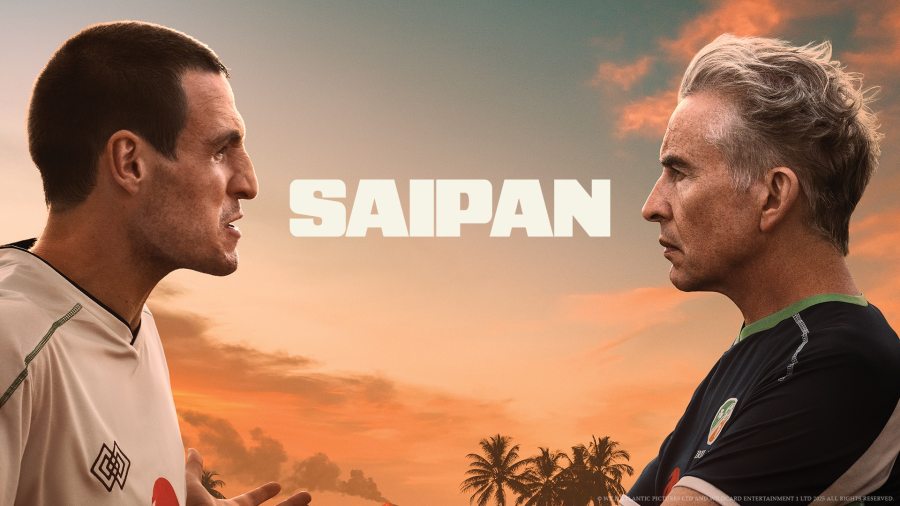
Quick Synopsis: A recreation of the Saipan incident involving the Republic Of Ireland national team during the 2002 World Cup. If those words mean nothing to you, this film isn’t for you.
The last football movie I watched was Balls Up. That movie was fucking terrible. All Saipan had to do was be better than that. Obviously it managed that; if it hadn’t, you wouldn’t be reading this; you’d be reading a news headline saying “Makers of film attacked by a crazed/idiot reviewer”.
That’s not to say it’s a fantastic watch. For all its faults (of which there were many), at least Balls Up was memorable (except for the title, because I’m still not 100% on whether it’s called Balls Up or Balls Out). Saipan isn’t. It won’t move you, teach you, or linger in the memory. It’s just there. It’s the film equivalent of the 90’s song Save Tonight, by Eagle Eye Cherry. In the moment, you’ll enjoy it, and it’s hard to find many faults. But it won’t take long for memories and warm feelings to fade. That’s both a positive and a negative. Saipan never embarrasses itself. You never sit there bored, or annoyed. But it also never threatens to become anything more than “just okay”.
On the face of it, it rivals Seinfeld for being a piece of media about nothing. I mean, really. “A footballer shouts at his boss and quits mid-tournament” doesn’t sound like the sort of event that legends are built around. Nobody was physically harmed. Nothing was damaged. Ireland came second in their group (eventual finalists Germany topped the group), and ended up going out of the tournament on penalties to a Spain side that were on the cusp of being one of the greatest international teams of all time. There’s no Sliding Doors “but what would have happened if he stayed?” alternate history. All that would have changed is how they played, the final result wouldn’t change.
But that’s missing the point somewhat. It’s not just about that incident. It’s about professionalism, national identity, and personal pride. The reason the incident dominated headlines wasn’t because of what happened; it was because of what people thought it meant. There’s no clear-cut right-and-wrong side. To some people, Roy Keane was a selfish egotist who had no idea how to be part of a team. But to others, he was a perfectionist who refused to lower his standards and was extremely disappointed when it seemed like everybody else wasn’t taking the tournament seriously. To some, Mick McCarthy was a realist, attempting to deal with an egotist (Keane) who was being encouraged by his club manager to treat the international team. Whereas to others, he was woefully out of his depth, weak, and should have never got hired in the first place.
Saipan understands this. It doesn’t portray either side as wrong. They’re both right, but they’re having different arguments. I genuinely have no idea where the writers or directors stand on the issue. The script is impressively neutral. Perhaps that’s because all the principal figures are still alive and theoretically capable of hiring lawyers, but whatever the reason, it works. The film trusts the audience to make up their own minds.
There are a few issues. The main one is that Eanna Hardwicke looks nothing like Roy Keane. That, in of itself, isn’t an issue. Michael Sheen has shown time and time again that it’s more important to capture personality than accuracy. And it wouldn’t be an issue here if it wasn’t for one thing: the film opens with a montage featuring the real Roy Keane multiple times, repeatedly reminding the audience what he actually looks like before cutting to an actor who bears very little resemblance to him. It’s an odd decision. Why not keep Keane at arm’s length at first? Show him from behind, in silhouette, or at a distance. Build up the myth before revealing the actor. Instead, the film practically invites the comparison, and it’s an invitation that you can’t receive well.
The other issue is that it doesn’t do enough to explain why any of this mattered.
The film assumes a certain level of prior knowledge and doesn’t spend much time bringing newcomers up to speed. Non-football fans will still understand the basic facts. They’ll grasp the what and the when. But I’m not convinced they’ll fully understand the why. Which is a shame, as the why is the most important part.
Ultimately, it feels like a TV drama, albeit a very good one. It’s consistently engaging, well-acted, and intelligently written. It’s also surprisingly difficult to feel strongly about. The real incident sparked years of anger, debate, and discussion. I don’t think it’s particularly cruel to suggest that the film probably won’t. That sounds harsher than I intend it to. I’d still recommend it. It’s a solid, thoughtful piece of filmmaking that treats its subject with far more nuance than I expected. I’d say you should watch it, but watch it with someone who remembers the actual event. You might find their talks as every bit as interesting as the film itself.

