
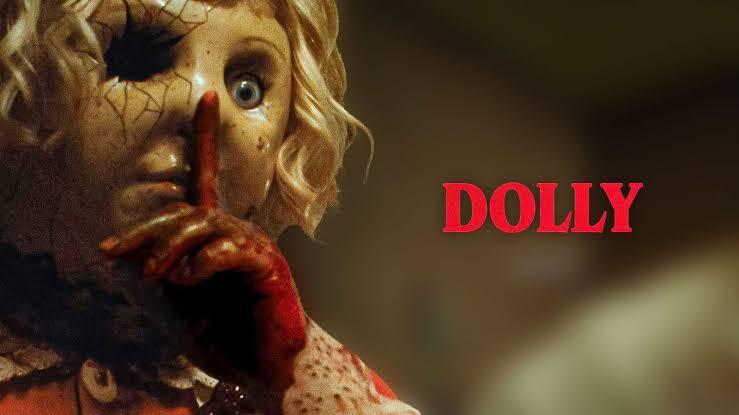
Quick Synopsis: Macy, a young woman who fights for survival after she is abducted during a hike by a monstrous figure intent on raising her as its child.
I was looking forward to this. Max the Impaler is my kind of person, and I like horror movies, so this should be right up my street. It’s not; it definitely took a wrong turn and ended up on a street with the same name but in a different town. That said, it could be just that Dolly and I aren’t speaking the same horror language. I know that certain people will absolutely love this. Dolly has an 80’s throwback aesthetic. The colours and presentation make you feel like you’ve stumbled across a hidden 80’s slasher. Specifically, one on a cheap VHS that isn’t legally available in this country, so you had to get it from a dodgy tape trader, watched so often that the defects become part of the cinematography.
There are moments where Dolly has its creepy moments (the film, not the character. Wait, no, the character too). The trouble is that it isn’t quite good enough to sustain them. Several moments felt repetitive. Horror films often recycle scares, kills, or visual motifs; that’s part of the genre. But when you’re already feeling that sense of déjà vu before the protagonist and antagonist have even properly crossed paths, something has gone wrong in the script. At one point, I genuinely checked to make sure I hadn’t accidentally rewound the film. The overly artistic editing doesn’t help matters either. Rather than enhancing the experience, it often feels like it’s actively getting in the way.
The editing creates some practical problems, too. Characters reach for an object, and the cuts are so rapid that we don’t actually see what that object is. That’s an issue when the object is about to be used as a weapon. It’s difficult to fear someone being hit by an object if we don’t know what the object is. Is it a smoked haddock, in which case it will hurt but not likely kill the person (the fish, on the other hand, that’s probably gonna die). Or is it a wrench, in which case, yeah, that might kill a mofo.
That same uncertainty extends to Dolly as a character. The mask obscures so much of their face that we rarely get a clear read on what they’re thinking or feeling. This becomes particularly noticeable when the protagonist starts fighting back. Is Dolly frightened? Angry? Offended that somebody has stopped playing along? Excited because things have become more interesting? We don’t know. I know, similar horror films also have characters wear masks, such as Texas Chainsaw. But this isn’t Texas Chainsaw, no matter how much the ending desperately wants to make you think otherwise.
The good news is that when it comes to violence, the film absolutely commits. Rod Blackhurst understands gore and, more importantly, understands impact. The violence here isn’t stylish or glamorous. It’s ugly, messy and unpleasant in exactly the way real violence should be. The injuries look painful, the deaths feel convincing, and the kills strike that sweet spot between inventive and deeply uncomfortable. These aren’t deaths that the audience cheers or goes “woooo” to; they’re deaths that are made to sicken you.
I also found Dolly surprisingly compelling as a character. They’re simultaneously terrifying and tragic, which is a difficult balancing act to pull off. It’s the kind of horror villain that future sequels would almost certainly ruin by explaining too much. As they stand here, though, they’re fascinating. You could even imagine a sequel where Dolly somehow ends up becoming the protagonist. I hope not, but you can see it happening.
Ultimately, Dolly felt like a Rob Zombie movie, and that’s not a compliment.

