
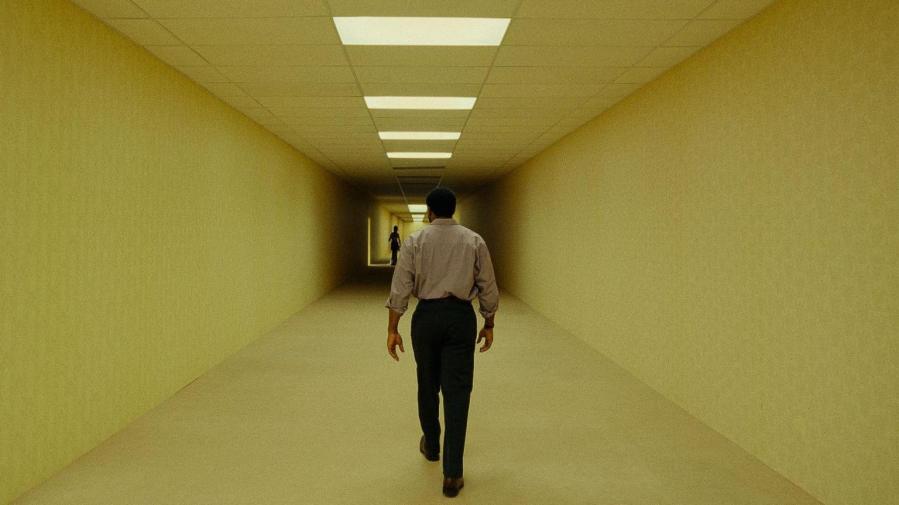
Quick Synopsis: Failing furniture store owner Clark accidentally stumbles upon a dimension of seemingly endless liminal spaces in this movie based on the popular internet legend.
My local cinema offers a membership card that lets me watch as many films as I want for a monthly fee. As a result, I technically haven’t paid for a cinema ticket since 2020’s Fantasy Island, which remains one of the worst films I’ve ever willingly sat through.
That changed with Backrooms. I was visiting friends when we decided to see it, but after missing our original screening, we had to buy another set of tickets. In effect, I paid to see Backrooms twice. You’d be forgiven for thinking that experience might have predisposed me against it. (I’m still not entirely convinced that my dislike of Oculus isn’t partly due to the cinema staff turning the lights on ten minutes before the ending.)
Adding to that, Backrooms is based on an internet urban legend I knew almost nothing about.
It’s a testament to the film, then, that I didn’t just enjoy it: I loved it. It’s deeply unsettling, although pinning down exactly why can be surprisingly difficult. If you described some of its most effective scares to someone who hadn’t seen it, they’d probably look at you as though you had “stare here” tattooed across your forehead. “Man walks around an empty room in silence” sounds more depressing than frightening. In that sense, it reminded me of Vivarium, which somehow turned “a couple driving around a suburban street” into one of the most unnerving sequences I’d seen in years. The difference is that Backrooms is actually good.
As I said, I wasn’t particularly familiar with the original urban legend going in, although I’ve since conducted extensive research; by which I mean I watched an eleven-minute YouTube video. From what I can tell, the film adapts the concept remarkably faithfully. It doesn’t feel the need to introduce random demons, sinister corporations, or some grand mythology to explain everything. The horror comes from the unknown. And by “the unknown”, I mean the abstract concept, not the strange metallic-faced creature from that infamous Willy Wonka experience in Glasgow.
That’s a difficult balance to strike. The Backrooms are fundamentally an idea rather than a story, and if you’re not careful, a film adaptation can easily end up looking like a bloke wandering around town while nursing the world’s worst hangover. Somehow, Backrooms manages to avoid that trap.
The characters help enormously. At first, you might congratulate yourself for seeing through Clark, played by Chiwetel Ejiofor. While he’s attending therapy sessions, it’s easy to sit there thinking, “Yeah, but you’re still an abusive arsehole.” The clever thing is that the film wants you to think exactly that. Clark is selfish, unpleasant, and often his own worst enemy. That’s precisely why he makes the choices he does.
His gradual transition from protagonist to supporting character is handled with impressive skill, even if I would have appreciated a little more clarity regarding how long he’d actually been trapped. As he recedes into the background, Renate Reinsve effortlessly takes centre stage. I’m not particularly familiar with her work, although both The Worst Person in the World and Sentimental Value have been sitting on my watchlist for a while. Her performance here only makes me more eager to get around to them.
What impressed me most about both leads was how believable they felt. These aren’t horror-movie caricatures sprinting from room to room while delivering exposition. They’re terrified. Exhausted. Broken down by an environment that seems determined to strip away every ounce of certainty and confidence they possess. You can practically watch their personalities deflate as they venture deeper into the building.
Anyone familiar with the original images or videos will immediately recognise the aesthetic. Endless yellow walls, harsh fluorescent lighting and chairs and tables that appear to have become partially absorbed into floors and walls. The production design is extraordinary, and the sheer amount of effort that went into creating these spaces is evident in every frame.
That said, I actually preferred the moments that looked cheaper. The grainy footage, muffled audio, and degraded visuals gave the film a grimy authenticity that made everything feel more real. The more conventionally shot scenes are still unsettling, but they occasionally possess a level of polish that feels slightly at odds with the concept. It’s difficult to fear a place that sometimes looks as though it belongs in an expensive architectural photography magazine.
My biggest reservation concerns the sequence involving the malformed human imitations. I understand what the film is aiming for, and the interpretation that the distorted woman represents Clark’s wife at least gives the scene some thematic weight. Even so, it felt like the film was pushing a little too hard.
It’s not a bad sequence. Far from it. It’s creepy, strange, and often fascinating to watch. It just feels like a slight detour from what makes the rest of the film so effective. The horror of the Backrooms comes from vast emptiness and uncertainty; introducing recognisably monstrous figures risks making the threat feel too tangible.
Also, the pirate looks goofy as fuck.
Still, these are relatively minor complaints. For the most part, Backrooms is one of the year’s finest horror films, and one that genuinely changes the way you look at the world around you.
After leaving the cinema, I found myself walking through a near-empty Tube station late at night. Somehow, that experience was more unnerving than ninety percent of horror films I’ve seen. That’s the mark of a truly great horror movie: not that it scares you while you’re watching it, but that it continues to haunt you long after you’ve left the safety of the cinema. If you get a chance, go see this on the big screen. It simply won’t have the same effect watched on a mobile phone or a train etc.

