Nuremberg (2025) Review

Quick Synopsis: As the Nuremberg trials are set to begin, a U.S. Army psychiatrist gets locked in a dramatic psychological showdown with Nazi war criminal Hermann Göring.

Movies can be useful teaching methods; numerous lives have been saved because kids have seen someone perform the Heimlich manoeuvre in movies. The lessons and themes that films feel the need to teach can often be indicative of the times they’re set in; the 60s were full of films warning of the danger of nuclear war. So it’s a bit weird to see a film in 2025 warning the audience of unchecked hatred leading to horrors. “How did this happen?” “because people let it happen”. Even more concerning is that this is somehow a controversial lesson.

It’s a lesson that’s taught very well in this film. We see how people who are evil are still people. This isn’t shown in a way to humanise or justify them. If anything, it makes their actions more horrifying. What’s more likely to scare you, the knowledge that some people are born evil and can’t be changed, so just stay away from them, or the feeling that one day your neighbours and friends will be the ones to pull the trigger on you? Nuremberg is incredibly effective in that aspect. It must have been a tricky movie to write because it’s a legal drama where everybody watching knows the people were found guilty.

Somehow, this film is still interesting. Part of that is down to how much detail it goes into. It explains the importance of legal procedure. The law is often seen as a hindrance in movies and television. Seriously, watch how many police TV shows operate on the basis of “if the cops arrest someone, they’re guilty. Lawyers just stop the police from doing their job”. Nuremberg shows how if the law isn’t implemented properly, you’re fucked. It explains easily how difficult the job was. Looking back, it may seem like they had a slam dunk case, but there was no precedent for foreign states punishing people for crimes against their own people. Before this, the only people who could bring a legal case were the leader of the country itself, which, for politically based crimes, you can see would be an issue, especially one where a lot of people in the country either agree with what happened, were directly involved, or deny its existence. As an examination of the time, this is tremendously fascinating.

Now onto the downside, and it’s a pretty big one. Rami Malek is not at his best here. His attempts at anger during some of the key scenes are almost laughable. It’s quite hard to take him seriously as he comes off like he’s auditioning for a comedy. This could be the role of a lifetime for some actors, but his performance is so low effort that it feels like a contractual obligation rather than something he’s actually excited about. I also wasn’t impressed with the climax of the trial, where Sir David Maxwell Fyfe (who later helped drive Alan Turing to his grave, so fuck him) successfully goads Goring into admitting he still has admiration for Hitler. It’s the key moment in the trial, and is the reason for the trial ending the way it does. For whatever reason, it doesn’t land. A moment like that should feel huge; there should be a sense of “oh, he fucked up there”. Instead, it just feels like another sentence. You’re not left with “oh, that’s it!”, instead it’s “oh, that’s it?”.

In summary, a pretty good movie. But I’d rather watch a documentary about it than see it again.

Lee (2023) Review

Quick Synopsis: The tale of Lee Miller, acclaimed war photojournalist

This review was going to be so simple. It was just going to be a lot of jokes about how the name character has the same name as me. Lots of “I don’t remember doing any of this” stuff. It was going to be SOOOOO dumb but funny. Now I can’t do that. And I can’t do that because this film is too good for that. It’s deeply emotional and important, and making stupid jokes about it feels like it would cheapen it a lot. Stupid Lee, being too good for me to make jokes about, as all my friends say: Lee ruins everything.

Lee is not perfect, at times it feels like it assumes you know the importance of certain images, so you’re sitting there and being amazed at the recreations and new insight into how they were constructed etc. As it is, you spend a few moments with no idea what is happening. My other issue, and it hurts me to say this, Andy Samberg is not as good a dramatic actor as the other performers. In a lot of films, that would be okay, but here, he’s opposite Kate Winslet who is at the top of her game. Despite my prediction towards small weird stuff, and my avoidance of the obvious big-budget films (by which I mean, I haven’t seen Titanic), I’ve always been a fan of Winslet, mainly because she’s in the supremely underrated Heavenly Creatures. This is off-topic, but she also seems like a hugely brilliant human being.

The other downside of Lee is going to make me sound a bit weird. There’s been a lot of Nazi films lately. Not films about Nazi leadership, or even the soldiers. But a focus on the ideology, about how it penetrates everyday society and needs to be snuffed out before it poisons. This concerns me. Not because I think “but free speech! people should be free to be racist idiots!” or “WOKE!” etc. But because writers, even those writing about the past, are ALL writing about the current world. So I’m slightly uncomfortable that so many writers in 2020’s feel the need to point out how nazi’s are bad, we don’t have that many “don’t eat lava” films, because we all know that’s obvious. So I’m worried that there is a resurgence in Nazi viewpoints being accepted in polite society, and astute writers are noticing that.

Otherwise, this is damn fine. There is so much to like about this. It’s shot beautifully for a start, done in such a way that it really makes you feel like you’re in a different time. The story is what’s key though. It’s incredibly engaging throughout. It’s the closest I’ve seen to Civil War in terms of how it details the importance of war photographers (incidentally, the lead character in that film was named after Lee Miller). It does so much right. Importantly, it starts off pre-war. But in a time where, in hindsight, war was inevitable. It’s fascinating to see how dismissive they are of the looming threat. It also provides a huge contrast when war does break out, even when you don’t see them, you are aware of what has happened to some of the characters we were introduced to in the opening (although it could do a better job of reminding you they are when they’re mentioned near the end).

In summary; there is A LOT to like about Lee. It’s harrowing, beautiful, and absolutely essential. I’ve seen some movies where the audience stands up and leaves the very second the closing credits start. Sometimes people sit there, but from the general hubbub, you can tell they’re just waiting for a credits scene. With this, there was silence, not of shock, not of exhaustion, but one of appreciation, almost reverance.

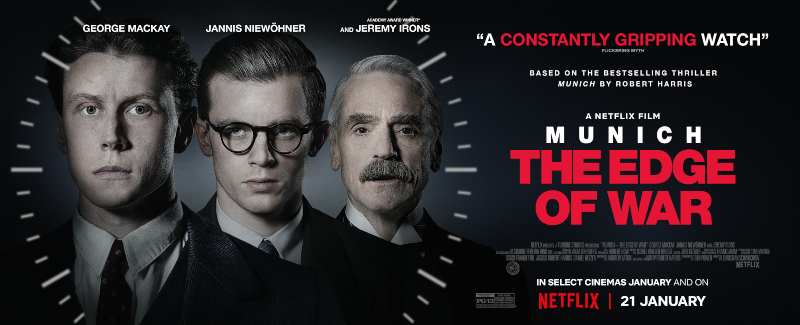
Munich: The Edge Of War (2021)

Quick synopsis: Set in the fall of 1938, Hitler prepares to invade Czechoslovakia, claiming it historically belongs to them and they promise they’ll stop there (definitely no modern parallels there, nope, it would be a made thing to Putin this blog). The government of Neville Chamberlain desperately seeks a peaceful solution. A British civil servant and a German diplomat, former classmates, travel to Munich to discuss peace.

Yup, it’s another World War 2 movie, because we haven’t had one of those for a few weeks. This is different though, rather than the standard “our brave boys”, or even a “Winston Churchill was the greatest person who ever lived. And if you point out that he wasn’t perfect in every way, then you just hate freedom”.

Neville Chamberlain is often portrayed negatively in WW2 movies, he’s shown as a blundering idiot who trusted Hitler and opposed Churchill. Most historians disagree with this assessment, arguing that he knew Hitler was lying and just signed the peace treaty to delay the inevitable. This is backed up by the fact that the first thing he did when he came back, is increase the production of weapons and vehicles. Hitler later stated that if it wasn’t for the peace treaty then he would have invaded earlier and possibly won the war. So really, Chamberlain was responsible for the war being won, despite knowing what it would mean for his public persona. It’s good that we finally get a film that shows that.

So that’s the historical reasons for me liking it, how about as a film? It’s actually pretty good. The performances are great, it’s not going to make George MacKay a household name (although it is disappointing that 1917 didn’t quite manage that either, as he was great in that), but it provides a good example of what he is capable of. Really, his biggest problem is that he shares a screen with Jeremy Irons, and anybody looks weaker compared to him.

From a technical viewpoint, it’s fine. There are no stand-out shots, but it looks good throughout, the music suits the film, and it all flows together wonderfully. Christian Schwochow did a pretty good job, the organic and natural look to it making the whole thing feel less like a film, and more like a play we’re watching unfold in front of us.

On the downside, it could do more with the flashbacks. The film focuses heavily on the friendship between three people, it bookends the entire thing. There are a few flashbacks there, but I feel if we saw a bit more of it it would mean more. As it is we see a scene where they are friends, and then the next time we see the three of them they’re having an argument about whether Hitler is the savior of Germany, or a not very nice man.

The whole character arc for Paul is a bit strange really. We see a flashback of him being excited to see Hitlers Germany, then in the present he’s working to bring down Hitler, and then flashbacks of him being radicalised. It’s a weird way to do it as it means that every time we see him he feels like a wildly different character. What his character does do well is showing how ordinary people became anti-semetic. He even says “I knew he was racist, I thought we could put all that awful stuff aside”, but it never really shows why Germany felt like that in the first place. If it examined more about German pre-war feeling, about the economic anxiety and troubles they were going through it would do a better job of showing why people did what they did. It is shocking how normalized the hated was. There’s a scene where a group of people are surrounding a Jewish couple who are being forced to clean the floor, everyone is just shouting slurs at them like it’s the most natural thing to do.

So in summary, it’s a good film, available on netflix and you should definitely watch it, very reminiscent of Bridge Of Spies if you enjoyed that. But maybe it would have been better as a mini-series. Give the characters more chance to develop and breathe.