
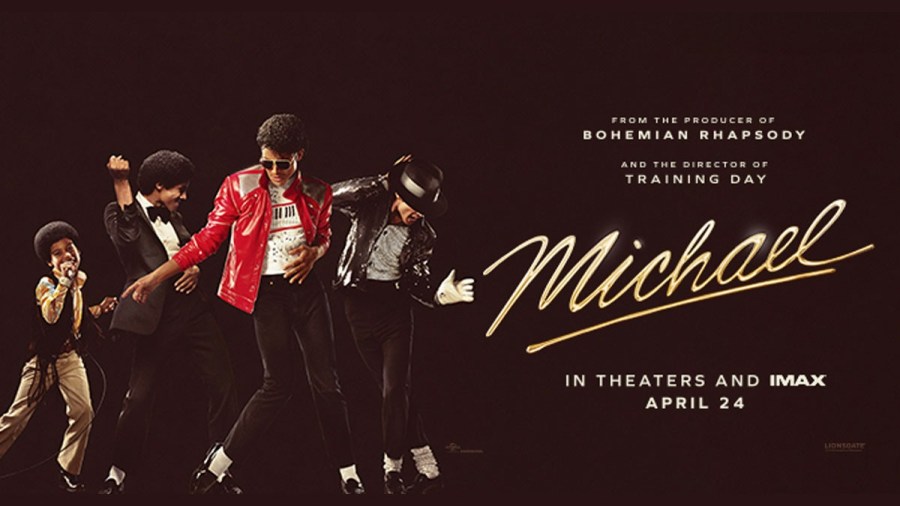
Quick Synopsis: A look at Michael Jackson, apparently, he was famous.
I think it’s fair to say that Michael Jackson is probably the biggest celebrity of my lifetime. The magazine Forbes used to run a feature every year where they talked about the 10 biggest celebrities of that year. The top 10 in 2014 (the final year it ran using a complex formula rather than just “who made the most money) included Ellen DeGeneres, Katy Perry, Floyd Mayweather Jr, and LeBron James (no prizes for guessing which country Forbes is based in). No disrespect to Mr James, but I don’t think there’s many people who would argue that any of them have a bigger cultural footprint or recognition than Michael Jackson, and that was 5 years after he died. So it makes sense that a film about his life would be made and be financially successful. This is probably the biggest film of the year so far. Other films have been made since he died, but they’ve all been unofficial, leading to them being criticised by his family members. Michael not only has the approval of most of his family members (not all; his brother Tito sadly passed away in 2024, and his father Joe, not as sadly, passed away in 2018), but has a lot of family members involved as executive producers, and Michael’s own nephew Jaafar was cast in the title role.
So what does John Logan do with this unique position of writing an official Michael Jackson film? Not a damn thing. A biopic needs to achieve at least one of the following:
- Teach you something factual about the subject.
- Give you an appreciation of their talent.
- Examine its subject in detail.
This movie does none of that. Michael Jackson had a full life, being in the public eye for roughly 43 of his 50 years on the planet. It’s not just longevity; his life story is full of chapters worth exploring: from his childhood fame, his marriages, his relationship with his family members, his health issues, plus his (let’s not mince words here) weirdness. How can a singular film ever hope to cover all of that? Answer, it doesn’t. It briefly mentions all of them (except the marriages, which are ignored), but doesn’t go into detail about any of them. It’s the biographical equivalent of listening to 30-second samples of a band’s greatest hits; you get the choruses, but none of the verses which build up to them. You see him perform Billie Jean, but are you given any indication as to the story behind that song? Nope. You see him adopt Bubbles the monkey, is there any examination as to the chaos that caused, or a mention of how the other house members had to adapt? Nope. The idea that his adult eccentricities were a result of him not having a childhood is not given any time, and like most things about this film, if you didn’t already think that, this film wouldn’t put that idea in your head.
Michael is not interested in examining the subject, holding a mirror up to it. Instead, it kneels before it in reverence. There are multiple scenes which exist only to tell the audience how nice he was, how talented he was, how unlike everybody else he was. The film also glosses over some of the more interesting parts of his life. It doesn’t even allude to the thing he’s most known for, a certain incident involving a 10-year-old boy. Yup, a film about Michael Jackson somehow didn’t mention his appearance on The Simpsons. Oh, it also didn’t talk about the child sexual abuse scandal. But I have no issue with them not mentioning that, and I won’t attack the film over it. Mainly because the film legally couldn’t talk about it due to a settlement. So it’s difficult to criticise a movie for something it has no control over; it would be like criticising a fish for not being able to make an omelette. The fight to get MTV to play his music video (the channel had a policy of not playing music by black artists, but this totally wasn’t racism on their part) is limited to a single scene. In fact, there’s barely any mention of racism at all, almost as if the film is scared of tackling any important subject. The Jackson 5 Victory tour of 1984 is seen as a triumph that led to Michael and his brothers regaining control over their own lives, and was only caused by the father emotionally blackmailing Michael to join his brothers. In reality, Michael was pressured by everyone in his family, including his mother and brothers. There were issues with ticketing as tickets were extortionately expensive, could only be purchased in batches of four, and weren’t guaranteed. Instead, there was a lottery system, so you had to pay for tickets, the money would be held in an account for 8 weeks, and then a lottery would be held to determine who was successful. At which point, if you weren’t successful, then your money would be returned, but the company would have made A LOT of money on the interest from the account. Michael himself was vehemently opposed to this idea as he felt it priced out less affluent fans. This could have been a plot point: a genuine moment where he tried to stand up for his fans and managed to convince his brothers how bad an idea it was. For these events, he also set aside some tickets that he would give away to poor children. Again, a genuinely nice thing to do, that you wouldn’t know about if you watched this film. The ticketing system also enraged James Brown, causing him to pull out from playing with the Jacksons in New York. How is that not a moment in this film? Picture it: Michael being approached by one of his idols, flashbacks to Michael listening to James Brown records, and James Brown being disappointed in him, leaving Michael crestfallen.
Of course, that would only work if the Victory tour was a centrepiece that the film anchored itself around. That’s what this film needs. It has no central idea or event. It’s not really about anything. There’s nothing for Michael to overcome in the grand scheme of things. No giant mountain for him to conquer, just a series of small hills. So there’s no flow to it, nothing connects to the next scene. All it is is: something happens, skip forward 2 years, something happens, skip forward, something happens, skip forward, repeat. I don’t even think it told you he died.
Like most biopics, especially around musicians, Michael is bookended with a specific event: Michael performing at Wembley Stadium. Obviously, playing Wembley is a big deal. But the film doesn’t tell us that. It doesn’t tell us that he planned this to be his final tour, as he wanted to go into filmmaking. It doesn’t tell us that the tour was the highest-grossing in history at the time, and had the largest audience. It doesn’t even tie into the narrative, as we jump straight into it after the 1984 Victory tour. Also, it draaaaaags. A performance of one of the most charismatic performers of all time should not be as painfully dull as the closing section of this movie is.
It’s not just Michael’s charisma that this film misses: it robs him of any sex appeal. It’s not acknowledged much today, but a lot of his branding was based around sex. Although for that to work, the film would have to portray him as an actual adult rather than the naive manchild it insists on portraying him as.
On the bright side: there’s no denying how good his songs are, and I appreciate how much effort the film put into showing the effort that goes into crafting them: not just the writing, but the recording and production too. Jaafaar Jackson is put into an almost impossible position of trying to emulate one of the most famous people of all time. Whilst it’s not perfect, it’s hard to see someone doing better. Colman Domingo is the only performer truly allowed to let rip, giving Joe Jackson an intense energy that is downright captivating, whilst never being heroic or nice. Joe Jackson was a piece of shit in real life, and Domingo shows that. On the downside, much like The Iron Claw, it actually tones down how much of a dick he was. There’s no mention of the allegations that he sexually abused La Toya. Probably because that would mean the film would have to devote screentime to someone other than its lead character.
Ultimately, this is a film for Michael Jackson fans. One that will help them justify their fandom of him. A love letter to a complicated man, which is something that certain people will love. But there’s nothing here for most people. If this film were any more shallow, it would be sung by Lady Gaga and Bradley Cooper.
 Troubled Productions