
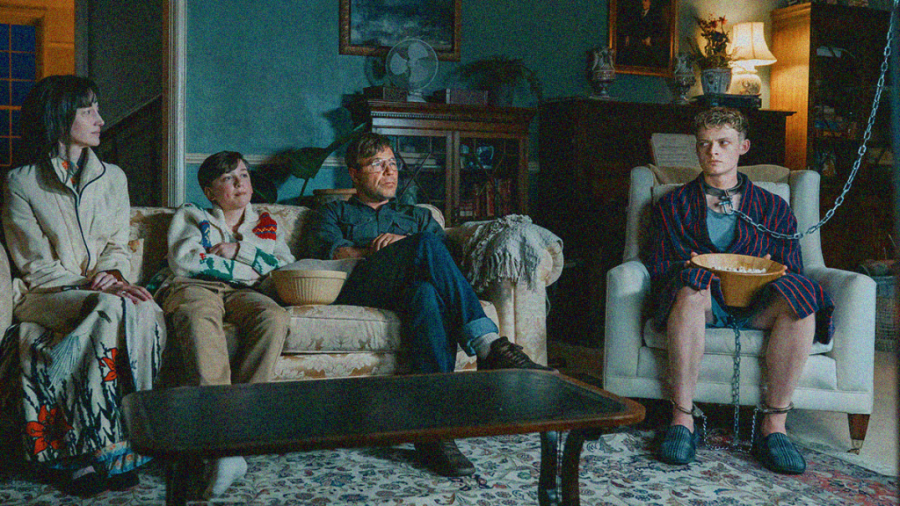
Quick Synopsis: A couple try to rehabilitate a teenage criminal, by kidnapping him.
Thoughts Going In/Expectations: None. I didn’t even know this film existed, and considering it was a secret screening I had no idea what type of film it was until at least 5 minutes in.
This could have been terrible. It could have ended up being overly Guardian Newspaper, either going “we just need to teach those ruffians good manners” or “these louts are too low class to fit in. They should be killed”, both of which would have been extremely annoying. In the end, the most annoying part of this movie is the title: released as “Heel” in some locations, “Good Boy” in others, and even more confusingly, being called “The Good Boy” in some publications. I’m just gonna go with “The Good Boy” as it sounds more like a title than Heels, and I already have a film called Good Boy from 2025 reviewed in the archives.
So that’s an entire paragraph about the title, how about the film itself? It’s fine. I don’t regret watching it, but I won’t rush out to see it again. It’s narratively and thematically ambitious. Stephen Graham continues to give a performance that isn’t Oscar-worthy, but you can easily imagine being used as justification for a studio casting him in something that would win him one. Andrea Riseborough is up there with Sally Hawkins as one of the most consistent British performers around. Fun fact, this isn’t the first time the two have played a married couple; appearing together in the film adaptation of the Matilda musical, which I haven’t seen, but I’m guessing is tonally very different from The Good Boy (TGB, pronounced Ta-goob). Without those two performers, TGB would be terrible. It’s anchored by those two, with both giving just enough layers to their performance to make the characters believable.
As I alluded to earlier, I had no idea what kind of film this would be when I sat down to watch it. The opening scene depicts Tommy. Tommy is a dickhead. He starts fights, pisses at bus stops, and is generally the kind of person everybody hates to see walk into a pub. I was concerned he was our lead, and we were going to spend the film watching his everyday life; I was not looking forward to it. I detested this guy, but it turns out that’s what the film wanted us to think: so that when he’s knocked out and chained in a basement, our first thoughts aren’t “oh, that’s terrible”, they’re “oh, he probably deserves this, it’s probably due to something he’s done in the past”. Those thoughts are fleeting because obviously they’re terrible things to think. But they are there, and the film wants those thoughts there. It wants us to be morally conflicted. We have a couple who have kidnapped someone, keeping them locked in their basement, and beating them whenever they feel he gets out of line. That’s all shitty, obviously. But the audience isn’t completely repulsed by them. It’s an incredibly fascinating, morally complex piece of viewing.
Until the closing section. The film hints at a disturbing past for the characters: a past which shapes their motivations. It feels like it’s building up to a revelation, something big that will recontextualise everything we’ve seen: constant mentions of someone called Charlie who used to live there. We see Tommy bullying a child, maybe that child was Charlie and he ended up killing himself. Maybe Tommy drunkenly caused a car accident that killed him. Maybe Charlie took a wrong turn and ended up overdosing, so the couple try to stop others walking that path. Or maybe he wasn’t even their child, but was another hostage who they’ve failed so is now dead to them. But subtle hints towards the past are all we get, and it’s too vague to be satisfying.
That’s not the other way TGB runs out of steam: the Macedonian housekeeper is dispatched with all the narrative efficiency of an Evri parcel. You could excise her subplot completely and it wouldn’t matter that much. The only impact she has is when she’s attacked at the end and Tommy stands up for her. That’s it. Might it have made more sense if it was one of Tommy’s friends, and the moment functioned as a clear divide between his past life and his future?
In summary, a feature film is possibly not the best way to tell this story. A book would have worked; each chapter from the POV of a different member of the household. A play would be intriguing, it already has a limited number of locations so would be easy to do. Even better: an episode of a TV show. Specifically, an episode of Inside Number 9. It does occasionally feel like an extended episode of that show, for better and worse.
TGB is one of the most fascinating and interesting films of the year, and if it sorted out the final 10 minutes it would have stayed as such.
 Troubled Productions