The Second Act aka Le Deuxième Acte (2024) Review

Quick Synopsis: It genuinely doesn’t f*cking matter, seriously.

It’s weird how a trailer can win you over by not showing a single second of what’s in the film. It may seem counter-productive to not include anything from the movie in the trailer, but sometimes it’s not needed. Sometimes, all you need is a way to tell people “This is the tone and style”. The Second Act (TSA, pronounced Tizz-ah, but not like the drink) trailer did that brilliantly and is probably the best trailer I’ve seen in a while. It tells you everything while showing you nothing. The complete opposite of most Marvel trailers.

Now, the film itself. It’s meta and weird. Near the start, a character says something mildly transphobic and then is told “You can’t say that we’re being filmed” Then the character tries to rephrase it differently. He doesn’t say that as the character, he says it as the actor playing the character, if that makes sense? It’s a weird moment, the first of many, and how you react to that scene will let you know whether its worth continuing with the rest of the movie. Personally, I found it funny. But I will admit that it does highlight a small issue I had with this; it is occasionally too meta. As much as I do love the opening scene and how meta it is, there is still a small part of you that thinks “Get on with it”. I’m not saying be less meta, I never say that, but spread it out more among the story. As it is, TSA will stop the story for 5 minutes to focus on meta-commentary, then pick up the story again. In a film that’s less than 90 minutes long, that’s a lot of waiting around. There should have been a more seamless way of threading the meta-ness through the narrative without pausing. I typed that after 10 minutes. Really I should delete it because this film wouldn’t exist without the meta. All it has is “we’re actors making a film” and fourth wall breaks upon fourth wall breaks (16 walls?).

That kind of stuff is to be expected from fans of Quentin Dupieux, those who watched and enjoyed the *checks notes* sentient tire that kills people with psychokinetic powers movie Rubber, will enjoy this. It’s very similar, you have to go into it expecting it to break the very notion of narrative and cinema, you’re not watching it for the plot, you’re just watching it for the experience of watching it. If you are expecting some form of sense, you’re going to be deeply disappointed.

I’m quickly falling in love with Lea Seydoux, she was phenomenal in The Beast, and continues to impress throughout TSA. She’s charming, friendly, and seems believable as a slightly frustrated actress. The others are all fine, but Seydoux is the best of a very good bunch.

From a technical standpoint, this is a marvel (and not just because it stops the plot to make jokes), not in terms of special effects or even outstanding beauty, but because of the tracking shots. Oh my science, the tracking shots. They’re so prevalent that the pre-credits scene makes a point of showcasing just how long the tracks were to make them happen.

Really the only thing to take from TSA? Films are silly. Making them is silly. Writing them is silly. So what not make it so watching them is silly too? It’s not for everybody, and I’d be lying if I said it wasn’t a slightly frustrating watch at times, but it’s also one that’s not entirely without merits.

Humanist Vampire Seeking Consenting Suicidal Person (2023) Review

Quick Synopsis: I feel the title adequately explains it.

As we approach the end of the year, I’m starting to think of the awards I will give out in January, and try to note the contenders for each award. Some are pretty much settled (Worst Moment is likely to go to Twisters for a character introduction that tainted the rest of the film). In contrast, some still require a lot of thinking (the Most Disappointing category is depressingly packed so far). One award that won’t be given is Best Title, if it was, Humanist Vampire Seeking Consenting Suicidal Person (HVSCSP, pronounced Hoo-vis-car-seep) would win that easily. I love that title, it promises so much. Not just the plot, but also the type of film it will be. A title like that is not going to be an incredibly depressing look at the human condition. It will be quirky, and it will be unique.

What you might not expect is just how damn sweet it is. It’s incredibly heart-warming, with the central relationship being more believable and recognisable than a vampire story should be. Some writers would have focused on the sexual energy of vampires, but HVSCSP is more sweat than sexual, and is all the better for it. I love the central relationship. There’s a moment between the two where they’re just sitting listening to music. There’s no dialogue, no dancing, they’re just sitting near each other. By all logic, that should be boring as hell. But it says something about the talent of director Ariane Louis-Seize, plus the performers Sara Montpetit and Felix-Antoine Benard that it works. You can tell there are moments when both of them want to speak, and you know exactly what they would say, and the characters know that too, so they want to respond, but because it wasn’t actually said, they don’t. That scene is a microcosm of the film as a whole; incredibly sweet and wholesome.

I’ve seen some reviews which have stated they wished this had more bite. I’m assuming they only said that for pun purposes. Cynicism and meanness would have ruined this. Yes, vampire movies usually do need to be dark and broody, but this particular film? It needs niceness. It’s like a Wes Anderson movie being caressed by Tim Burton.

Don’t get me wrong, there is some violence, but it’s used to tell a story. The killing of the clown in the opening scene is shown to have traumatised Sasha, so it makes sense that even with the ability to do so, she would be reticent to commit violence unless she needed to. This builds up beautifully to a moment where she violently attacks a group of people threatening Paul. If the film was filled with violence, that scene wouldn’t land. If the violence was shot as “cool” and fun, that moment wouldn’t land. HVSCSP understands restraint better than a German dungeon mistress and uses it to great joy.

It’s not perfect. The soundtrack is kind of bland. The aforementioned scene of the two listening to music together? Perfect song choice. The rest of the movie? Forgettable. I’m not saying EVERY film needs more 80’s dark synth music, but some Bauhaus would have improved this immensely.

I also found it difficult to get a solid grounding on the universe contained within HVSCSP. Are people aware of vampires but decide to ignore them? Are they aware but deathly scared? Do they consider vampires as mythological creatures? There are moments which support all three assertions, so it’s difficult to work out what world this takes place in. This leads me to the other problem; with the exception of the main two, the characters are all tremendously bland. It doesn’t feel like a real group of people, they’re not main characters in their own life, they’re only supporters of the tale we’re being told right now.

This is still a lovely film. It’s not among the best of the year, but it’s worth watching, even if only once.

The Beast aka La Bête (2023) Review

Quick synopsis: In 2044 the rise of AI has led to humans being deemed useless because their emotions compromise their decision-making. Gabrielle undergoes a procedure that will purify her and get rid of her emotions, a procedure which involves delving into their past lives.

Many of the films I review on this site are the ones you find everywhere. The last three films I’ve reviewed have all been expensive franchise pieces. In my defence, the only cinema I have near me is a Cineworld, so it’s not as though I get much access to obscure arthouse films. When I do, it’s normally on a streaming service, 9 times out of 10 it’s Mubi, which if you’re a pretentious film dick, is an essential streaming service to have. It’s on Mubi where you’ll find today’s film. A bizarre mostly French-language piece directed by Bertrand Bonello. I think this is the first foreign-language film I’ve reviewed on this site since Monster back in April (unless you count “shit, utter and complete shit” as a language, in which case, the haunted swimming pool movie Night Swim). It being mostly in French isn’t the thing that’s going to stop this from being a massive hit in English-speaking countries. Nope, what’s stopping that happening is that The Beast is, well it’s really fucking weird. I have a high tendency for weirdness, I’m currently sharing my room with someone who is so weird he decides what films to watch by using a random number generator, yeah it’s me. But there were a few times when even I was sitting here thinking “Wait, what the fuck?”. It’s an incredibly unsettling watch, where some scenes don’t make sense until twenty minutes after they happen. Unless you’re paying a lot of attention, it risks coming off as borderline incomprehensible. I’m not saying “explain everything, “but there are times when it’s overly complicated just for the sake of it.

It’s also oddly fascinating. Few films make you work as hard as this one does to appreciate it, and those that do are often not worth it. The Beast is a difficult watch, but it’s utterly compelling once it does have its hooks in you. Like all good science fiction, it says a lot about where humanity is now, and where it’s heading. The somewhat futuristic nature of the story is even weirder to take in when you realise it’s actually inspired by the 1903 novella The Beast In The Jungle, very loosely. I’m not that familiar with the original work, but I highly doubt that it’s about two people crossing paths over three separate periods whilst they undergo a procedure to rid them of emotion so that they can get a job in an AI-led world. I also highly doubt it would feature a section set in 2014 and be mainly about an incel douchbag.

The incel section is probably the most interesting, and not just because it allows George MacKay to play someone incredibly out of character, and do a phenomenal job of doing so. The version of him in the other two timelines is also interesting, but it’s the 2014 section which is the most fascinating to watch. The version of Lea Seydoux’s character in that timeline is very similar to her other versions. As talented as Seydoux is (probably the most well-known French actress to UK audiences due to her roles in Dune and No Time To Die), she’s not given much to-doux. Her performance is great, but it does feel like she’s playing the same through all three. It makes sense, they are supposed to be the same character just their past lives. Like I said, it’s a strange film. But it’s also beautiful. My brain tells me it was full of more colours than a cocktail-fuelled vomit, but when I actually sit down and think about it, a lot of the colours were quite subdued and real. The editing is a different story, there are some brain-melting scene transitions which are creepy in a way I can’t explain, it’s like the film is collapsing in on itself. It makes sense, most of the film is supposed to be her regressing to her past lives, so it would make sense that her brain would “rebel” against those unnatural intrusions.

In summary; I’m not sure how I felt about this. Which is a weird thing to admit in a review. At times ugly and confusing, at times beautiful and as unsubtle as a flashing neon sign. At times it’s unemotional and cold, but then it breaks you (especially near the end). You may love it, you may hate it. But if you’re a film student or you want to move into film as a career, this is probably an essential watch. Even on the moments when I wasn’t that big a fan of what Bonello was doing, I always respected him for having the creativity to try something new. Even the ending credits are inventive; instead of traditional credits, it just has a QR code, which is great for now. But I fear that in a few years time it will send you direct to either dick pics, guns, or a computer virus; either way, it will be something messy that you don’t want to go off in your face.

Anatomy Of A Fall (2023) Review

Quick Synopsis: A woman is suspected of her husband’s murder

I didn’t really know much about Anatomy Of A Fall (Aoaf, pronounced Eye-aff) when I watched it, when I came out of it I assumed it was a short movie, around the 100-minute mark. It’s actually 150. That says a lot about how incredibly paced this is. It’s odd as really you can sum it up quite quickly; a woman is accused of killing her husband. That’s it, we get a quick set-up, the death, and then the court case. I genuinely have no idea what the 2 and a half hours came from, despite not much really happening, nothing felt like it took up a long period of time. It says a lot about the talent of Triet that this works as wonderfully as it does.

He’s helped by terrific performances from Sandra Hueller and Samuel Theis, who have a chemistry which makes you think they’re constantly one sentence away from either murder or marathon sex (that’s sex that goes on for an extended period of time, not sex with/using the chocolate bar now known as a Snickers).

The look and general tone reminded me of a Nordic noir, but that might have just been the snow and the lighting. It also reminded me that I know next to nothing about the French legal system but it seems interesting.

It’s not as gratuitous as a lot of similar films have been. It’s not about the shocking death, but about the shocking nature of the human condition. It’s more about relationships and fractured romance than it is a mystery. I don’t really remember being transfixed into the mystery of whether she killed him or not. Really the only part of my enjoyment of this film that depended on the truth was whether it would match with the ending. If she didn’t do it and was free then that’s fine, if she did it and ended up being found guilty that would also be fine. But if she did it and got away with it, or didn’t do it but was convicted anyway, then I would have soured on it. Thankfully, the ending does play it true and wraps it up nicely too.

I mentioned earlier that Aoaf reminded me of a Nordic noir series. But that’s not a good indication as to whether you’ll like this. Really, the closest I can think of is Gone Girl, and I mean that as a compliment. The central relationship is certainly more believable in this. It’s nowhere near as tense or as compelling. But that’s only because Gone Girl is superb. This is just very very good. I’ve only just touched on all the wonderful building blocks that go towards the creation of the house of Aoaf. The honest look at depression, the way it handles media intrusion on celebrities’ lives, the balance between art and realism when it comes to violence, and the incredibly well-made scientific analysis made on screen. I have never been as comfortable yet also entranced as I have here.

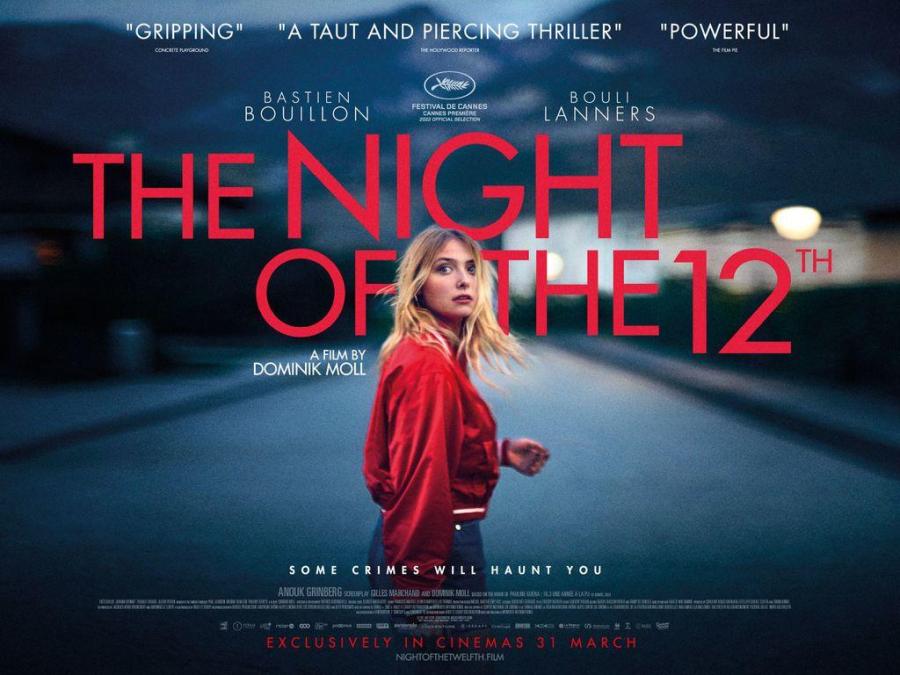
The Night Of The 12th aka La Nuit du 12 (2022) Review

Quick Synopsis: It’s said that every police officer has a case that haunts them, this is the story of one of them.

Many people aren’t going to like this for one simple reason; it’s a murder investigation where the murderer is never found. I know, spoilers, but in my defence, the film does open with text saying “A lot of murders are not solved, this is one of them” so you can’t exactly say you’re not surprised. But despite that, when the police are investigating the death, interviewing suspects, and following leads, you still have hope they’ll get the right person. So whilst it is frustrating, it’s also kind of genius. It’s like if someone came up to you and said “I’m going to con you out of thousands of pounds with a card trick” and being so masterful and charismatic that they manage to do it anyway even though you’re aware it’s coming.

Rarely has a film put you in the shoes of the characters as well as this. That frustration and annoyance when they don’t find their man? That’s felt by both the characters and the audience. The most frustrating part is the truth of the result. We’re used to police on-screen solving crimes and finding the person responsible, and it gives people a false sense of security that if something does happen to them, they’ll be brought to justice. That’s not just a pithy comment from me by the way, the way that television depicts forensic investigation has led to issues with juries overestimating how precise it is, to the detriment of justice. To know that THIS, this is how a lot of these investigations end is heartbreaking. It’s not just the fact it’s unsolved, but the sheer brutality of the murder makes it difficult to forget. It’s actually a really well-filmed murder. Far too many films about young women being murdered manage to make the murder uncomfortable but for the wrong reasons. They’re usually not uncomfortable because of the senseless death of a person, but because of the weird sexualisation of the murder; a young woman moaning when she’s penetrated by a more dominant male who is taking pleasure in his act. That happens far too often and it’s fucking weird. And those which aren’t sexualised are filmed in a way that either glorifies it or seems a bit gratuitous. The way it’s done in The Night Of The 12th is shocking; someone just walks up to her, throws fluid on her and sets fire to her. There’s no glamour, no sense that this is “cool”, it’s horrific, it’s unsettling, and it’s exactly how it should be.

None of this would matter at all if the performances weren’t up to par. There are not many performers who are that well known in the English-speaking world, but like all good subtitled films, eventually you forget it’s subtitled and just enjoy. Its weird, I can almost hear the dialogue, but I hear it in English.

Like all non-English/American films, there are a few cultural differences you need to get used to, but nothing too extreme that you’ll be lost. The cinematic language is slightly different from what you’ll be used to, but you’ll still be able to follow it, Dominik Moll does such a good job with the visual storytelling that even if you sit back in your chair and are unable to see the subtitles you’ll still be able to get a good indication of what is happening.

Now onto the downside; it’s almost two hours long and I don’t think it needs to be. The cycling sequences are there for a reason (to show the stress etc that the character is under) but they are a bit too long and repetitive, staying long past the point that they’re necessary. There is quite a jarring time-skip as well. Once you’re resettled in the new timeline it makes sense, but it just happens like a normal scene transition; should have been handled much better. It also provides slightly too much characterisation. That’s a weird thing to say, I know. But there are multiple instances of things mentioned, in a way that you think means they will be relevant later, that is never really raised again. It’s like Chekov’s Gun but if it misfires and shoots the walls.

Overall, an incredibly fascinating watch, but not an easy one. Plus, let’s face it, the lack of a conclusion will frustrate some.

Médecin De Nuit aka The Night Doctor (2020)

Quick Synopsis: Mikaël (Vincent Macaigne) is a doctor on night call. He looks after patients from underprivileged neighbourhoods, as well as drug addicts. We see his nightly work as he’s torn between his wife and his mistress, and embroiled in trafficking fraudulent prescriptions.

The trailer had me excited. It looked like it was going to be incredibly intense and dark. And while watching it, I was on board. But the longer the film went on, the more my fondness for it dulled. It’s one of those films which you think is really good as you watch it and see it unfold, but after setting up all these narrative dominos, it seems to get bored and wander off, so it just leaves you feeling unsatisfied. It’s a shame as there are some great performances in here, and some incredibly tense moments. But overall a lot of it feels inconsequential.

I know this sounds cheap and goes against my usual “all about the narrative” viewpoint. But this needed a gimmick. Maybe it would have worked if it was done as a one-shot, as that would have shown the chaos he’s going through, and his panicking would have seemed real. But considering how much driving is in this that would have been difficult. The best bet would have been to have it like Locke, all take place in real-time. Most of the conversations with his wife could have been done over the phone. as could his dilemma with the mistress and cousin. It’s hard to love this film knowing that if they did it another way it would have been SOOOO much better. The character in this is supposed to be panicking and feeling trapped, but we never really get that. We never feel much emotion for him and his troubles, we just feel like an observer. It’s not helped by the fact that the longer the film goes on, the less you buy him as a character. He overpowers seasoned drug dealers too easily and at times it feels like self-insert fanfiction. The only person he doesn’t seem to easily physically overpower is his cousin, he goes from “quickly punching people in the face and taking them out ” to “awkward grabbing”.

That moment comes just after he had a fight with notorious drug lord Ossip, who is one of those characters who is supposed to linger over the entire film, but in reality, doesn’t. You don’t feel his presence looming over when he’s not on screen. He’s not built up as a danger. If we saw him executing somebody, then he’d feel more of a threat. As it is you don’t really get that “oh no, he has to do this or that drug lord will harm his family”. The film tries to fix this with the ending, but the way they do it seems cheap and is done purely to get the sympathy of the audience with the main character. That’s the issue the whole film has, by the way, it doesn’t know how to treat the main character. We’re supposed to sympathise with him, but he’s quite unsympathetic. But done in a way that constantly justifies all his bad decisions. It’s like the writers want to create a morally complex character, but want to ensure we still sympathise with him.