The Odyssey (2026) Review

Quick Synopsis: Odysseus, the Greek king of Ithaca, undergoes a long and perilous journey home after the Trojan War and encounters mythical beings as he attempts to reunite with his wife Penelope

I don’t think I need to see another Nolan film ever again. My problems with Nolan are well documented: his scripts often lack emotion, while his dialogue somehow manages to both overexplain everything and leave you wondering what anyone actually means (as perfectly encapsulated in this video). Of course, actually hearing that dialogue has always been another challenge thanks to Nolan’s sound mixing (a problem that’s cropped up throughout his career, but reached its peak with Tenet). The result has always been films I admire more than I actually connect with.

None of that is why I don’t want to see another Nolan film. I just wanted to lull you into a false sense of security. I don’t want to see another Nolan film because The Odyssey feels like what his career has been building towards. The fragmented timelines in Dunkirk, the sense of foreboding that hangs over Oppenheimer, the manipulation of geography in Inception, his exploration of mythic heroes from Batman. Everything has been building towards this moment. Seen in retrospect, the rest of his filmography feels like practice for The Odyssey. Homer’s epic demands a filmmaker obsessed with time, perspective, spectacle and impossible journeys, qualities Nolan has spent twenty-five years refining

The internet has spent an impressive amount of time arguing about the historical accuracy of a film based on a myth. Some of it has simply been misinformation, claims that Elliot Page is playing Achilles, despite actually playing Sinos. Some of it has been uglier, with people claiming Lupita Nyong’o is “too black” to play Helen of Troy (despite being one of the most strikingly beautiful actors working today, which feels rather relevant when casting Helen). Then there’s the debate over accents, with complaints that everyone speaks in historically inaccurate American accents, rather than the obviously much more historically accurate British ones. I didn’t invent that last argument, by the way. James Hibberd of The Hollywood Reporter was so annoyed by the accents that he wrote an entire article about it, arguing that the modern British accent is “traditionally considered universally pleasing and ‘just foreign enough'” to create a timeless quality. Apparently, the ancient Greeks were just waiting for actors to discover Received Pronunciation.

However, there is one criticism that does deserve to be taken seriously: Emily Wilson’s. Especially because her 2017 translation of The Odyssey formed the basis of Nolan’s adaptation. She argues that the film simplifies Odysseus, stripping away much of the complexity of the character and leaving little to say about the major themes of Homer’s work.

From the perspective of someone who has spent years studying the text, it’s a difficult criticism to dismiss. However, there is also a difference between experiencing The Odyssey as a scholar and experiencing it as a general audience member. Wilson has pored over every word of the original, examining it through historical context and the work of other translators and academics. A filmgoer is approaching the story very differently. They are not necessarily looking for every character, or comparing every choice against centuries of interpretation; they are experiencing the story Nolan has chosen to tell.

Let’s be honest, most audience members won’t leave the cinema wondering where Queen Arete is or which elements of the poem have been omitted. As historian Tom Holland (not the actor who appears in this film) has pointed out, there is no historically accurate version of Odysseus to recreate. He is a mythical figure. An “impressionist” interpretation of ancient history is arguably more valuable than a painstaking attempt to recreate every historical detail, because such accuracy is impossible. So with that in mind, how is the film itself? As you can guess from my second paragraph, I loved it. It’s long, you can’t deny that, but every scene feels like it earns its place. There is so much mythology packed into this story that removing anything risks making the journey feel incomplete. Some stuff you’ll be familiar with (the Trojan horse, the sirens, Circe), some you won’t (I can’t say because I don’t know what you’re familiar with). The impressive thing isn’t that Nolan includes these famous moments; it’s the way he reinterprets them. The Trojan horse isn’t simply a giant wooden structure waiting to be wheeled into Troy. The song of the sirens is not a beautiful melody, but a haunting lament for everything you’ve left behind. Circe’s transformation of men into pigs is one of the most disturbing versions of that event you could hope for, helped enormously by another excellent performance from Samantha Morton. Surely an Academy Award for one of her performances is only a matter of time?

The cast is one of the film’s biggest strengths. There are no real weak links. Robert Pattinson gives a deliciously sleazy performance that will make your skin crawl, somehow making every appearance both entertaining and deeply uncomfortable. Matt Damon is perfectly cast, and not just because this is another film where he spends the story desperately trying to get home. Somehow, that has become his very specific niche. As said earlier, Samantha Morton is excellent as Circe, bringing a genuinely unsettling quality to a character who could easily have become just another stop on Odysseus’ journey. The only criticism you can really make of Tom Holland is that his babyface means he doesn’t quite look like a 30-year-old Odysseus, but that is hardly a fault with his performance.

Visually, this might be Nolan at his most impressive. Polyphemus the cyclops looks genuinely monstrous; the way he kills Odysseus’ soldiers brings to mind Francisco Goya’s Saturn Devouring His Son, not simply because of the violence, but because of the sense of something ancient and unstoppable consuming something helpless. The Laestrygonians are similarly nightmarish, not only because of their size, but because of the way they manipulate the landscape itself to trap and kill their victims.

This makes it the perfect opportunity to talk about one of Nolan’s greatest strengths: his understanding of scale. A low angle alone does not make something feel enormous; the audience needs something familiar beside it for comparison. This is partly why I think Godzilla x Kong: The New Empire did not work as well as it could have. The monsters were huge, but the films rarely gave us a true sense of that size. Nolan understands that difference. Here, everything that is supposed to feel massive actually does, from the mythological creatures to the buildings, landscapes, and entire worlds they inhabit.

Perhaps the most impressive thing about The Odyssey is not what Nolan builds, but what he allows us to see. The film takes us across coastlines, mountains and islands that feel almost untouched by time, and Nolan is confident enough to simply let them exist. The scenery becomes almost another character, shaping the journey as much as the people within it. Each location represents another stage of Odysseus’ journey, not just geographically but emotionally, giving the entire film a sense of scale and reality that artificial environments often struggle to replicate.

These are not historical places recreated for the camera. They are places that existed before the film and will continue to exist afterwards. Every mountain, coastline and cave has texture and history, making the journey feel less like a series of movie sets and more like an actual voyage across an ancient world.

For all Nolan’s strengths, emotion remains his greatest weakness. There is emotion here, but it comes mainly from the performances rather than the writing. The actors create feelings that the script itself rarely manages to reach. There are moments that should be devastating, but they are presented with such clinical precision that you end up more impressed than affected by what you are seeing. You understand what the characters are feeling, but you remain outside the experience rather than being pulled into it. There is an emotional distance between the audience and both the characters and the story.

The closest the film gets is near the end, when the fall of Troy is presented not as the glorious conclusion of an epic, but as what it actually was: the destruction of a city and a war crime. Even then, however, it does not have quite the impact it should. It is brutal, but in a film where soldiers are killed by living trees, transformed into pigs, or have their heads bitten off by monsters, the human horrors of war somehow feel strangely tame in comparison. You cannot present something as the tragedy that reshaped a civilisation if the audience does not feel its weight more than the fantastical violence surrounding it.

I meant what I said at the beginning: I don’t need to see another Nolan film. Not because I have lost interest, but because I genuinely cannot see how he could top this. The Odyssey feels like the culmination of everything he has spent his career working towards. Every other film now feels like a filmmaker refining the tools he would eventually need for this. Every obsession, every stylistic quirk, and every technical innovation finds the perfect material to justify itself.

I cannot imagine another Nolan film topping this because I cannot imagine another story that suits him quite this perfectly. But I hope I’m wrong. Because if Nolan somehow manages to surpass this, then we will have another one of my favourite films to add to the list.

Apex (2025) Review

Quick Synopsis: Mourning the death of her partner, Sasha travels around the Outback, finding herself being hunted by Ben, a cannibalistic serial killer.

Four years ago, I reviewed Beast, another film by Baltasar Kormákur that was about someone being hunted in a landscape. In that review, I specifically mentioned how great it looked, and how great a cinema experience it was. So I was sceptical that this was released straight to Netflix, doesn’t exactly fill me with confidence. I mean, it still looks pretty. But that might be due to the landscape doing half the work for him.

I need to open this review by talking about Australian actors. I mean, they must exist otherwise Home and Away wouldn’t have lasted as long as it did, so why cast a Welsh actor to play Ben? To be fair, they do touch on it, making it clear he wasn’t born there. But he tries an accent for most of it, so he’s supposed to be, at the very least, naturalised. It almost feels like the “You’re not from here, are you?” line was added after someone noticed the accent slipping. The only way it works is if it’s his gimmick, that he’s overexaggerating his Australian nature as part of his “public persona” for some reason, I dunno, because it’s “crazy” and wacky? That would suit the rest of his character. He is definitely supposed to be crazy. But it doesn’t work. It’s like the character isn’t sure if he’s supposed to be Heath Ledgers Joker, or the villain from a 90’s Saturday morning kids cartoon, and not even a good one. Every scene has him narratively screaming, “Look at how crazy I am!” rather than simply letting him be frightening. It’s annoying and kind of distracting, feeling like the character itself is going overboard, rather than the actor. The best screen killers don’t need to constantly advertise their insanity. Michael Myers barely emotes. Anton Chigurh speaks almost conversationally. Even Mick Taylor (watching the Kill Count video for Wolf Creek as I write this), another Australian outback killer, is terrifying because he feels like someone who could actually exist. The villain in Apex feels like someone doing an impression of what a movie psychopath is supposed to look like.

That’s not the only thing harming him as a character. For a serial killer, he doesn’t do much killing. Two people (I think) died in this movie; both died in the exact same way, killed by the protagonist. The antagonist apparently has a history of murdering people, but the audience barely gets to see him do it. We’re told he’s dangerous, but storytelling generally works better when you show these things. By the end, gravity has claimed more victims than the serial killer.

That’s a problem.

It’s like making a Friday The 13th movie where everyone dies in a bus crash. Eventually you stop worrying about the villain and start keeping an eye on the terrain. There’s an obvious rewrite staring the film in the face. Make him an Outback tour guide. It’s perfect. Tourists trust him. He knows the landscape better than anyone else. He can separate people from the group without raising suspicion. Better still, we get to see him operating before the protagonist becomes his target. We understand why he’s dangerous because we’ve watched him be dangerous. So, when he meets someone who refuses to become another victim, we’ve already bought into him as a threat.

Instead, the film spends most of its running time trapped in a hostage scenario rather than delivering the hunt it advertises. The premise promises a predator tracking prey across the Australian wilderness. What we actually get is people being stuck somewhere while the plot periodically remembers there’s supposed to be danger involved.

This is a shame, because buried under the clichés is a genuinely interesting premise. Imagine spending your life preying on easy victims, only to discover this one keeps surviving everything you throw at them. The hunter slowly becomes frustrated. The prey grows more confident. Suddenly the balance of power shifts. That’s a film. Instead, Apex never really commits to that dynamic. Scenes happen, and large stretches of the film simply wash over you. Rather than a tense game of cat and mouse, it often feels like everyone is just waiting for the next location. Also, because the cast is so small, narrative convention tells you neither character is going anywhere until the climax.

The result is a thriller that never quite finds its pulse. It’s never aggressively bad. It’s too well-shot for that, and the scenery genuinely is spectacular. But almost every interesting idea feels like it’s sitting in the draft immediately underneath the one that got filmed.

You can see the better version peeking through the cracks. But I don’t want to spend my time peering at cracks, I risk getting put on a list for that.

Moana (Live-Action) (2026) Review

Quick Synopsis: The island of Motunui is struck by blight, leaving the inhabitants at risk of extinction. It’s left to future chief Moana to try to find demigod Maui and get him to restore the heart of Te Fiti. That’s a lot of names thrown at you, trust me, it’s much simpler than it sounds.

It’s rare for a BBFC certificate to fill me with a strong sense of foreboding. It normally happens when I watch a horror film and realise it’s rated 12A. But it’s what happened with this movie. It’s not called Moana; you may think it is because that’s how everyone talks about it, and it’s how it’s listed on the poster and the trailer, etc. It’s not even called Moana (2026). According to the certificate at the start, its official title is actually Moana (Live-Action). So from now on, when I talk about Moana (Live-Action), I will constantly give it its full title of Moana (Live-Action). Yes, it will get annoying and sound clunky the more I talk about my thoughts on Moana (Live-Action), but that just illustrates my point that it’s a terrible title.

I’ll admit, that was a longer discussion about the name of the film than I do in most reviews. I suppose I should talk about the film itself. Which is going to be difficult, because there’s nothing new to talk about. Annoyingly, I didn’t review the original; otherwise I could just copy and paste that review. I could probably get away with copying my How To Train Your Dragon review though. Much like that movie, I had memories of the original, but not enough to recognise subtle differences. But I did pick up on similarities. Of which there are a lot. I get it, Moana is fantastic, and people hold it in high regard, so you don’t want to mess with what worked. But the repetition of scenes, shots, jokes, etc, means that Moana (Live-Action) never feels like its own movie. It feels like what it is; an imitation.

If you haven’t seen the original, then you will love Moana (Live-Action). Okay, I’m gonna stop that running joke now because it’s really annoying me. Plus my editor told me to. What worked about the original still works here. It’s still funny, it’s still stunning to look at, and the music is still incredible. But if you have seen the original, then you can’t help but feel a little disappointed. This movie has a writer who wasn’t involved in the original, which is baffling, as there’s certainly not enough changes to justify paying someone. There’s a new song, and a few tweaks, but nothing major. Now that Moana 2 exists, it could have easily put the characters from that movie into this one. I’m not saying they should be new leads or massively affect the story, but would it have hurt to have them referenced? It also could have fixed a few problems with the original story; it really should have focused more on the island whilst Moana wasn’t there. At the moment, the film is so focused on WHAT she’s doing that it doesn’t demonstrate WHY effectively enough. What has happened on the island whilst she’s gone? Are they worried? Is the food situation getting worse? Do they think she’s dead?

None of these accusations of laziness can be levied at the technical crew and the performers. The Rock is still the perfect casting for his character. Catherine Laga’aia is scarily good considering her lack of big-screen experience. I have faith that her career will survive this; she has an electric presence and can only go up from here. While he wasn’t on screen much, when he was, I couldn’t help but notice how much John Tui resembled professional wrestler/nose-biter offer/mace survivor/all-round very scary man Haku. Turns out he has already played another wrestler; Afa Anoi’a, who was cousins with The Rock’s dad. Huh, small world. Anyway, he’s great in this too. Rena Owen and Frankie Adams also play their parts well. But again, none of the three islanders gets much of a chance to show what their characters are once Moana gets to sea.

It still looks breath-taking. Considering how much of it is blue sky and blue water, it would be easy for the visuals to be muddled and make it difficult to see what happens. That never happens here. Everything is clear, visible, and stunning. There’s almost nothing at all that looks fake; even the dancing tattoo looks real. Nothing about the visuals takes you out of the story.

The music still slaps. New song Along The Way slips so perfectly into it that you’d be forgiven for not realising it’s a new song. That sounds harsher than I intend it to. The Rock has improved his vocals slightly from the original film, but not enough to justify the internet becoming obsessed with You’re Welcome again.

Moana is not a bad film. On its own merits, in a vacuum, it’s superb. But it’s not released in a vacuum, is it? It’s released not only with the original existing, but with the entire success of this movie depending on people remembering the original existing and wanting to see it again.

In summary, it’s not bad, but it is disappointing. Disney need to stop remaking films like this. Either remake films which were badly received (and improve them), or remake films from decades ago which people will want to see live action versions of. Basically, Disney need to do a live-action remake of 1973’s Robin Hood (1973? Really? Wow. I assumed it was 80s). Not only will it look different from the original (the original Moana looked so life-like already, which is another reason a live-action remake is pointless), it will also make a shitload of money for two reasons:

  1. People LOVE the original.
  2. Furries.

Evil Dead Burn (2026) Review

Quick Synopsis: After the loss of her husband, a grieving widow seeks solace with her in-laws in their remote family home, only to find them possessed one by one by Deadites, forcing her into a blood-soaked fight for survival against demonic evil.

I’ve not watched an Evil Dead film since Army Of Darkness. I like to watch series in order, and I didn’t see the original until Halloween 2024. So I’m two movies and a three-season television show behind. There’s quite a fair bit of lore in this franchise, so there was a chance I’d be lost.I was, briefly. At the start, I found myself wondering who certain people were, but truthfully, it didn’t actually matter. I didn’t need to know who it was; the important thing was WHAT they were: deadites.

The franchise is weirdly regarded as comedic, despite that comedy only really coming to the forefront in Army Of Darkness; the rest have had moments of comedy, but first and foremost, they have always been horror (unless you find the idea of a tree sexually assaulting a young woman funny, in which case, ew). In that sense, EDB (EBD, pronounced Ee-deeb) is a huge success. It’s incredibly disturbing. I worried it would mistake cruelty for horror in the same way some horror films have (hello Thanksgiving, and the work of Rob Zombie), but thankfully it doesn’t. For one thing, you never get the sense that you’re supposed to cheer or revel in the violence. It fills you with fear, which is what a horror film should do.

EDB isn’t just violence; it also brings tension to the table, specifically the dinner table, where one of the year’s most tense scenes takes place. I’ve not exactly been quiet in my love of dinner scenes in movies, and EDB has a great one. The tension builds beautifully. You know something will happen. There are too many shots of heavy and/or sharp objects for something not to happen. But what it will do is it will get close, then draw back. So you’re relieved; the nightmare is over. But then it starts again, getting more tense this time, then quiets down. It repeats this until your nerves are at their breaking point. By the time the inevitable explosion of violence arrives, the film has earned every second of it.

It’s helped by having believable characters. These aren’t characters; they feel like real people. You could easily imagine them existing outside of a horror movie. They clearly have a history together. This is great as it means there’s an emotional resonance to the actions. You’re not just watching people die and be physically harmed. You’re watching family relationships get broken, trust be shattered, moments where the emotional pain cuts almost as deep as the physical. When Alice (played brilliantly by Souheilia Yacoub) is being hunted at the end, you’re not bored; you’re nervous. You want her to stop suffering, you want her to survive, not just because she’s the protagonist and that’s what’s supposed to happen, but because you’ve grown so attached to her that she feels like a friend. That’s the case for everybody in this film. Even if you don’t like them (and some are truly despicable), you understand their motivations. They’re all played by good actors too. There’s not a single weak link; everybody is on top form. EDB benefits from an unusually small central cast. Yes, technically the cast list is much larger, but most of those characters only appear in the opening and closing scenes. The overwhelming majority of the film unfolds with just six people trapped inside a single house, giving it an intimate, claustrophobic quality that suits the story perfectly.

In fact, I think you could have set almost the entire film within the grounds of the house. You’d need a few flashbacks and some narrative adjustments to cover what happens around the funeral, but it would work. It would also strengthen the parallels with the original, replacing the isolated cabin with the isolated lakehouse.

Not everything works, though. Susan’s capitulation to Edgar doesn’t quite feel real. By that point, she’s already seen what he’s become, so she has every reason not to open the door. I understand what the film is trying to achieve dramatically, but it makes her seem inexplicably foolish. Narratively, she threw a bag full of knives out a window and expects us to believe she’s shocked that those knives stabbed someone.

That’s not my only criticism. I mentioned earlier how the dinner party kept pulling back the tension only to build it up further. It tries that again near the end of the film, but pushes it a bit too far. There are multiple times where we’re given the film language of “this will end soon”, only to have another scene start. The ending is not bad, but it does definitely feel like the end of a rollercoaster where the thrills are over, and you can feel the brakes being put on.

I was also less enthusiastic about some of the visual choices. None of them looks bad (in fact, the film is consistently gorgeous), but there are moments where it feels as though individual shots were designed to look striking in a trailer rather than serve the story as effectively as they could.

The score is similarly effective without ever becoming particularly memorable. The sound design, however, is exceptional. It works hand in hand with the visuals to make every injury feel revoltingly tangible. Weapons don’t pass silently through flesh; you hear skin tearing, bones cracking and bodies breaking. It’s deeply unpleasant in exactly the way the film intends.

Those are minor quibbles. It’s otherwise a damn solid horror movie. It’s not quite as good as Backrooms, which remains my horror film of the year, but it’s comfortably one of the best genre offerings I’ve seen in 2026. More importantly, it understands what horror is actually supposed to do. Too many modern horror films mistake cruelty for fear, or assume gallons of blood automatically make something intense. EDB knows that gore without context is just noise. Every gruesome moment works because it’s rooted in believable characters and emotionally grounded situations, however supernatural they become. The violence isn’t there to earn applause; it’s there to make you flinch.

Overall, I love it. Even coming into the film without all the intervening lore, EDB reminded me why Evil Dead has endured for over forty years: beneath all the blood and possession is an understanding that horror only works when you care who’s suffering. I’m already excited for the next one (and to catch up on the ones I’ve missed).

Minions And Monsters (2026) Review

Quick Synopsis: Those annoying little yellow shits that you may know from memes your relatives post on Facebook decide to make a movie.

As I sometimes do with sequels, I’m going to post a segment from my review of the previous movie, this time, 2022’s Minions: The Rise Of Gru:

I was ready to slate this; I was ready to come down on this harder than the next UK Prime Minister comes down on an unemployed person not applying for jobs in their sleep. I was going to use every insult that exists, and a few that I made up just to express my anger at this film.

But then it ruined my plans by having the audacity, the sheer gall, to actually be okay. How very dare you! I mean, it’s not going to end up on my “best of 2021” list, mainly because it’s 2022, but also because the best it ever gets is “okay”. I’ll admit, I’m not a huge fan of the franchise; I think it’s because it’s basically old Buster Keaton skits, but in animation so there’s no sense of danger or risk. There’s also always the sneaking suspicion that it’s a merchandise-driven series rather than a creative one. It’s strange as it’s when this film links to the others in the franchise that it’s at its weakest. The timeline doesn’t line up AT ALL with the first Minions film, and when it makes references to the other films it falls flat, and like every prequel ever made has moments where the audience reacts with “what a useful skill/gadget, that would have been useful in [scene in a film made earlier but chronologically takes place later]”.

I try to keep politics out of reviews unnecessarily, but I have to commend Minions and Monsters (MAM) for allowing me to use less energy by recycling my own review. Hashtag, we only have one planet. Really, the only thing I would change from that review to make it applicable to this is remove the year 2022. Everything else is still accurate. It’s still a franchise that feels like it was conceived as a series of Happy Meal toys rather than a movie, with all the continuity of a drunk person explaining the Halloween franchise. In my review of Black Phone 2, I said: “As a stand-alone film, it’s pretty good, as a sequel, it’s a mess”. MAM is similar; the weakest parts are when it remembers it’s a Minions movie.

One sentence from that earlier review rings a lot more true this time: the Buster Keaton comparisons. Parts of MAM don’t just resemble a Keaton short; there are a few parts where it grabs you by the shoulders and tries to sell you a box set of his greatest hits, so much so that it feels like he should appear in the credits under “special thanks”. I watch a lot of films that people would describe as pretentious, and I can’t remember the last time I saw any film (let alone a mainstream animated film featuring yellow kidney beans) craft such a heartfelt love letter to silent movies. I’m used to animated films putting in references for adults, but even the parents would be too young for a lot of these references. Is there a crossover between “people who watch Minions” and “People who would recognise a reference to the 1902 Georges Méliès A Trip To The Moon”? That fills me with hope. Because it means that there’s a chance a kid will watch those scenes and then catch a glimpse of one of the original works, and be inspired to look into it, and find themselves falling in love with silent cinema.

Don’t worry, though. It doesn’t stay classy for too long.

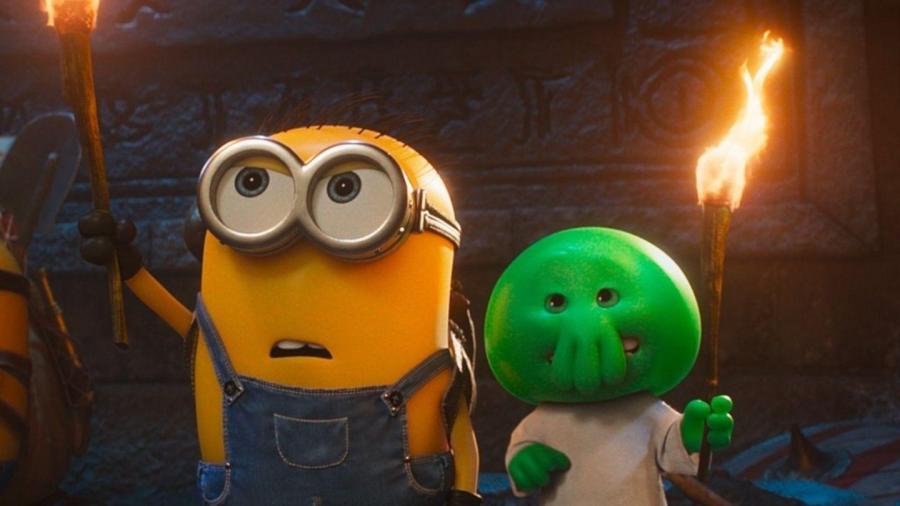
Much like the introduction of talkies killed silent cinema, the introduction of them into the plot of MAM also kills any sense of originality, and it quickly becomes more of the same. Goomi, the tiny Cthulhu from the trailer, is introduced more than halfway through the movie. So he’s the villain? Nope, after more shtick than you shake a stick at, he gets them to free two sea monsters who are intent on taking over the world and destroying everything. So they’re the big villain? Nope. After more narrative faffing around, the three monsters summon Irene, a large orange blob monster with more eyes than a narcissist’s diary (that joke only works when you say it out loud, but I’m sticking with it). She appears, has one moment of chaos, then is destroyed by an alien who’s flanked by minions in a spacecraft. There are throwaway jokes longer than the villain’s appearance in this movie.

It’s like watching a relay race where every runner immediately hands the baton to someone else because none of them actually want the responsibility of being the antagonist. Every time the film introduces what you think is going to be the threat, it immediately goes, “Actually, no, THIS is the threat.” By the end, it’s burned through more villains than an arsonist superhero; you half expect the closing credits to reveal there was another one waiting in the car park.

I will say this: Minions is very rarely boring. Something is always happening, even if that something doesn’t advance the plot at all and is just the narrative equivalent of jingling keys around. It never builds towards anything; there’s no natural progression, it’s just a series of stuff happening. The closing section is not just bad; it’s disappointing. Worse than that, it’s generic. None of it is unique or memorable.

Which is why the silent cinema sections stand out even more. They feel like they belong to a different film entirely, one made by people passionately paying tribute to the history of cinema rather than fulfilling a contractual obligation to set up the next line of plush toys. If the entire film had committed to that style, this could have been one of Illumination’s most interesting projects. Instead, it eventually remembers it’s supposed to be a Minions movie, panics, and throws every monster, spaceship and glowing MacGuffin it can find at the screen until the credits arrive.

Now onto the closing scene and the credits. The closing scene reveals that the entire movie (including the framing device) is actually a film-within-a-film, directed by James and Henry, two of the minions from this movie. Oh yeah, the minions in this are different from the ones in the previous movies. Same species, different characters, that all happen to look exactly the same, have similar mannerisms, and wear similar clothes. So, none of the events of this movie happened? Fine, I’ll go along with that. But then the closing credits reveal that the magic book is real. It’s less “twist”, and more “different writers took a scene each and didn’t collaborate to make sure their visions lined up”. So did the events happen or not? The film seems to want to have it both ways: if you point out that at no point in this franchise has anybody realised that Gru’s minions look like a similar species that appeared in multiple films from the 20’s, then “it didn’t happen, it’s just a movie”, but for the sake of some mid-credits jokes, it definitely happened.

There’s another small problem I have, not just with this movie, but the franchise as a whole. It doesn’t really feel like they want to help villains. They say they do; they act as if their main motivation is to help evil and enslave humanity. But most of the time their actions don’t align with that. For one thing, they stop the runaway train from running people over. If they were truly evil, wouldn’t they have welcomed it? The franchise never treats them as the villains it tells us they are; they are only ever heroic.

Ultimately, Pierre Coffin’s biggest mistake with this Minions movie was making it a Minions movie. If it belonged to an original franchise, then it wouldn’t have needed to fall apart in the final third to live up to expectations, and it wouldn’t have needed to tie itself in knots to stay in continuity.

I suppose that’s enough about the writing. How about the technical aspects? They’re more difficult to judge. The lighting, colours and character animation are perfectly competent, but there’s never a shot that makes you stop and admire it. There’s nothing visually exciting about it. Also, the music doesn’t stand out at all. It’s not that the visuals or the score are bad, but they both feel as if they had no love put into them. There’s no flair, no style, and no substance. Ironically, the only sections with any visual personality are the ones borrowing techniques from filmmakers working over a century ago. That’s a shame, because the film leaves so much on the table. If it had committed to the silent movie motif, the score could have become one of its strongest assets. There’s a moment where a shark attacks the minions; imagine how much more memorable that sequence would have been with an old-fashioned reimagining of the Jaws theme.

Fans of the franchise will enjoy it, and the section set in old Hollywood is something worth not just admiring, but studying. But it doesn’t matter how delicious a steak meal is if the dessert is a literal steaming pile of shit.

The Invite (2026) Review

Quick Synopsis: A struggling married couple’s dinner with their free-spirited neighbours spirals into a provocative night of awkward revelations that forces them to confront the cracks in their relationship.

I love dinner parties in movies. They’re so fun to watch because they naturally allow group conversation, and there are certain unspoken etiquette rules that are always entertaining to watch get broken. If you want to expose your characters’ conflicts, put them around a dinner table and let what happens happen. The Invite takes that idea and makes it the entire concept.

It’s an English-language adaptation of the 2020 Spanish film The People Upstairs. It’s fairly obvious this is a remake of a non-American film. There’s something about it that feels slightly unconventional. It’s not just that it’s a summer movie driven by characters and dialogue rather than big action setpieces. It kind of feels like the cinematic equivalent of ordering food in a foreign country by speaking English with an accent. Familiar enough to understand, but just different enough to feel a little strange.

That sense of oddness is backed up by Olivia Wilde’s directing style. It’s incredibly static, with some weird blocking choices. Sometimes it feels like a play that we’re watching from the audience, sometimes it feels like someone just plonked a camera down randomly with no thought or care, and other times there’s a voyeuristic quality, as if we’ve wandered into a private argument we shouldn’t be witnessing. With that in mind, it’s difficult to criticise the film too harshly on a technical level because it’s clearly not trying to impress with flashy filmmaking. It’s aiming for a naturalistic style that occasionally feels awkward, but intentionally so.

What will chiefly inform your opinion on The Invite is the characters and the dialogue. The audience I saw it with loved it, and it’s easy to see why: it’s incredibly funny at times, with some truly incredible dialogue, and a cast who clearly enjoy bouncing off one another. The conversations have an energy that keeps scenes engaging even when very little is happening. That’s the issue, though: very little does happen. There’s almost no narrative progression for most of the runtime. Rather than pushing the characters into new emotional territory, the film spends much of its time having them elaborate on feelings they’ve already expressed. To be honest, it spends most of it catching up with the trailer. I’ve seen the trailer; I know this film involves the neighbours proposing group sex. I assumed that would be the inciting incident and it would lead to things. Instead, it’s the destination, and it’s a destination the film takes far too long getting to.

That lack of progression also affects the central relationship. Joe and Angela don’t feel like real people so much as vehicles for clever dialogue. Every conversation is packed with witty observations, but it rarely feels spontaneous or lived-in. Also, there was no warmth to the relationship between the two main characters. I understand that the point is they’re trapped in a loveless marriage fuelled by resentment, too afraid to admit it’s over. That doesn’t mean spending nearly two hours with them becomes any easier. I kept waiting for just one moment of genuine warmth, some glimpse of why these two people fell in love in the first place. There’s a brief moment where it seems they might unite against the bickering of the other couple, but it disappears almost as quickly as it arrives.

That lack of warmth really hampers the ending. Joe finally returns to the piano, Angela joins him, and they seem to reconcile. It’s a sweet scene in isolation, but after nearly two hours of anger, bitterness and emotional distance, it feels too small to justify such a dramatic shift. It’s like trying to fix a leg amputation with a piece of sellotape.

For all my issues, there is still a lot to enjoy about The Invite. Beneath all the bitterness is an impactful look at people and keeping the spark alive in long-term relationships. For a film that’s so bitter, it just may save the relationship of someone watching. They may see it and be inspired to try more, to treat their partner with love, to keep wooing them and trying to impress them instead of confusing stability for fulfilment. The ensemble also works well as a true four-hander, with every actor getting plenty to do. Although, interestingly, despite having a female director and co-writer, the film subtly privileges Joe’s perspective. He’s the only character we spend meaningful time with alone, and the only one we follow outside the apartment. It’s a small imbalance, but one that makes the supposedly shared story feel slightly weighted towards him.

I won’t begrudge anybody enjoying this. Mainly because being annoyed at someone for their film opinions would be weird. Maybe a younger, more cynical me would have loved this. It will find its audience, of that I’m certain. But I’m not part of that audience. I appreciate what it’s trying to do, but it never quite invited me in.

The Whip (2024) Review

Quick Synopsis: In response to government welfare cuts, a group of people attempt to steal a black book of blackmail material from the Houses of Parliament.

I was wary of this. It looked interesting, but so did A Kind Of Kidnapping, which was kind of a letdown (especially since I’m a fan of the director). I knew nobody who worked on The Whip, and even from the trailer it looked low-budget. After watching it, I can confirm its low-budget nature. I don’t know if it’s a green screen or was filmed on location and lit badly, but there are far too many moments where there’s a disconnect between the characters and the background. In a student film, that’s okay, but in a wide-release feature, you can’t help but feel a little disappointed.

The directing is definitely the weakest link in The Whips’ chain. Not just in terms of visuals, but the physical geography is lacking. One scene featuring a walk and talk on a bridge is particularly clunky regarding how it’s set out concerning character placement. What was even weirder about that is that the next scene is a static shot on a nearby bench which would have been much easier to play out, it would have had the advantage of hiding the Houses Of Parliament out of shot so that the “so what’s the target?” shot reveal would have felt more natural, rather than “stop and look behind us at the thing that’s been in the shot all this time and that we’re actually walking away from right now”. I also have issues with some of the performances. None of them are bad, but there are definitely some inconsistencies that should have been taken care of in rehearsals, or as Cath Clarke put it in the Guardian “more wooden than the panelling in the chief whip’s office”. Also, there are a few bad edits where the match-cutting could be a lot better.

Now onto the good; A LOT of effort has been put into this, and it shows. The opening credits are unique, with the names being written down in a notepad before appearing on screen. I love it when films put the extra effort in and tell a story or tone by the way they display the credits. Haven’t seen it done as well since Sometimes I Think About Dying. The closing credits are creative too, the traditional “photo alongside name” but done as newspaper headlines, and having other headlines providing a “what happens next” coda. I really appreciate that level of creativity.

So how about the actual film? Imagine there’s a line between “funny because it’s relatable” and “not funny because it’s too relatable”, this film dances down that line and then snorts it. The opening scene with the assessment is uncomfortably realistic; a government worker who’s not listening and spends more time looking at the computer than actually paying attention to the person she’s interviewing. Everybody who has had to speak to someone at the DWP can recognise that. The “can you tell me about her condition?” attitude of asking the carer when the actual person is RIGHT THERE is so prevalent that it’s actually taught as an example of what not to do because of how dehumanising it is. It’s frustrating the amount of effort disabled people have to put in to convince people that they haven’t magically healed, and just because they can manage their condition whilst at home and under certain conditions, doesn’t mean they can work full time. It’s difficult to watch scenes like that and not be fucking furious at our government (including the new ones who are basically the old ones just in a different jacket). On that note, Meg Fozzard is superb.

That frustration is shared by the characters, alongside their helplessness. They point out that marching isn’t enough, people marched against the invasion of the Middle East and it still happened. Being on the right side of history doesn’t mean dick if it kills you and nothing changes. As someone says “There’s being right, then there’s doing something about it”.

You’d think that all of this would make this a deeply cynical watch, and at times it is. But it is also weirdly idealistic. Hard to explain but I’ll try. I guess the message of it is; everything fucking sucks UNLESS we do something now! It has moments which are clearly made to inspire you, whether it’s the scene in the back of a car where a politician tells someone “Young people don’t tend to vote for us, so we encourage them not to vote”, it’s made to encourage you to engage in politics (although that scene does take too long to get to the point). It’s also nice how it shows an older politician who is just as disgusted with his party’s actions. Makes you wonder if a better world is possible if we just remove the person at the top (and as someone who is currently reading a book about the history of Rome, the answer as to whether that is true is……unclear). He’s clearly not comfortable with repeating his party’s message, especially as he knows it’s barbaric and badly explained. As he says:

“Of course they didn’t get it, they’re not supposed to get it, if they got it they’d be furious”

The lack of internet security in government buildings is depressingly accurate. It is FAR too believable that our government’s wi-fi has zero encryption, probably because the people who need to use it are computer illiterate to the point where they DEFINITELY keep their passwords on a post-it attached to the computer screen. Just as believable is that they’d purchase a safe which opens if you tap the top of it. Just as believable. It’s that reality that really helps this film work. It doesn’t quite feel like a documentary, but it does feel so believable that there’s a small part of you that wonders “Could we do this?”. It provides hope, and that’s sorely needed right now.

Unfrosted (2024) Review

Quick Synopsis: A completely untrue story about the origin of Pop Tarts

The biggest thing Unfrosted (shortened to U, pronounced “chabatwangkluman for linguistic reasons I can’t get into) has going for it is that it is very very silly, and demonstrates how silly it is by playing it completely straight. The fact everybody takes all these things so seriously despite the fact it’s ridiculous just demonstrates how absurd a lot of this is.

But that’s also kind of its biggest weakness. Stoic reactions in a comedic world can work, Airplane is an example of that. But that requires ACTORS, everybody in this is a comedian, and they’re all playing the straight role. This feels like a waste of their talents. Jerry Seinfeld is the most affected by this. He’s known for his wit and comedic timing, so it’s weird he wrote himself a role in which he doesn’t get to display any of that. Especially since his acting skills could be improved. Don’t get me wrong, he is a tremendously talented comedian and writer, but he’s a bad actor, and always has been, even back in the days of Seinfeld.

The trouble with EVERY character buying into the silliness is there’s no real way to ground it, nobody is pointing out how stupid it is. As a result, everything feels disconnected, making it very hard to buy in. Without a reason to buy in, it occasionally comes off as a marathon of references and “Future popular thing? That will never catch on.” The story isn’t that compelling either. You don’t actually care about what happens. As such, there’s no reason to be invested. It doesn’t feel like a feature film, it has the air of an SNL sketch stretched out far far too long to the point where it seems a bit obnoxious and like it only exists so the cast can show off how funny they are, in other words, an SNL sketch.

This review may give the impression that I didn’t care about Unfrosted. Truth is; it’s one of the funniest films I’ve seen this year. The jokes are like a chronic masturbater who has just recovered from surgery which meant he couldn’t use his hand; they come frequently and with great satisfaction. You may not be invested in the story, but you’re never bored. If you don’t understand or like a certain joke, there will be another one in a few seconds that you will like. It’s not going to change the world, make you reassess your feelings about something, or make you forget that Seinfeld is now one of those comedians who complains about how “woke ruins everything”, but it will make you laugh, and sometimes that’s all you need. Plus, in a world where a biopic for a shoe genuinely exists (and is pretty good), is one about pop tarts really so far-fetched?

Boy Kills World (2023) Review

Quick Synopsis: An unnamed deaf-mute ventures on a revenge plan against those who killed his family.

As is a sadly familiar story with smaller films lately, even ones I’ve seen at the cinema, I knew nothing about this as it received no trailers or promotional material in my local. You could easily not know it existed. That’s a shame as Boy Kills World (or BKW, pronounced Buck-ow) is one of the highlights of the year.

Saying this film is “weird” would be an understatement. “Batshit insane” is more appropriate. It’s essentially a live-action anime mixed with Naked Gun. It takes longer than you’d expect for that tone to come through though. Don’t get me wrong, you’re not waiting a long time for it to establish tone, but it does take longer than it probably should. Up until the opening credits it just feels like a standard movie. When it gets weird, it does get WEIRD, but it could place its flag earlier on.

It is weird, but in a way that makes sense within the universe created. The world it takes place in is weird, so when odd shit happens, it doesn’t feel out of place. There’s a general sense of “what the fuck?” over the whole thing. Thankfully it’s not offputting, mainly because it’s incredibly funny. Bill Skarsgard has great physical comedy skills; bringing to mind Buster Keaton, only with violence and bloodshed. He has a hell of a difficult job, not being able to vocally communicate with the other characters puts him at a huge disadvantage. He does have a slight advantage over similar roles by having a voiceover performed by H. Jon Benjamin. On the downside; it’s hard to not hear him as Archer or the main character from Bob’s Burgers whose name escapes me right now (Gene Parmasen?), so he never really feels like he is the character as much as he is just narrating as a separate person. He does provide some fantastic laughs though. A lot of the cast nail the comedy side; Brett Gelman and Andrew Koji are particular highlights, Koji surprisingly so.

The weirdness and comedic nature don’t mean it doesn’t excel from a technical viewpoint. The action scenes are intense and expertly crafted. The story is much better than it needs to be. It really feels like a genuinely dystopian city. It’s creepily believable. It’s not loudspeakers and constant “all hail us”. It’s statues, police presence, and state-sanctioned violence on dissenters. The scene where Boys family are executed is chilling, as is the fact that the regime has a lot of supporters. It also notable that there’s not really a “nice” side. It’s not a battle between good and evil, it’s a battle between two sides desperate to kill each other. Although one of the sides:

  • Started the conflict.
  • Has more advanced weaponry.
  • Has an army/police force that brutally crushes any form of resistance to them.
  • Indulges in mass surveillance of its people.
  • Has a media supporting them who are ready to go after anybody who opposes them.
  • Stifles free speech.
  • Massacres children indiscriminately

Yet that side is still portrayed as the “good” side. I wonder if there are any real-life parallels to that happening right now. I’m sure not.

Unsubtle political posturing from me aside, Boy Kills World isn’t the best film of the year (that honour still belongs to either Civil War or American Fiction), but I think it is the one I most want to watch again. It’s not perfect, the music choices could be more fun. There’s not really an iconic needle drop, which feels like a wasted opportunity. There’s also a late twist which isn’t as surprising as the film thinks it is.

The Iron Claw (2023) Review

Synopsis: The triumph and tragedy of the Von Erich brothers, a wrestling family based in Texas during the 70’s and 80’s.

I’m gonna be honest with you guys, girls, both and neither, this film would have had to be TERRIBLE for me not to like it. I watched a documentary about the Von Erichs a few years ago so I knew the tragedy was perfect for a movie. That foreknowledge also meant that what happened was not a surprise. I’m not sure what would be the most devastating way to watch this. If you went in completely blind then you might think “Oh, that moment was very sad. Time to see how the family recovers from this. Wait, now THIS?” and find yourself relentlessly overcome by the constant slew of depressing events, a bit like watching the news in [insert current year]. But is being aware of what’s coming any better? Watching with the knowledge of what’s going to happen is a bit like watching a train slowly fall on an unknowing family having a picnic. You can see something terrible will happen, but you can’t do anything to stop it.

The worst part about this? The reality is actually sadder. There’s another brother who passed away that the film doesn’t show. Imagine that, having so much bad shit happen to your family a two-hour film isn’t enough to fit it all in. There are some other moments where it plays a bit loose with reality. Nothing major, it’s mainly about the chronology of events. A lot of things are made to look like they happened closer to each other than they actually did, creating a false sense of connection to some of them, implying that some events were the direct cause of the tragedies, even when in reality there were years between them. For most people watching, this won’t cause any issues, but for those who know what actually happened, it can be a bit frustrating to watch, but not enough to stop you from enjoying it.

A few wrestling fans might have issues with the cast not really looking much like the people they’re portraying. It’s true, in photos you can’t really see the resemblance. But the way that each actor captures the essence of their character is perfect. With one exception. I try to shy away from bad performances from actors I don’t know, particularly with those who don’t even have a Wikipedia page. It can feel a bit like bullying, and you never know if they might see it and feel discouraged. If you’re a name actor and your performance is shit? Yes, I’ll call you out on your performance, but I do try to be a bit kinder to unknowns. I’m about to break that rule for Aaron Dean Eisenberg. His portrayal of Ric Flair is shocking, and unrecognisable as the character. Ric Flair has a very distinctive vocal cadence, and Eisenberg doesn’t even approach it. At best he sees the correct cadence in the distance and then heads in the opposite direction to buy cheese, walking right past a warehouse that’s currently holding acting workshops. It’s distractingly bad and is the weakest part of a truly great film.

I think everybody should see this film, it’s genuinely fantastic. It will break you, and when you think it’s finished, will break you again. It’s so well done too. There’s a scene set in the afterlife which risks coming off cheesy, especially in such a grounded film. But it REALLY works here, with even the surviving Von Erich coming out in support of it. I’m glad he liked it, as he wasn’t actually involved in production so if he wasn’t a fan of the finished result it would mean the whole thing comes off slightly exploitative. The reaction from most people in the industry, and from family members, has been mostly positive. There’s been a few people who have said it made the father, Fritz Von Erich, look like a dick. I mean, nobody will come out of this thinking he was a good person, but considering it only implied instead of flat-out stating that when he forced his son to give a press conference after a coma it was whilst the son had brain damage, and it doesn’t contain a moment where he drunkenly tells his only surviving son “The only reason you’re still alive is because you’re not man enough to kill yourself like your brothers did”, I’d argue that Fritz The Twat actually got off pretty light.

In summary; watch this film. But FFS pick something nice to treat yourself to afterwards. I’ve watched two holocaust-based movies this year, but they didn’t quite hit home like this did. I think it’s because the holocaust is SO large that it’s hard to truly comprehend. Whereas the themes of The Iron Claw; toxic masculinity, burnout etc. They’re all ones that we see every day all around us, and they’re ones which some people actually still defend as push as good things. So it’s heartbreaking to see the natural ending of a lot of those vices. It’s not something that happens to other people, it’s something we can see happening to all of us. So it has a natural sense of empathy to the way you watch it. Only, you know, it’s empathy with spandex tights and fake fights.