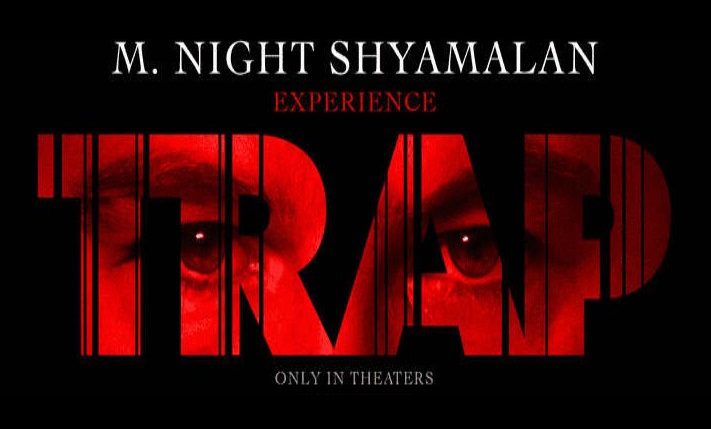
Trap (2024) Review

Quick Synopsis: The Butcher is a serial killer who has gone to a concert with his daughter. He quickly discovers (through a far too-talkative member of staff) that the police are there to catch him. So begins a tense cat-and-mouse game between him and the police.

I remember catching the trailer for this in the cinema. The name “Saleka” was all over the trailer, making a point to name her and mention that she’s in this. This got me wondering, who is she? Is she some American musician I don’t know, who is in her first acting role? Maybe she’s famous on TikTok. She has to be somebody, right? She’s front and centre of the marketing, like “making her feature film debut and you want to see it”. So, who is she? I’ll google her. “Saleka Shyamalan is” Okay that explains it. This is the second M.Night nepotism film I’ve reviewed this year, so I don’t have high expectations.

That aside, is Trap a good film?

Short answer: no. Long answer: well, read on.

Maybe I’m being cruel, maybe Saleka is a talented performer and she’s not just here because she’s the director/writer’s daughter. And maybe it’s just a coincidence that it’s that character who ends up saving the day and being the only person to outsmart the killer. I’m trying to not sound too cruel here; her acting talents do not match the acting responsibilities she’s been given. It’s made worse by the fact that the moments when she takes over the film are the worst moments from a narrative standpoint too. The trailer made it seem like this could be a tense claustrophobic thriller, with the whole thing taking place in the concert. M.Night made his name for almost being Hitchcockian in his ability to construct tense scenes. There were plans to shoot Trap in a 4:3 aspect ratio to make it feel more claustrophobic, this was later abandoned because it was felt that this would limit the shots, plus it was too much effort.

Once the characters leave the concert, all tension leaves with them. Not just because it puts more focus on Lady Raven (played by the aforementioned Saleka), who, as I said earlier, is not a good enough actress to pull this off. Her character is badly written too. At one point, Cooper (played by Josh Hartnett, who does a pretty good job tbf) tells her that he’s got someone locked up and that he can kill him at any point just by pressing a button on his phone. Her response is to annoy him. The entire closing section is a dumpster fire of shite and disappointment.

Not that the moments before that are remarkable either. The main issue is that it doesn’t feel like a concert. For a start, there are parking spaces near the venue and the toilets are clean. The cops’ plan feels kind of stupid too. To clarify; their plan here is to lock 20,000 people in a building with a serial killer. There are sooooo many ways that could go wrong. I know that the American police approach to civilians is similar to Drago’s approach to Apollo Creed, but this isn’t just a building full of thousands of people, this is a building full of thousands of middle-class white people. That would be a PR nightmare if The Butcher ran amok and killed people because he felt trapped. Also, I’m not quite sure how that works in terms of fire exits, you can’t lock them, surely? Even if a serial killer doesn’t get them, an errantly tossed cigarette could still kill them.

The main issue is that Trap is not as smart as it wants to be, and not as dumb as it should be. It seems to think it’s very smart though. In his mind, M.Night has created an epic, the cinematic equivalent of Bohemian Rhapsody. In reality; he’s given us Ice Ice Baby. A poor imitation of talent.

Sometimes I Think About Dying (2023) Review

Quick Synopsis: A story about isolation, boredom, and lacking purpose. No it’s not my biography and it’s rude of you to say that.

A few years ago I travelled to New York at the end of winter. In preparation, I purchased some winter clothing. Among them was a new pair of boots. Not just warm and sturdy, but they also came with a neat little extra; spikes on the soles that you could flip down in harsh icey conditions. I still have those boots (we don’t really have “winter” here, we just have rain) and I consider the flippable cleats a genius design. It’s so simple too, you see them and think “why don’t more companies do this?”. That’s how I felt about the opening credits of Sometimes I Think About Dying (Otherwise known as SITAD, pronounced sit-add). The fact that they use a different font is embarrassingly mindblowing. It takes the same amount of effort as doing them the same way as everyone else, but it does SO much in establishing style. I’ve mostly seen it in horror movies to be like “Oh look, we’re spooky”, or to establish the time period in which the film is set. Here it’s to establish a theme. It’s such a simple thing but it works beautifully and it means that no matter what happened for the rest of the runtime, I was going to take something positive from this.

Thankfully, even without that, I’d be able to be positive about SITAD, it’s delightful. But not in a “everything is fantastic and wonderful if you just believe” fake BS way that Hollywood provides. In a way, you can say it’s twee, kind of. But it’s a sense of twee with all the colour and joy drained away from it. Mostly it’s a film that says “I don’t understand people”. Those three previous sentences may seem disjointed (and some would say inherently contradictory) but that’s the wonder of SITAD. It’s depressive elegance, with some stark cinematography that’s beautiful in its simplicity. It’s shot not to sell a story, but to sell a character and a mood.

The script matches that, doing so much with so little. Normally characters establish themselves by saying things, SITAD establishes itself by having the main character not say anything while everybody else talks around her. In a lesser film, this would be met with scenes of her trying to say something but getting cut off whenever she tries to speak. Here, she doesn’t even attempt to say anything, she just stands in the background until she can safely leave without anybody noticing. She doesn’t have isolation thrust upon her, she actively prefers it. It’s great because when she speaks out loud, it actually means something. It’s at least 20 minutes before Fran (Daisy Ridley’s character) utters her first words. Side note, one of these days I’ll remember what Daisy Ridley looks like when I’m not looking at her, my brain keeps picturing Charlotte Ritchie. Daisy Ridley gets a lot of praise (and she should, she’s PHENOMENAL), but I feel that Marcia DeBonis needs praise too. Her speech near the end where she’s talking about her husband suffering health issues is heartbreaking and delivered perfectly. Crucially, it’s not delivered as “a performance”, with perfect diction and line delivery. She stumbles over her words, is slightly unclear on a few syllables, and pauses mid-sentence. In essence; she feels REAL.

That’s partly why I loved this film so much, nothing about it felt fake. It doesn’t feel like we’re there watching them, it’s better than that. Even though we see her from an audience’s perspective, it somehow feels like we ARE Fran. It’s helped by a powerful score (brought to you by Dabney Morris), and a powerful performance. But it is mostly anchored by how good the writing is.

It’s not perfect though. Fran is a little bit too cruel at times which can make her hard to root for. But when she does say something heartless such as “You’re exhausting, no wonder you can’t stay married”, the VERY next scene shows her obviously regretting it.

As you can probably tell. I LOVED this movie. It’s not up for my favourite of the year, but it is possibly the one I’ve connected with the most. Good films entertain, and great ones inspire. This will inspire you as a writer, as a director, as a musician, as a performer, fuck it, with the way this tackles themes of isolation and self-sabotage, this will inspire you as a person. A lot of people won’t like it, and even those who do like it might not like certain parts of it. For example, I saw some reviews say the party scene was cringe and went on too long. Personally, that was the highlight of the movie. It felt like the first time Fran felt accepted, she was letting the mask of insecurity slip, and the sheer joy she showcases is infectious. I’m not saying this is the best film of the year, but it is probably the one I would recommend most at the moment if you want to feel things and be touched (not in a Kevin Spacey way). One of the most genuine movies I’ve seen all year, and I’m a better person for having watched it.

One Life (2023) Review

Quick synopsis: The story of British humanitarian Nicholas Winton, who helped save hundreds of predominantly Jewish children from the Nazis on the eve of World War II.

Something I don’t hide particularly well is that I am in general quite a cynical person (probably due to living in the UK in the 2020s teaching me that nothing good ever happens), I’m also not a fan of predictability in cinema, plus there have been so many films about the second world war that, to be honest, I’m kind of bored of them. We get it, it was the last time Britain was important on a global stage, plus it’s one of the few examples of war where there was one side that was undeniably evil and unjustified, so it makes good cinema. But my word, I’m bored of seeing it on screen.

So you’d think I would not really be a fan of this. But I have to admit, it got me. You know how it ends, there are no twists or surprises, and everything is incredibly obvious. But it’s so well made that it’s still effective. I’m glad I saw this at the cinema as it meant I could confirm that it wasn’t just me, the whole cinema felt emotionally affected by it. When the film ended and the credits started to roll, nobody moved. Normally you get people who stand up to go pee or beat the traffic, but when this ended, everybody in the screening stayed seated for a good minute. There were no angry mutterings, or even excited chatter, the only sound was the distinctive sound of everybody trying to hide the fact they were crying.

He seems to be doing a lot of schlock lately (Armageddon Time, Zero Contact, Transformers etc), but when you see a performance like this, it reminds you that Anthony Hopkins is a phenomenal actor. When I saw the trailer, I thought it would be a case of Hopkins just appearing at the beginning and the end, with the bulk of the narrative being flashback, and as such, the younger version of the character. I’m glad that’s not the case, we’re given enough of present-day Nicholas Winton that Hopkins is given a lot to work with. Johnny Flynn as the younger version of Winton? He’s okay. He mainly suffers from two things which he can’t control. One is that he’s playing the younger version of a character played by Anthony Hopkins, and it’s constantly switching between the two which means that comparisons between the two are inevitable. It’s difficult to give a good performance when you’re being compared to one of the best actors of all time. The other comparison is more in his control, but I don’t blame anybody for not making the comparison; Harry Enfield’s character Tim Nice-But-Dim. Once I noticed the similarities in vocal cadence, it became hard to take it seriously.

The other performers are all fine, but they obviously pale in comparison to Hopkins. Helena Bonham Carter does what she needs to, but could be replaced by a cheaper performer without affecting it too much. Samantha Spiro does an almost pitch-perfect imitation of Esther Rantzen, but is only seen for a few minutes. To see the similarities, you do need to watch the original clip online, which is weird as I thought they would have played it during the credits. It’s standard to show real-life photos of characters in biographies, and it doesn’t do that for this, which is a bit weird.

This isn’t a perfect movie though. I’m not sure the story has enough legs to justify a nearly two-hour movie, there was just enough for a one-hour television episode. The predictability also harms it, and it’s not that interesting from a visual or audio perspective. From a technical standpoint, it feels like there’s a lot of “well this will do”. The actual operation feels kind of underbaked as well, with the story focusing on the people in Britain who are in no danger.

To summarise; this a hugely emotional experience. It’s a good reminder that the people being helped aren’t soldiers, politicians, or anybody who had a choice in the war or where they live. They were just children who were at constant risk of being arrested and executed just for existing in their current location or as their current ethnicity/religion. It’s impossible to comprehend something similar in modern society.

Unless you’re Ukrainian

or Palestinian

or….