
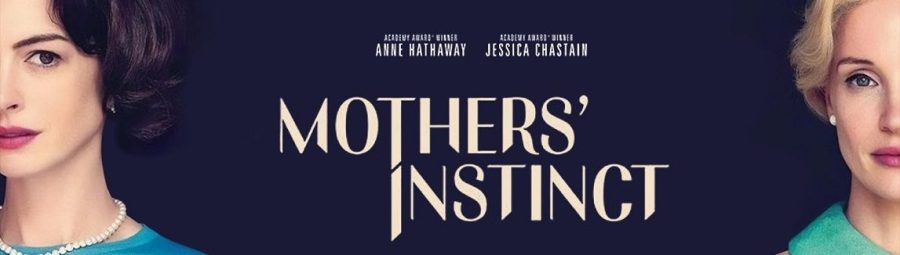
Quick Synopsis: Housewives Alice and Celine are best friends and neighbours who seem to have it all. However, when a tragic accident shatters the harmony of their lives, guilt, suspicion and paranoia begin to unravel their sisterly bond
Anne Hathaway is quite good, isn’t she? I know that it might come as a shock that a multiple award-winning actress is quite good at this whole “acting” thing, but it must be said. She’s a big part of why Mothers’ Instinct works. She plays Celine as somebody of whom you’re never quite sure of her intentions. She is either a cold-hearted manipulative woman who is trying to gaslight Alice into madness and steal her family, or she’s just a grieving mother who is doing her best to cope with an unimaginable loss? It’s not so much that flits between the two depending on the scene, it’s that at all times she could conceivably be any one of them. I’d be interested in watching it twice again, each time focusing on assuming a different thing.
Actually, that’s a lie, I’m not interested in watching this again. As good as this Mothers’ Instinct is (and it is finely crafted), nothing about it really warrants a second watch. There’s nothing inherently wrong with it, but like a lot of films based around a mystery or possible misunderstanding, once you realise the truth, is there much left to it?
As I said, this was directed by Benoît Delhomme. Obviously not the first time the name “Benoit” has been associated with dead children. Delhomme has a history in cinematography, with this being his directorial debut. He does a really good job. There are some very interesting shot choices, his use of angles to suggest uncertainty is brilliant. It’s a really basic trick, but he utilises it perfectly.
Unlike a lot of thrillers/horrors, the majority of this movie takes place during the day. Lit by natural sunlight, small lamps, and of course, a lot of gaslighting. The original film Duelles took the modern setting of the original book (Derrière la haine) and changed the setting to the ’60s. That time change has been kept in this English language version, and it suits the themes perfectly. There are so many moments that wouldn’t be as effective if it was set in a modern age. It would still work, but it hits more when every character is repressed by the time period they are living in. You don’t need to ask why they’re not doing certain things, because “they’re women in the 60s, and that’s just not done” is there. I listen to a podcast called How To Survive, which deals with how to survive (hey, that’s where they get the title) in certain films, usually horror. I highly doubt they are going to cover this, but if they did, then I imagine it would just come down to a single word: therapy. It’s mentioned that Alice has had issues with mental health in the past, to the point of being briefly institutionalised, but never being allowed to talk about it. Celine is clearly going through some shit and NEEDS someone to talk to. But since her friends are abandoning her because everybody finds it too awkward. At one point, she is flat-out told “You shouldn’t be here, your presence is making everyone sad”. The characters are clearly all broken, which fuels their paranoia and decisions. So in a way, there is no good, there is no evil, and the real villain is trauma. But in another, more accurate way, the villain is the person who killed a bunch of people.
I still can’t figure out why I didn’t love this movie. It had a good story, great performances, and it was very well made. But it never quite warmed its way into my heart. It’s technically brilliant, but colder than a British summer before global warming. It’s a bit like its own main characters; constantly unsure of itself, constantly figuring itself out whilst it waits to find its footing. It’s a very easy film to be impressed by, a very easy film to praise, but it’s a very difficult film to be excited about. That’s its main problem.
 Troubled Productions