
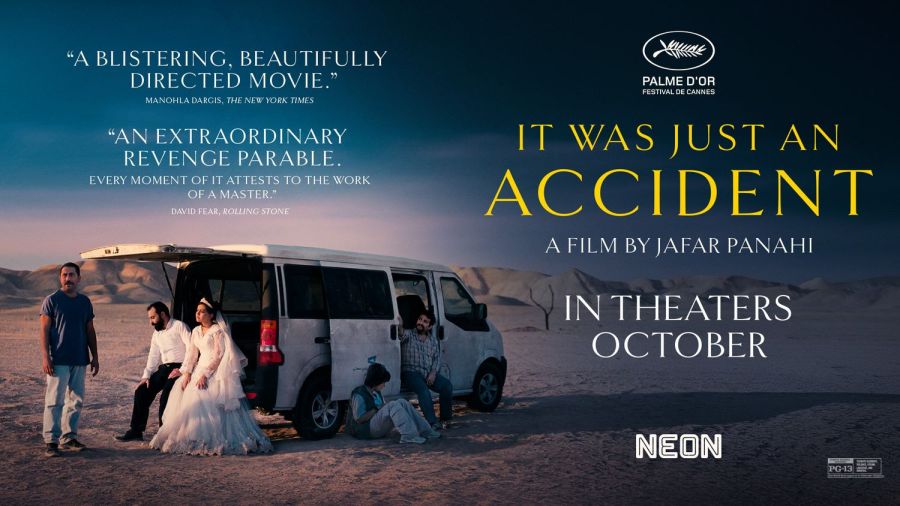
Quick Synopsis: An unassuming mechanic is reminded of his time in an Iranian prison when he encounters a man he suspects to be his sadistic jailhouse captor
I had a tiny amount of knowledge about the story of It Was Just An Accident (IWJAA, pronounced Eye-woo-jah). I knew it was about a man who comes face-to-face with his former torturer. So when we were introduced to a happy family accidentally running over a dog, I thought that the father might be the innocent person tortured, and he stumbles across his former enemy, who is hiding out as a mechanic. Nope, the mechanic is the victim. Not sure if that makes me an idiot or if it’s just clever writing. Possibly a mixture of both. That being said, we don’t have enough of the torturer (Eghbal) as a normal person to really feel it. We get a very brief moment of him as a normal family man. I feel that if it somehow intercuts it with his domestic life, it would help highlight the notion that the people committing these terrible acts weren’t cartoon villains, they were everyday people, they were neighbours, fathers, people who are known as kind pillars of their community. That being said, it does do a good job of building him up as a symbol of fear. The way characters speak of him, you can tell they’re traumatised by him. The group all responds in different ways too; some are angry and want to kill him, some never want to see him again, and it all feels very realistic.
IWJAA is an interesting watch. This is a story of pain, of trauma, of PTSD, the likes of which most people will never know. How do you cope with coming face-to-face with someone who tortured you? Do you want revenge? Or do you want closure? It’s that inner argument that drives the movie. Really, Eghbal is not a character in this, not really. He’s a story device. It’s not “the group against Eghbal”, it’s “the group against themselves”. It’s akin to other “Before you embark on a journey of revenge, dig two graves” works, like The Count of Monte Cristo. But it’s about so much more than that; it’s about oppressive governments and the impact they have on their citizens.
Now’s a better time than any to speak about the writer/director, Jafar Panahi. Panahi is badass. He’s been arrested multiple times. He broke the law multiple times whilst making this film, and not in a Victor Salva way (not really relevant, I just think it’s important to recognise that the director of Jeepers Creepers raped a 12-year-old, so fuck that entire franchise). The women involved broke the law by not wearing the hijab in public. Fun fact: Iran isn’t the only country that’s mistreated him; he was also detained by the police in another dystopian hellcape: JFK airport. He’s probably one of the best modern examples of film as protest, and I love him for it.
So how is the film on its own merits, outside of political contexts? It’s pretty impressive. It was nominated for best screenplay at the last Academy Awards. Which is a pretty big deal considering it’s not only not American, it’s not even in English. In terms of narrative, it does lose momentum slightly once they’ve tied him a tree, but it pulls it back for a phenomenally unsettling closing. There’s some interesting shots, with a lot of dialogue happening with the characters backs to the camera. It works, though. It means we’re focusing on the reaction those words are having, and the words being said.
Judging performers in a second language is always difficult because it sometimes feels like you’re not getting the full experience in terms of delivery etc. Mohammad Ali Elyashmeher veers a bit too close to cartoonish overreaction at times, but I feel that behaviour is natural for someone who has suffered like that character has, so it’s difficult to criticise it too harshly. I have to single out Mariam Afshari for her performance. Even in a second language, she has presence that’s difficult to ignore.
In summary: this will not be for everyone, but it was for me. Openly political, and very much needed in modern times. It would be a bit bleak if every film was like this, but I am glad it exists.
 Troubled Productions