
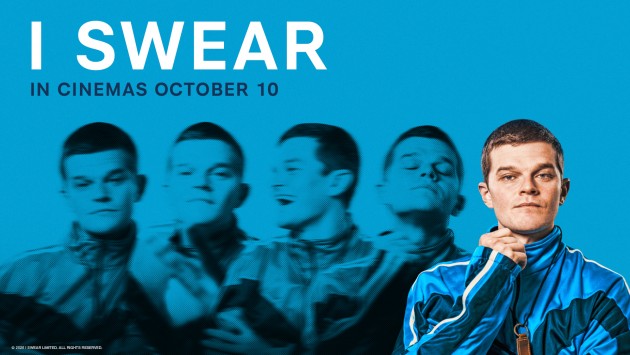
Quick Synopsis: The true story of John Davidson, a man with an issue which causes people to mock and belittle him, being Scottish. Oh, he also has Tourette’s syndrome.
It’s difficult to figure out how to judge “based on a true story” films. Do you judge them on their own merits as a film, or does the true story itself affect reactions? I change between the two. Personally, I see it as a “factual errors won’t stop me liking a movie, but it will make me like it less”. The Iron Claw, for example, made multiple errors. Not small ones, they lied about the number of brothers who died for one thing. But I still enjoyed that movie. Well, I say “enjoyed”, it made me cry. It also matters how important the lies are to the key themes and climactic moments. Bohemian Rhapsody made a few errors that felt disrespectful to the memory of Freddy, mainly in terms of the timing of his diagnosis. That soured me on it somewhat.
How is any of that relevant here? I’ll come back to it at the end, because it is important when I talk about my feelings towards it and how I feel a bit iffy about it. But I’ll start with the positives. I Swear is a beautiful movie, not visually, but narratively and emotionally. It’s heartbreaking at times. Especially since so many of the problems faced by the main character are entirely down to how others react to him, rather than what he’s done. From the teachers (and his parents) assuming he’s just being a little shit, through to the police arresting him, and the judge in one of his court cases basically saying Tourette’s doesn’t exist. It’s frustrating to see him being unable to clear the hurdles which society has placed in front of him and then chastised him for not being able to clear.
It’s comforting to think that society has moved on (in some aspects) when it comes to disability acceptance. And it’s horrific to see how backwards society was just a relatively short time ago. It’s comforting how it ends, when we see him speaking as an advocate, talking to the police about how they can do better, speaking to schools telling them to stop being dicks, and talking to other people with Tourette’s about their lives (and talking to their family members too).
There are moments where the film does feel like it’s using the condition for laughs, but it never feels like it’s mocking it, which is important. It’s a film coming from a place of understanding and education, something which is a lot easier to do when it’s anchored by such great performances. I’m not entirely sure how many of the supporting cast have the condition, but I suspect that a few of them do. Robert Aramayo doesn’t, and I’m sure specialists will be able to spot that, but as a casual movie-goer, it’s easy to believe. Ordinarily, that would mean I call him the best performer, but he’s acting alongside Maxine Peake, who constantly feels like she’s one film away from being an A-list superstar.
Now onto the bad (and referring back to what I mentioned earlier about the “based on a true story” complications). Well, “bad” is overstating it, but most of the weak parts come from the same problem: the desire to tell a complete story. Yes, that is admirable, but it feels like writer/director Kirk Jones is determined to tell as much of the story as he can, so he squeezes things in when there’s no natural narrative space for them. There are at least two minor subplots which could be excised completely. Literally, if you cut out the sections, the narrative gaps would close themselves with no indication that something was missing. Yes, those sections do show us how sad his life can be at times, but they feel so episodic and are never referenced again, so they feel a bit pointless.
Now onto the other issue: what’s not mentioned. The closing credits show real-life footage of the characters. It’s good to see how accurate the performances and moments are (it shows that he does occasionally accidentally punch his friend in the face). But some of it was from years ago, and it made me wonder who filmed it. Turns out, the main character was the subject of a BBC documentary when he was 16, then again at 30, and once more at 37. Those documentaries are NEVER mentioned or referred to during the film, which feels a bit weird. It kind of changes the narrative, because he’s no longer a youth leader just because of his work in the local community; at least part of it would have been because of his notoriety for appearing in a documentary. My main problem is that there are so many interesting stories that could have led to: how did he feel about his portrayal in that documentary? How did his town feel? More importantly, in the 1980s, kids were dicks. Their response to seeing Joey Deacon, a kid with cerebral palsy, on Blue Peter, was to use “Joey” as an insult. It’s not hard to imagine that seeing John Davidson on television would have had a similar effect; kids would have used his name as an insult. That realisation, that he’s seen as a national joke, would have been an INCREDIBLY powerful scene to see. It’s strange that a film that was so focused on telling us everything left out such an important part of his life and journey. It would be like making a film about One Direction and not mentioning The X-Factor.
Overall, I Swear is kind of hurt by it’s “based on true story” nature, but also improved by it. In general, it is definitely worth seeing. I caught it at a secret screening. For those unaware, that’s a thing that Cineworld do where they preview a film, and you have no idea what it is until you go in. Ordinarily, the title card for these is usually met with a few people walking out, as it’s not what they expected. I Swear is set to be released on 10th October. Before that, we have:
One Battle After Another
The Strangers: Chapter 2.
Radiohead X Nosferatu: A Symphony Of Horror
Him
The Smashing Machine
All of those are pretty big deals, and it’s not difficult to imagine that some people went into this screening expecting it to be one of those (I felt certain it would be One Battle After Another). Despite the almost guaranteed “oh, didn’t think it would be that”, nobody left when the title came up. Nobody left at any point. That’s a HUGE deal for a secret screening. I was at a “Halloween Classics” secret screening a few years ago, and somebody left when they found out it was The Shining, and that’s a classic. The fact that this held everybody’s attention is a sign of how good it is. It should do well, and it will be received well, but it may not be something people remember in 5 years’ time.



 Troubled Productions