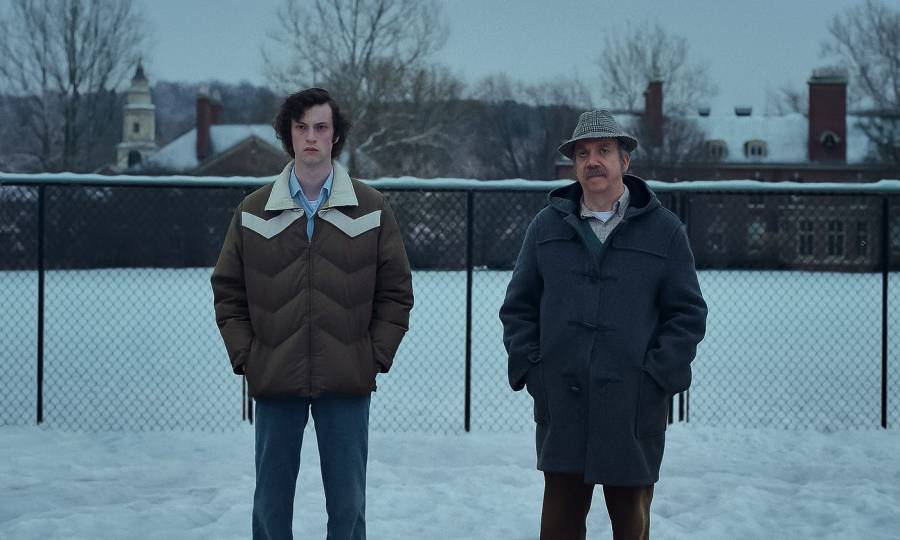
Quick Synopsis: It’s 1970 and a New England boarding school sends it’s students and staff home except for Christmas, with the exception of classics professor Paul Hunham (Paul Giamatti), student Angus (Dominic Sessa), and greaving cafeteria worker Mary (Da’Vine Joy Randolph).
Normally, I start these reviews with an introduction, or sometimes just a weird wandering paragraph that’s very loosely tied into the themes (spoilers for my review of The Iron Claw, which is likely to start with a paragraph about Mulan). Today, I’m going to launch into it on the back of a single sentence:
I see in The Holdovers what everybody else sees in Wes Anderson. The time capsule nature approach to directing, the rapid-fire dialogue, and the general nostalgic feel to it. The main difference between this and Wes Anderson films is that I actually like The Holdovers. I like how it never breaks the 70’s immersion, even in the opening classification card. I’m sure there are a few anachronisms, I wouldn’t be surprised if some of the songs are actually modern indie. I like how funny the dialogue is. I like the performances, Giamatti continues to remind the world just how brilliant he can be, Da’Vine Joy Randolph provides a good foil with her warmth and humanity providing a contrast to the sarcastic misanthropy of Giamatti. The real revelation is Dominic Sessa. This is his first acting role but you wouldn’t guess. He easily holds his own against acting heavyweights. Time will tell if this leads to Sessa developing further, if he continues on this path he could genuinely become one of the best actors of this generation. That’s not an exaggeration by the way, if this is his first EVER performance, then who knows how far he could go. The big downside is he does look distractingly like an American James Acaster.
The thing that will stick with me the most about The Holdovers is just how utterly charming it all is. The whole thing feels incredibly real and relatable. The script is one of the most effortless of the year. It flows from one moment to the next with ease. Heartbreaking tales of loss and mental illness sit aside quick scenes involving frozen prostitutes. At times it feels like nothing is happening, but then you realise that so much is developing inside the minds of the characters. I did mention how good the dialogue is, but there is so much that happens when people say nothing. The unspoken conversations, the unsaid realisations, they’re all so powerful.
There are moments where it does feel like the film is pottering about a bit too much. Annoyingly, there are moments where it feels like it’s doing the opposite and moving on too quickly. There are numerous moments where the scenes fade out and I was disappointed because it didn’t feel like the scene was over. I wanted to see where the conversation was going to carry on to, or how people would react to what had just happened. On the other hand, there are scenes that reach their natural ending point, then continue to the point where it’s tiresome.
Some people won’t like it, they’ll find it dull, maybe a bit too nostalgic for a time that a lot of people don’t belong to, that a film focused entirely on privileged people isn’t something the world needs right now. But then again, sometimes it’s nice to have a distraction, something that’s not ABOUT anything, something that’s not important or out to change the world, something that exists simply as observation and storytelling. On those days, there will be few better options to watch than this. That being said, it is absolutely baffling that the studio decided to release it in the UK in late January, it’s clearly made to be watched in December. There was nothing really Christmas-ey out at cinemas in December (nothing that was new anyway), and it would have been nice to have the option to watch a new potential Christmas classic.
 Troubled Productions